
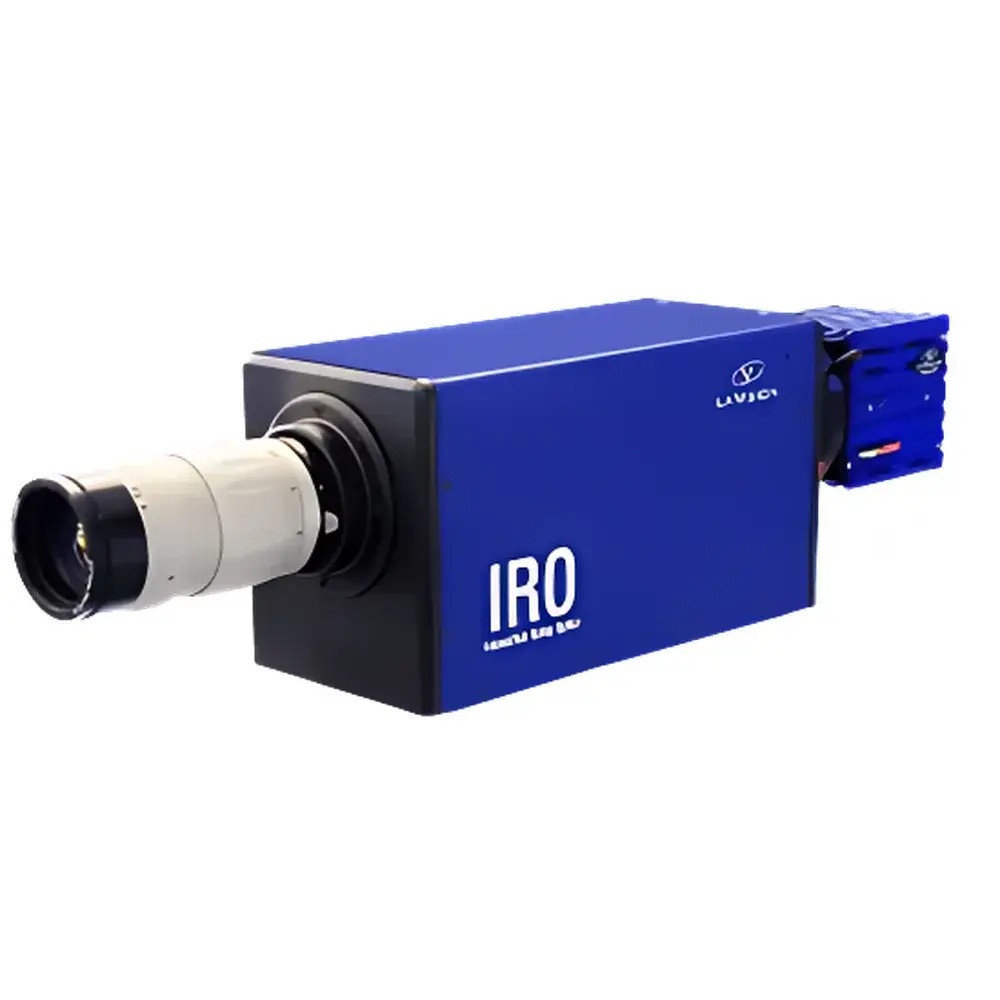
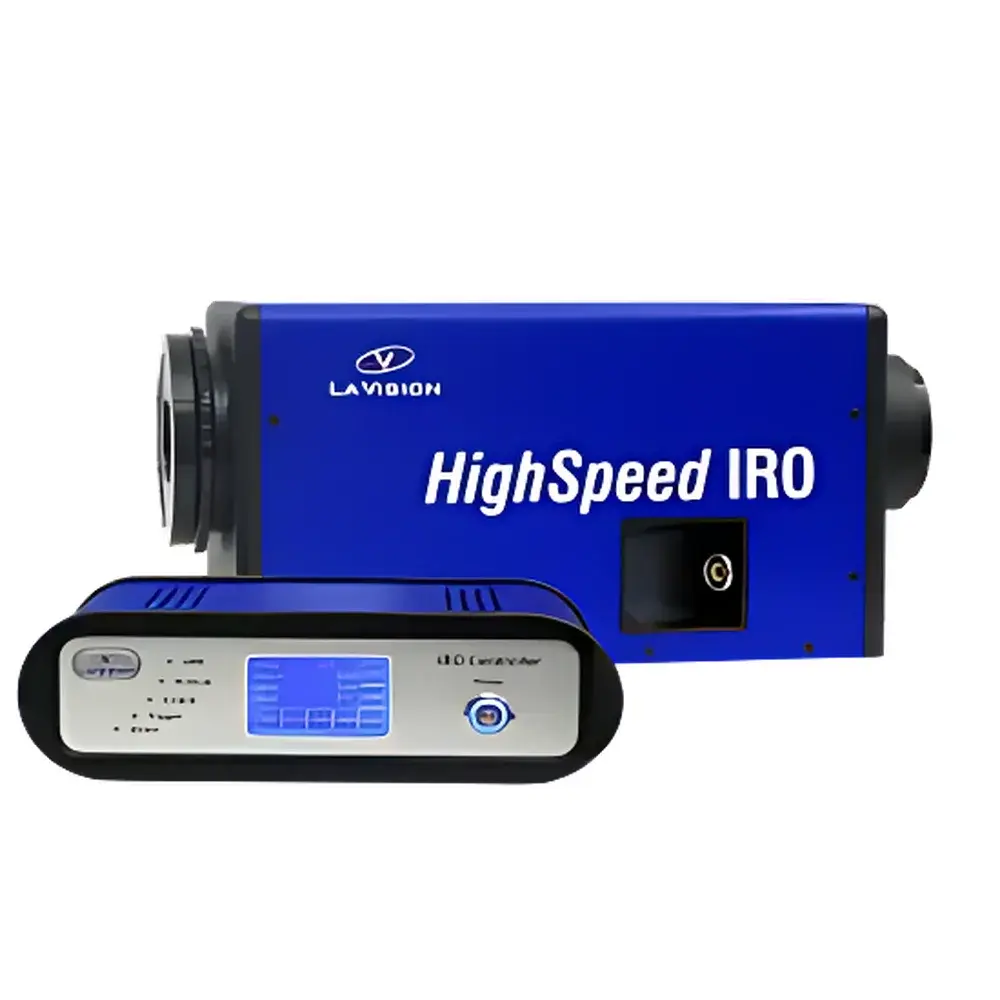
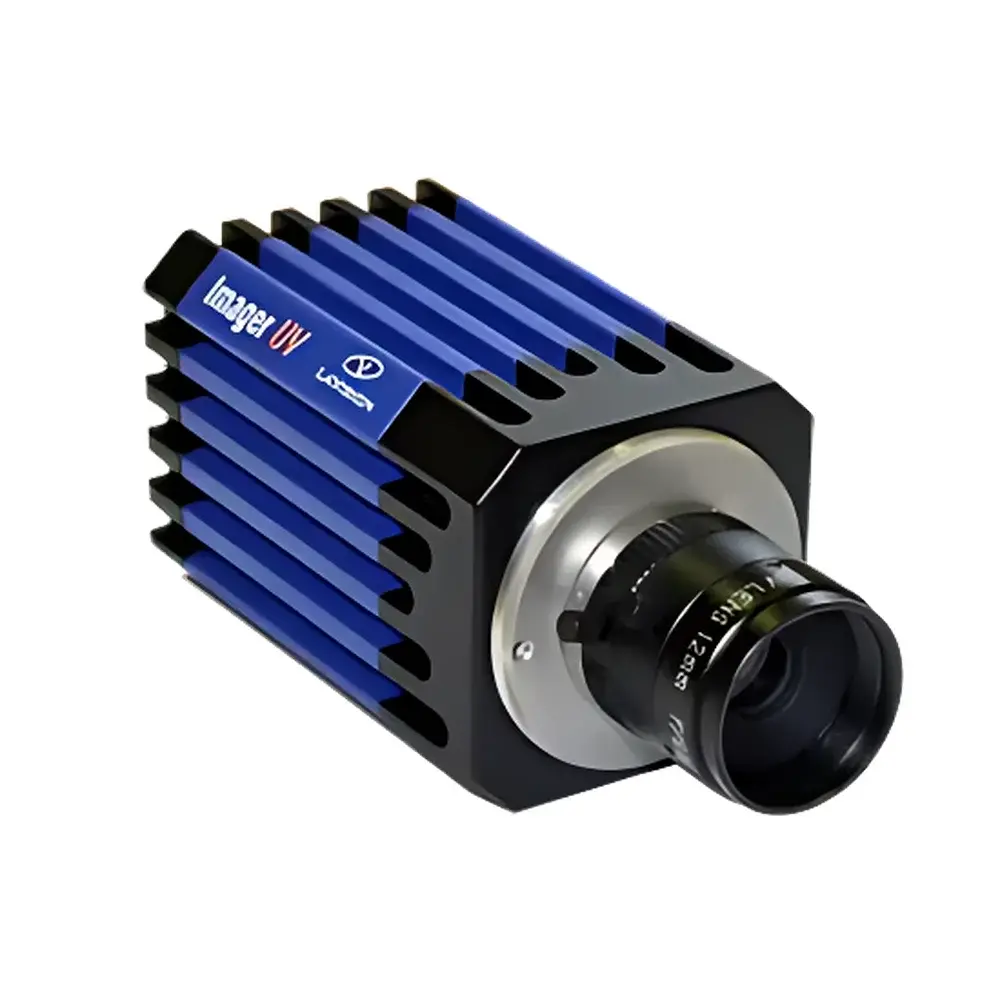
LaVision IRO Lens-Coupled Image Intensifier
| Brand | LaVision GmbH |
|---|---|
| Origin | Germany |
| Model | IRO |
| Effective Pixels | 2048 × 2048 |
| Pixel Size | 6.5 µm |
| Minimum Gating Time | 5 ns |
| Coupling Type | Lens-Coupled |
| Control Interface | Universal IRO Controller (DaVis Software Compatible) |
| Compliance | Designed for GLP/GMP-aligned optical diagnostics, compatible with ASTM E2831-22 (standard practice for intensified imaging in combustion and fluid dynamics) |
Overview
The LaVision IRO is a high-performance lens-coupled image intensifier engineered for quantitative scalar laser imaging in transient gas-phase phenomena—including combustion, shock wave propagation, plasma diagnostics, and turbulent mixing. Operating on the principle of photocathode-based electron multiplication within a microchannel plate (MCP), the IRO converts incident photons—spanning UV to near-visible wavelengths—into amplified electron cascades, which are then phosphor-converted back into intensified visible-light images. Its modular lens-coupling architecture enables seamless integration with a wide range of scientific cameras (CCD, sCMOS, or high-speed CMOS), transforming standard imaging systems into time-resolved, single-photon-sensitive diagnostic platforms without permanent hardware modification. Unlike fiber-optic coupled alternatives, the IRO preserves spatial fidelity and MTF across the full 2048 × 2048 active area by eliminating pixelation artifacts and vignetting inherent to fiber tapers. The system supports precise temporal gating down to 5 ns, enabling sub-microsecond synchronization with pulsed lasers (e.g., Nd:YAG, excimer, or ultrafast Ti:Sapphire systems) for freeze-frame capture of rapidly evolving flow structures.
Key Features
- Lens-coupled design ensures diffraction-limited optical transfer between intensifier output and camera sensor, maximizing modulation transfer function (MTF) and minimizing geometric distortion
- Removable mounting interface allows rapid reconfiguration between intensified and non-intensified imaging modes—critical for experimental flexibility and calibration traceability
- Universal IRO controller provides synchronized, software-driven adjustment of gate width (5 ns–1 s), inter-gate delay (10 ns resolution), and MCP gain—fully integrated into LaVision’s DaVis acquisition environment
- Photocathode options include S20 (UV–visible), GaAs (broadband, high QE), and solar-blind CsTe (deep UV), supporting application-specific spectral optimization
- Robust mechanical housing with magnetic shielding and thermally stabilized MCP voltage regulation ensures long-term gain stability (<0.5% drift over 8 h at constant temperature)
- Compatible with industry-standard C-mount and F-mount lens adapters, facilitating alignment-free coupling to commercial and custom optical trains
Sample Compatibility & Compliance
The IRO is routinely deployed in ISO/IEC 17025-accredited laboratories for time-resolved planar laser-induced fluorescence (PLIF), chemiluminescence imaging, and particle image velocimetry (PIV) in reactive flows. Its spectral response and gating performance comply with ASTM E2831-22 for intensified imaging validation in combustion research. When operated within DaVis-controlled workflows, audit trails for gate/delay/gain parameters are automatically logged with timestamped metadata—supporting FDA 21 CFR Part 11 compliance for regulated R&D environments. No radioactive or hazardous materials are used in construction; all components meet RoHS 2011/65/EU directives. Calibration certificates (NIST-traceable quantum efficiency and temporal response) are available upon request.
Software & Data Management
Full operational control is embedded within LaVision’s DaVis 10.x platform, enabling synchronized triggering, multi-channel parameter scripting, and real-time preview of intensifier gain and timing states. The IRO controller communicates via USB 2.0 or Ethernet, allowing remote configuration and integration into multi-instrument experiments (e.g., simultaneous PIV + OH-PLIF). All intensifier settings are saved as part of experiment templates and exported with raw image data in HDF5 format—including header metadata compliant with the NeXus standard. For post-processing, DaVis supports automatic dark-current subtraction using gated reference frames, gain normalization maps, and photon-counting mode conversion for low-flux quantification.
Applications
- Time-resolved OH-, CH-, or NO-PLIF in internal combustion engines and gas turbine combustors
- UV-excited soot volume fraction mapping using laser-induced incandescence (LII)
- High-speed schlieren and shadowgraph imaging of shock-boundary layer interactions
- Single-shot Rayleigh scattering for density field reconstruction in supersonic flows
- Multi-spectral gated imaging for flame extinction detection and reaction zone tracking
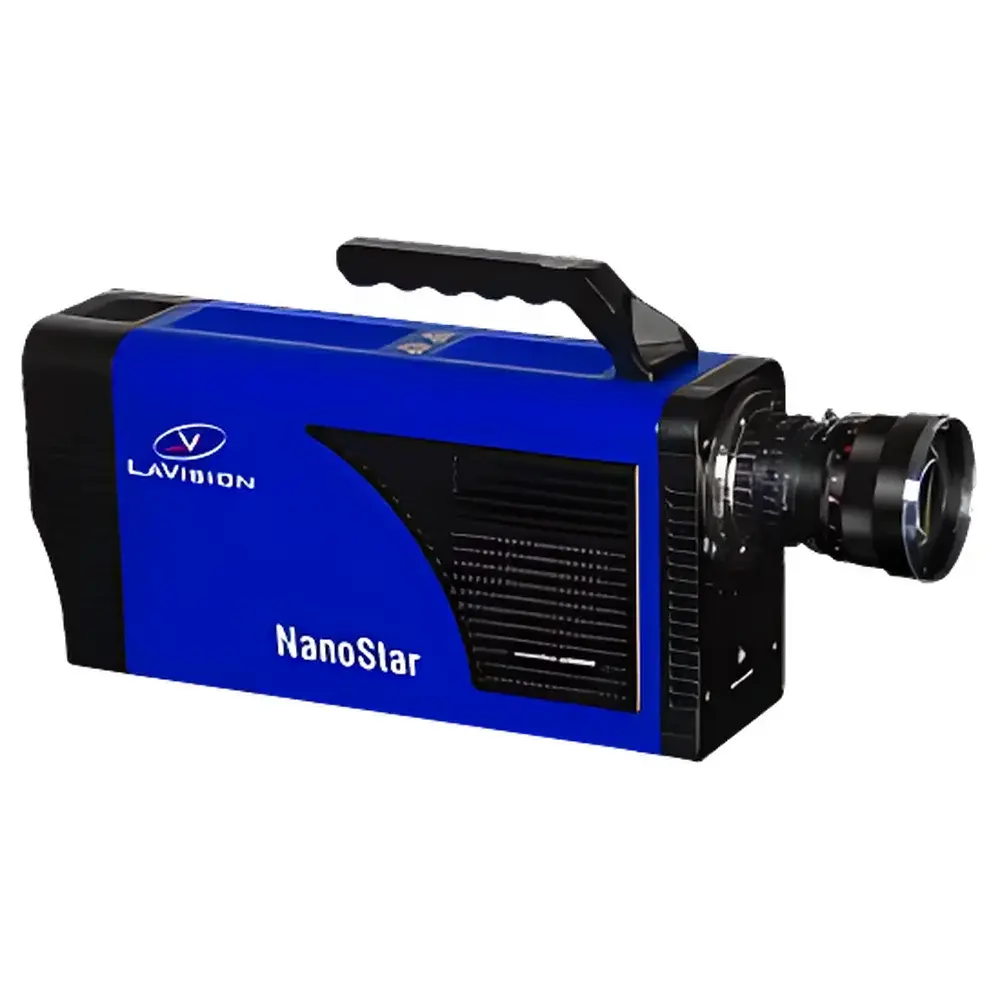
- Integration with LaVision’s NanoStar platform for 104 fps, 16-bit intensified sCMOS acquisition
FAQ
Can the IRO be used with non-LaVision cameras?
Yes—the lens-coupled interface is mechanically and optically agnostic; compatibility requires only appropriate flange distance matching and external trigger synchronization.
What is the typical lifetime of the MCP under continuous gating operation?
At nominal gain (10⁴ electrons per photon) and 1 kHz repetition rate, the MCP exhibits >10⁹ total gated exposures before measurable gain decay (>10%). Lifetime scales inversely with average current density.
Is vacuum maintenance required for the IRO unit?
No—the intensifier is hermetically sealed during manufacturing and requires no user-accessible vacuum pumping or maintenance throughout its service life.
How does the IRO compare to fiber-coupled intensifiers in terms of resolution preservation?
Lens coupling avoids the fixed pixel grid and fill-factor limitations of fiber-optic tapers, preserving native camera resolution and enabling accurate MTF characterization per ISO 12233.
Does DaVis support automated gain calibration routines for the IRO?
Yes—DaVis includes a built-in uniform-field illumination protocol that measures spatial gain variation and generates per-pixel correction matrices for quantitative intensity normalization.




