
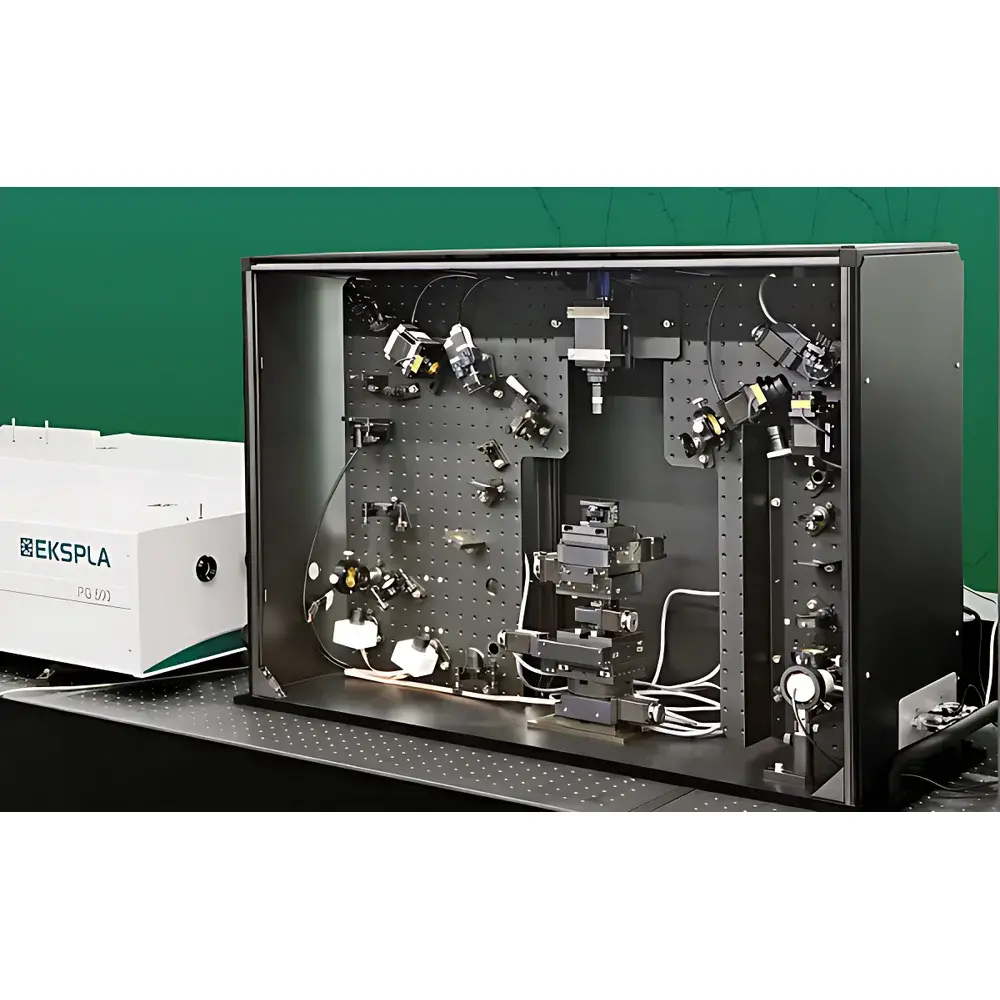
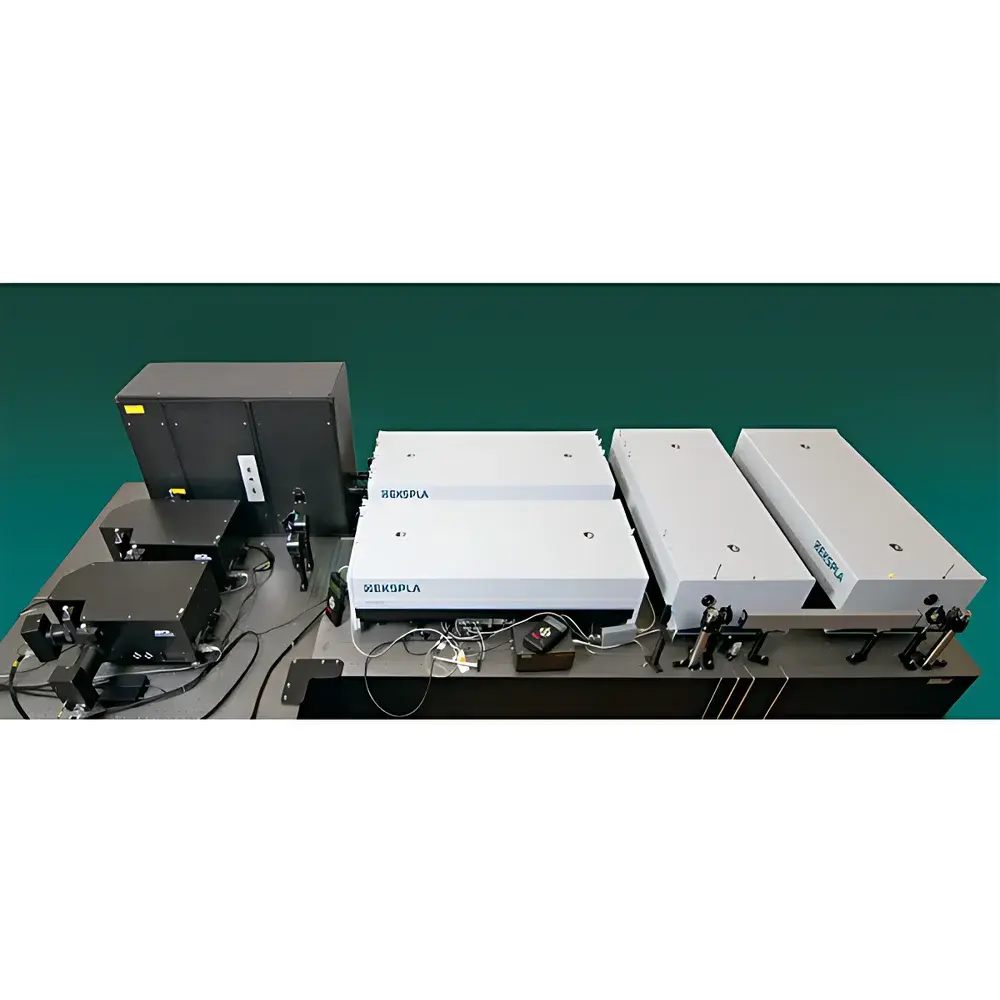
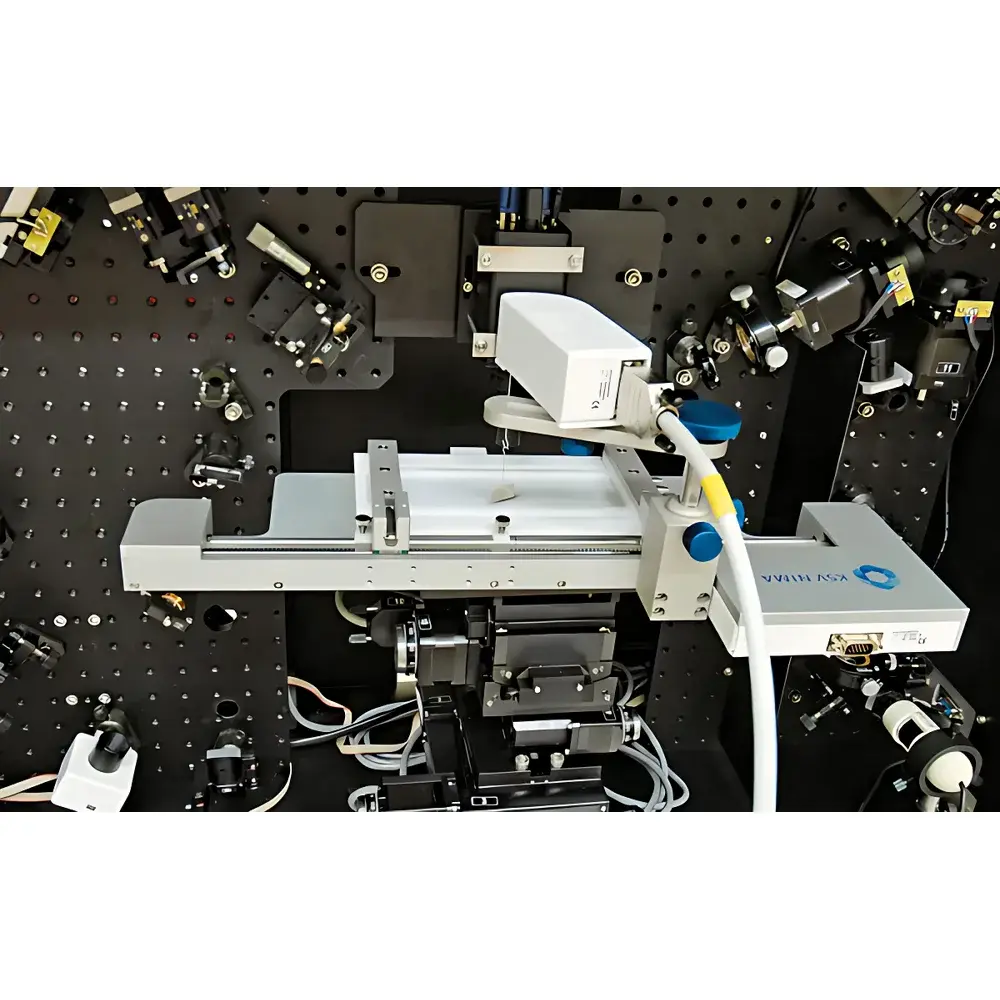
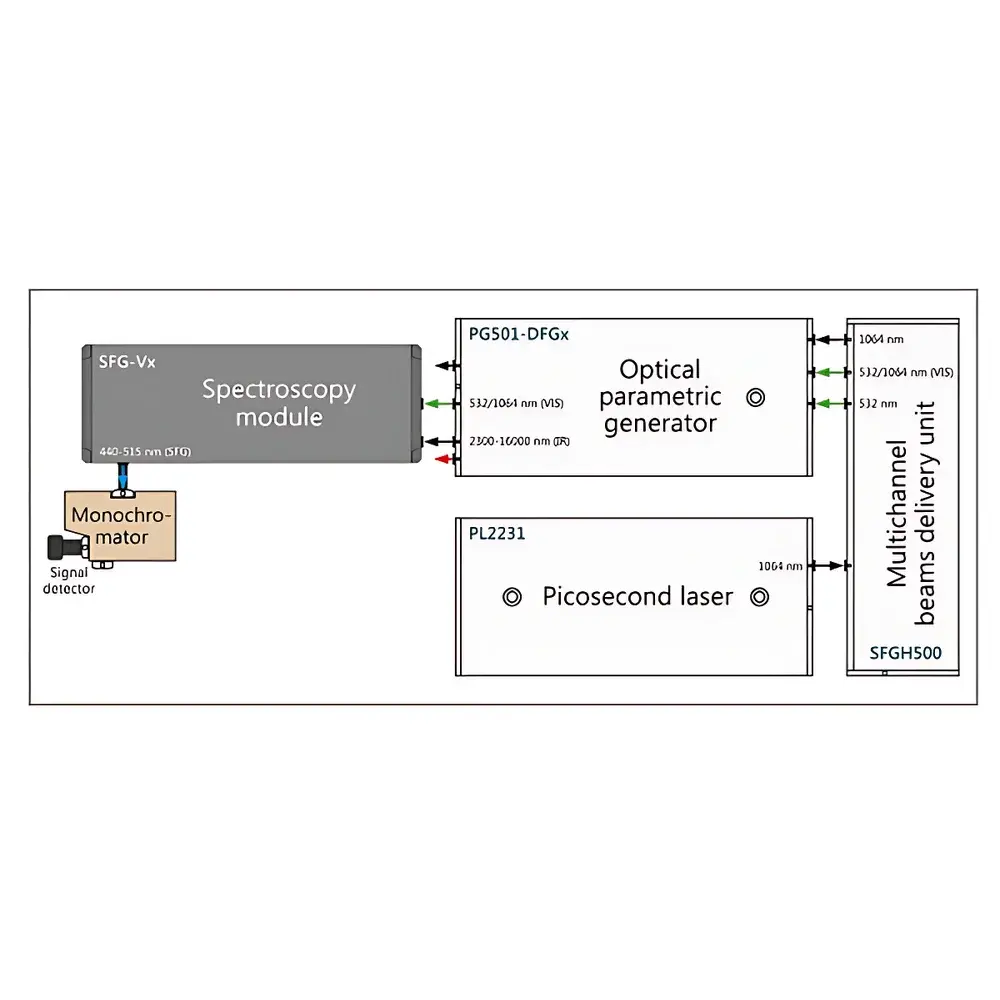
Ekspla SFG Surface Sum-Frequency Generation Spectroscopy System
| Brand | Ekspla |
|---|---|
| Origin | Lithuania |
| Manufacturer Type | Original Equipment Manufacturer (OEM) |
| Product Category | Imported Instrument |
| Model | SFG |
| Price | Upon Request |
| IR Tuning Range | 2.3–10 µm (4300–1000 cm⁻¹) |
| Spectral Resolution | < 6 cm⁻¹ |
| Detection Sensitivity | ~10 photons/shot |
| Acquisition Rate | 10 Hz |
| VIS Beam | 532 nm, < 2 cm⁻¹ linewidth, ~1 mJ pulse energy, 20–30 ps pulse duration, linear polarization (>100:1 extinction ratio) |
| IR Beam | 2.3–10 µm tuning, < 6 cm⁻¹ linewidth, linear polarization (>100:1), 20–200 µJ pulse energy |
| SFG Output Wavelength | 432–505 nm (with 532 nm VIS pump) |
| Optional Extension | Up to 16 µm (625 cm⁻¹) IR coverage |
Overview
The Ekspla SFG Surface Sum-Frequency Generation Spectroscopy System is a high-precision, non-invasive optical platform engineered for molecular-level interrogation of interfaces and buried surfaces. Based on second-order nonlinear optical mixing—specifically the coherent sum-frequency generation (SFG) process—it enables vibrationally resonant spectroscopy exclusively from symmetry-broken interfacial regions where centrosymmetry is absent. Unlike linear techniques such as FTIR or Raman, SFG exhibits intrinsic surface and interface selectivity: the SFG signal (ωSF = ωIR + ωVIS) arises only from molecules located at interfaces (e.g., solid/liquid, liquid/vapor, solid/vacuum, or polymer/polymer boundaries), with negligible bulk contribution. This makes the system uniquely suited for in situ and operando studies of molecular orientation, conformational order, hydrogen bonding networks, and dynamic reorganization at functional interfaces under realistic environmental conditions—including ultra-high vacuum (UHV), controlled gas atmospheres, electrochemical cells, and ambient-pressure liquid environments.
Key Features
- High-stability dual-beam laser architecture: Synchronized picosecond Nd:YAG-pumped OPO/OPA system delivering tunable mid-IR (2.3–10 µm, extendable to 16 µm) and fixed 532 nm visible beams with precise temporal and spatial overlap (< 100 fs timing jitter, < 10 µm spatial overlap).
- Surface-specific detection sensitivity: Capable of detecting sub-monolayer molecular coverage with signal-to-noise ratios optimized for vibrational mode identification at interfaces.
- Programmable polarization control: Independent s- and p-polarized IR and VIS beam configurations enable complete determination of molecular tilt angles, azimuthal orientation, and tensor element contributions via polarization-resolved SFG measurements.
- Robust mechanical and thermal design: Vibration-isolated optical table integration, active beam pointing stabilization, and temperature-controlled optics enclosure ensure long-term measurement reproducibility over multi-hour acquisition sessions.
- Modular upgrade path: Native compatibility with second-harmonic generation (SHG) configuration for complementary electronic structure probing; optional integration with electrochemical flow cells or UHV-compatible sample stages.
Sample Compatibility & Compliance
The Ekspla SFG system supports diverse sample geometries and operational environments without sample modification or labeling. Compatible substrates include single-crystal metals (Au, Ag, Pt), dielectric oxides (SiO₂, TiO₂, Al₂O₃), semiconductor wafers, polymer films, Langmuir–Blodgett monolayers, biological membranes, and catalytic electrodes. Measurements comply with fundamental principles outlined in ISO/IEC 17025 for analytical instrument validation, and data acquisition workflows support audit-ready metadata logging per GLP and FDA 21 CFR Part 11 requirements when paired with compliant laboratory information management systems (LIMS). All optical components meet RoHS and CE directives for laser safety (Class IV compliance per IEC 60825-1).
Software & Data Management
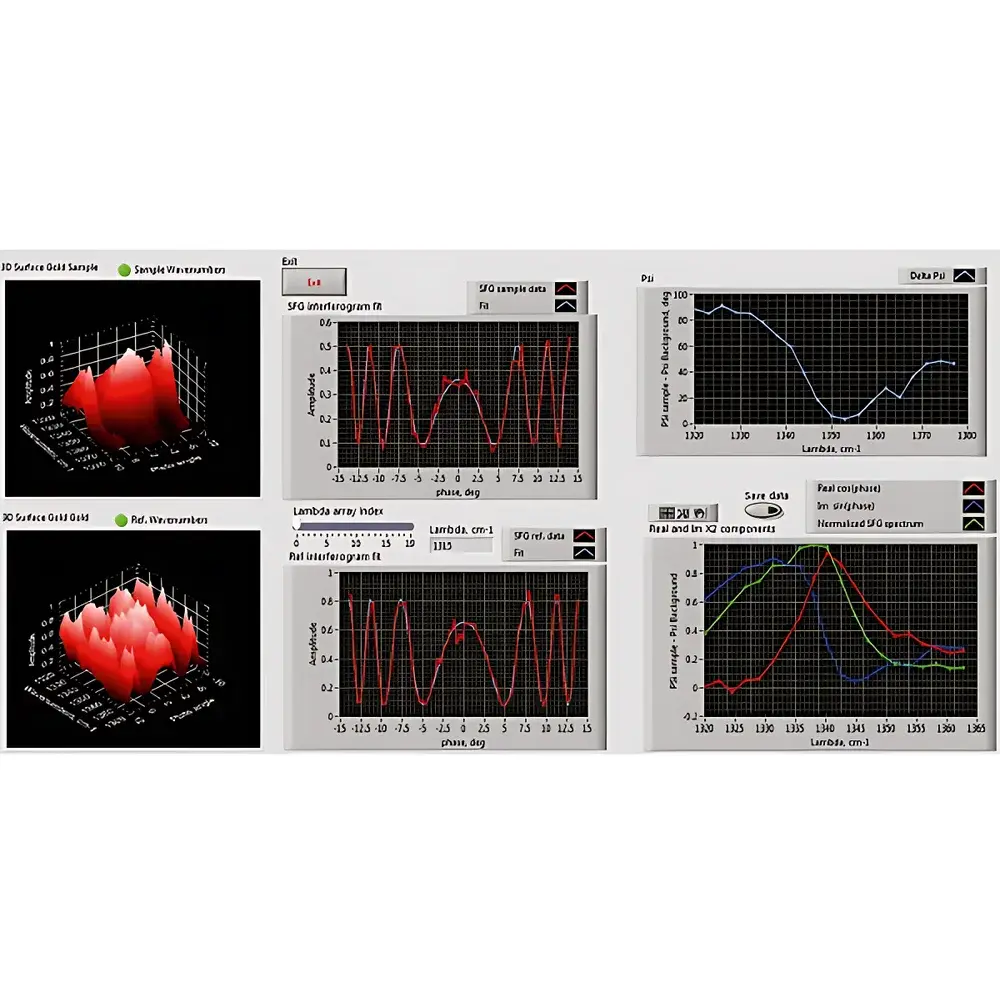
Control and analysis are performed via Ekspla’s proprietary SFG Control Suite—a Windows-based application enabling full automation of wavelength scanning, polarization sequencing, delay-stage synchronization, and real-time spectral preview. The software implements standardized HDF5-based data storage, embedding experimental parameters (laser energies, polarization states, incident angles, environmental conditions) directly into each dataset. Post-processing tools include baseline correction, Lorentzian/Gaussian peak fitting, χ(2) tensor decomposition, and orientation angle calculation using the standard SFG intensity formalism. Export options include ASCII, MATLAB .mat, and CSV formats for third-party statistical modeling or machine learning pipelines. Remote monitoring and scheduled acquisition are supported via TCP/IP interface.
Applications
- Molecular organization at solid/liquid interfaces in electrochemical energy devices (e.g., Li-ion battery SEI layers, PEM fuel cell catalysts).
- Conformational ordering and end-group orientation in polymer blend surfaces and thin-film coatings.
- Hydrogen-bonding structure and proton transfer dynamics at aqueous interfaces, including air/water and lipid bilayer/water boundaries.
- Catalytic reaction intermediates and adsorbate geometry on single-crystal metal or oxide surfaces under reactive gas environments.
- Self-assembled monolayer (SAM) formation kinetics, defect density mapping, and interfacial dipole evolution during functionalization.
- In situ monitoring of surfactant adsorption, protein folding at interfaces, and nanoparticle ligand shell restructuring.
FAQ
What types of interfaces can be studied using this SFG system?
The system is applicable to any optically accessible interface lacking inversion symmetry—including solid/vacuum, solid/gas, solid/liquid, liquid/vapor, liquid/liquid, and buried polymer/polymer interfaces.
Is vacuum operation required?
No. While UHV compatibility is available, the system operates robustly under ambient pressure, in controlled gas cells (N₂, O₂, CO, H₂), or immersed in transparent liquids (water, organic solvents, ionic liquids).
Can polarization-resolved measurements be automated?
Yes. The software controls motorized waveplates and polarizers for sequential ssp, ppp, sps, and other polarization combinations with synchronized data capture.
How is spectral calibration performed?
Calibration uses a stabilized HeNe reference laser and calibrated IR spectrometer (FTIR-grade), traceable to NIST standards; real-time wavelength verification is integrated into each scan cycle.
What maintenance is required for long-term stability?
Routine alignment checks every 3–6 months; OPO crystal replacement every 2–3 years depending on usage; no consumables beyond standard laser optics cleaning protocols.
Related Products





