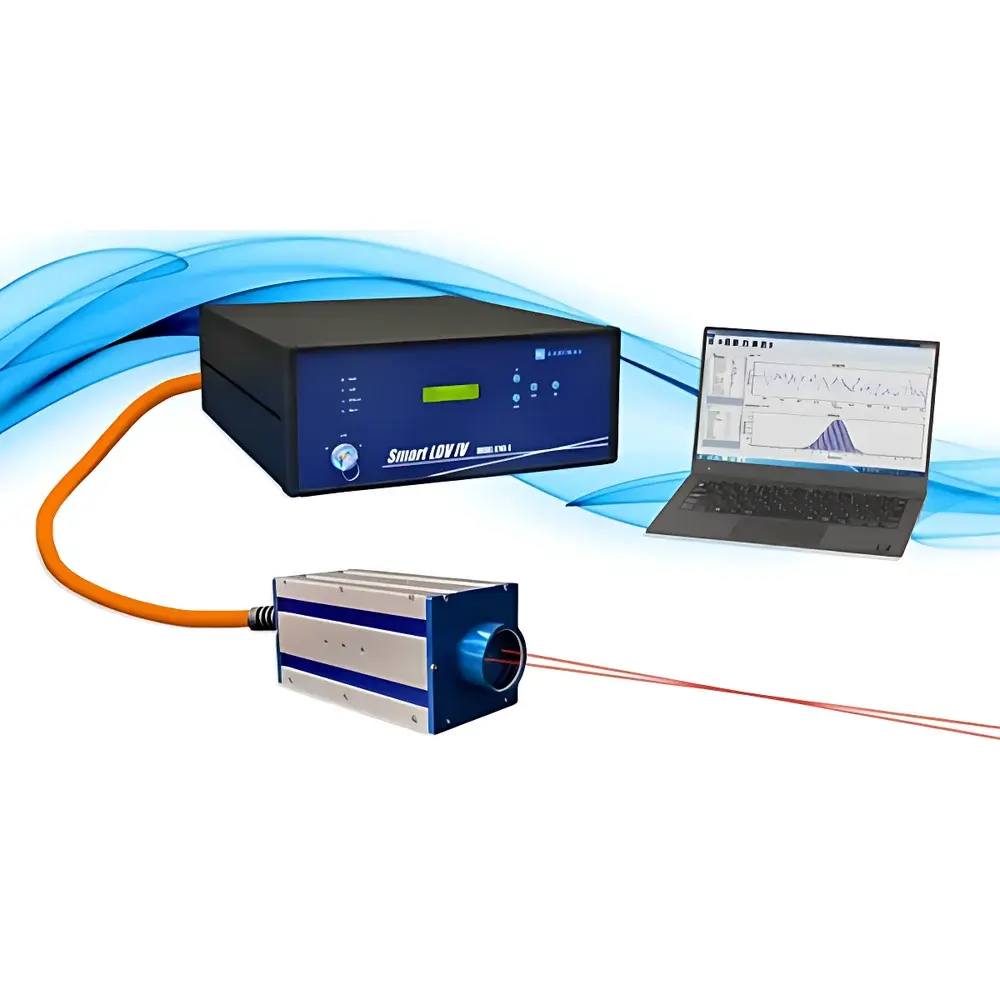
KANOMAX SmartLDV IV Compact Laser Doppler Velocimeter
| Brand | KANOMAX |
|---|---|
| Origin | Japan |
| Model | 8745-S |
| Laser Wavelength | 660 nm |
| Laser Power | 60 mW |
| Velocity Range | –40 to +264 m/s (at 400 mm focal distance, model 8745-S) |
| Focal Distances | 150, 200, 250, 300, 350, 400 mm |
| Spot Size | 0.13 mm × 1.3 mm (f = 200 mm) |
| Probe Dimensions | Ø61 mm × 345 mm |
| Probe Weight | 3.5 kg |
| Frequency Shift Range | 0.01–10 MHz |
| Signal Processor | SmartLDV Model 8008 |
| FFT Resolution | 8-bit |
| Frequency Bandwidth | 1 kHz – 40 MHz |
| Input Signal Range | 20 mV – 1 V |
| Data Acquisition Rate | 16,000 samples/sec |
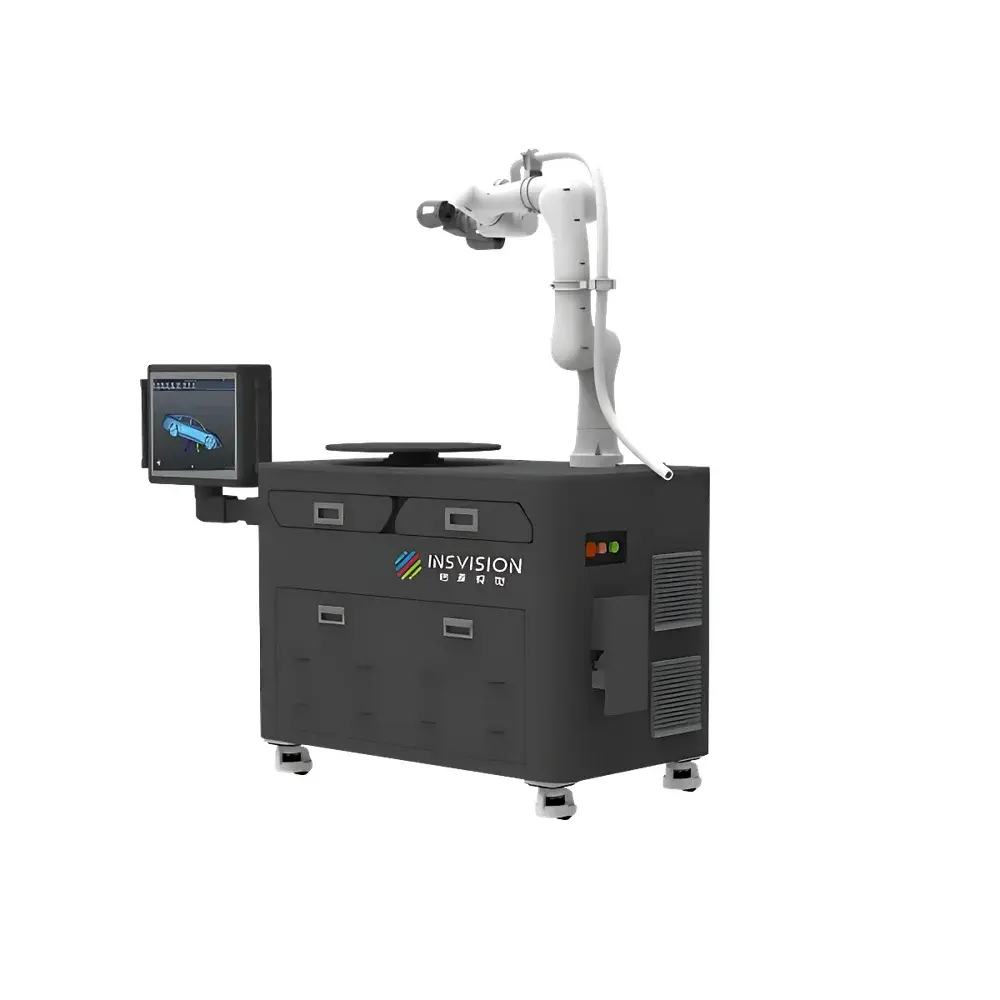
| 3-Axis Traverse System | Max. vertical load 7 kg, travel speed 80 mm/sec, positioning accuracy ±0.025 mm |
| Interface | RS232C |
| Compliance | CE-marked, RoHS-compliant, designed for ISO/IEC 17025-aligned laboratory environments |
Overview
The KANOMAX SmartLDV IV Compact Laser Doppler Velocimeter is a high-precision, non-intrusive optical instrument engineered for point-wise velocity measurement in gaseous and low-scattering fluid flows. Based on the fundamental principle of laser Doppler velocimetry (LDV), the system detects frequency shifts in coherent light scattered by moving particles—typically naturally occurring dust or intentionally seeded tracer particles—within the measurement volume. Two collimated beams from a single 660 nm diode laser intersect at a precisely defined angle, generating a periodic interference fringe pattern. As particles traverse this pattern, they produce modulated scattered light whose frequency is directly proportional to their instantaneous velocity component along the measurement axis. The SmartLDV IV integrates a compact dual-beam optical probe with an embedded signal processor (Model 8008), enabling real-time spectral analysis via 8-bit fast Fourier transform (FFT) over a bandwidth spanning 1 kHz to 40 MHz. Designed for integration into wind tunnels, combustion chambers, and HVAC validation setups, the system delivers traceable velocity data without flow disturbance—critical for boundary layer studies, jet characterization, and turbulent kinetic energy quantification.
Key Features
- Compact dual-beam optical probe (Ø61 mm × 345 mm, 3.5 kg) optimized for confined test sections and multi-point scanning applications
- Adjustable focal distances (150–400 mm) with calibrated spot sizes down to 0.13 mm × 1.3 mm (at f = 200 mm), ensuring spatial resolution suitable for high-gradient flow regions
- Integrated frequency shifter (0.01–10 MHz range) enabling bidirectional velocity discrimination and extended dynamic range (–40 to +264 m/s)
- Dedicated SmartLDV Model 8008 signal processor with real-time FFT processing, 16,000-sample/sec acquisition rate, and configurable input sensitivity (20 mV–1 V)
- Motorized 3-axis traverse system with ±0.025 mm positioning repeatability and 80 mm/sec translation speed—designed for automated mapping of velocity fields
- RS232C interface for PC-based control, data logging, and synchronization with external triggers (e.g., PIV lasers, pressure transducers)
- CE-marked and RoHS-compliant architecture; compatible with ISO/IEC 17025 calibration protocols and GLP-aligned experimental documentation workflows
Sample Compatibility & Compliance
The SmartLDV IV is intended for use in transparent gaseous media where naturally present or introduced seeding particles (e.g., TiO₂, SiO₂, or oil droplets < 1 µm diameter) provide sufficient Mie scattering cross-section at 660 nm. It is not suitable for opaque, highly absorbing, or particle-free flows. The system complies with IEC 61000-6-3 (EMC emission standards) and IEC 61000-6-2 (immunity requirements). All optical components meet JIS Z 8120 classification for laser safety (Class 3R), with integrated interlock circuitry for shutter control. For regulated environments—including pharmaceutical cleanroom airflow qualification and automotive intake duct validation—the system supports audit-ready data export (CSV, ASCII) with timestamping and metadata embedding per FDA 21 CFR Part 11 principles when paired with validated third-party acquisition software.
Software & Data Management
While the SmartLDV IV operates autonomously via its onboard processor, it interfaces seamlessly with host PCs running Windows-based acquisition platforms (e.g., LabVIEW, MATLAB, or custom C++ applications) via RS232C. Raw Doppler burst signals, FFT spectra, and centroid frequency outputs are streamed in real time with microsecond-level timestamp resolution. Post-processing utilities support spectral peak detection, turbulence intensity calculation (via RMS of frequency distribution), and ensemble averaging across user-defined acquisition windows. All datasets include embedded header information: probe ID, focal distance, shift frequency, gain setting, and environmental timestamp—facilitating traceability in multi-instrument test campaigns. Calibration certificates (NIST-traceable velocity standards) are provided with each unit and may be imported into analysis pipelines for automatic gain correction.
Applications
- Aerodynamic characterization in low-speed and transonic wind tunnels (boundary layer profiling, wake decay analysis)
- Combustion diagnostics in gas turbine combustors and industrial burners (flame front velocity, recirculation zone mapping)
- HVAC system commissioning and ASHRAE Standard 111-compliant air distribution verification
- Calibration reference for hot-wire anemometers and thermal mass flow sensors
- Fundamental turbulence research requiring high temporal resolution (< 62.5 µs inter-sample interval) and directional ambiguity resolution
- Academic fluid mechanics laboratories where space-constrained, turnkey LDV capability is required without optical table infrastructure
FAQ
What particle size is optimal for reliable signal generation in air?
Particles between 0.3 µm and 1.0 µm in diameter provide optimal scattering efficiency at 660 nm while remaining neutrally buoyant in typical airflows. Polydisperse aerosols require careful evaluation of Mie theory-based signal-to-noise ratios.
Can the SmartLDV IV measure in liquids?
No. The optical design, laser power, and signal processing architecture are optimized for gaseous media with low refractive index gradients. Liquid measurements require higher-power lasers, immersion optics, and different signal conditioning—addressed by KANOMAX’s separate LDA-Liquid series.
Is the 3-axis traverse system included with the base configuration?
Yes—the motorized XYZ stage, controller, and mounting hardware are standard equipment for the SmartLDV IV system (model 8745-S), supporting repeatable volumetric scans without third-party integration.
How is velocity directionality resolved?
Directional ambiguity is eliminated using the built-in acousto-optic frequency shifter, which introduces a known offset (0.01–10 MHz) into one beam path—enabling unambiguous sign assignment to Doppler shifts during spectral post-processing.
Does the system support synchronization with external measurement systems?
Yes. The RS232C port accepts TTL-level trigger inputs and provides synchronous output pulses aligned to data acquisition frames—enabling phase-locked operation with PIV systems, pressure scanners, or thermocouple arrays.