
EKSMA GTH-5-250-4 Gaussian-to-Top-Hat Beam Shaper
| Brand | EKSMA |
|---|---|
| Origin | Lithuania |
| Manufacturer Type | Authorized Distributor |
| Import Status | Imported |
| Model | GTH-5-250-4 |
| Component Category | Beam Shaping Optics |
| Material | Schott LF5 Glass |
| Recommended Wavelength Range | 400–1550 nm |
| Refractive Index | n = 1.5659 @ 1060 nm, n = 1.5848 @ 546 nm, n = 1.6192 @ 365 nm |
| Effective Aperture | Ø11.0 mm |
| Laser Damage Threshold (Uncoated) | >3 J/cm² @ 532 nm, 10 ns pulse duration |
| Mounting | Standard 1-inch (25.4 mm) threaded ring mount |
Overview
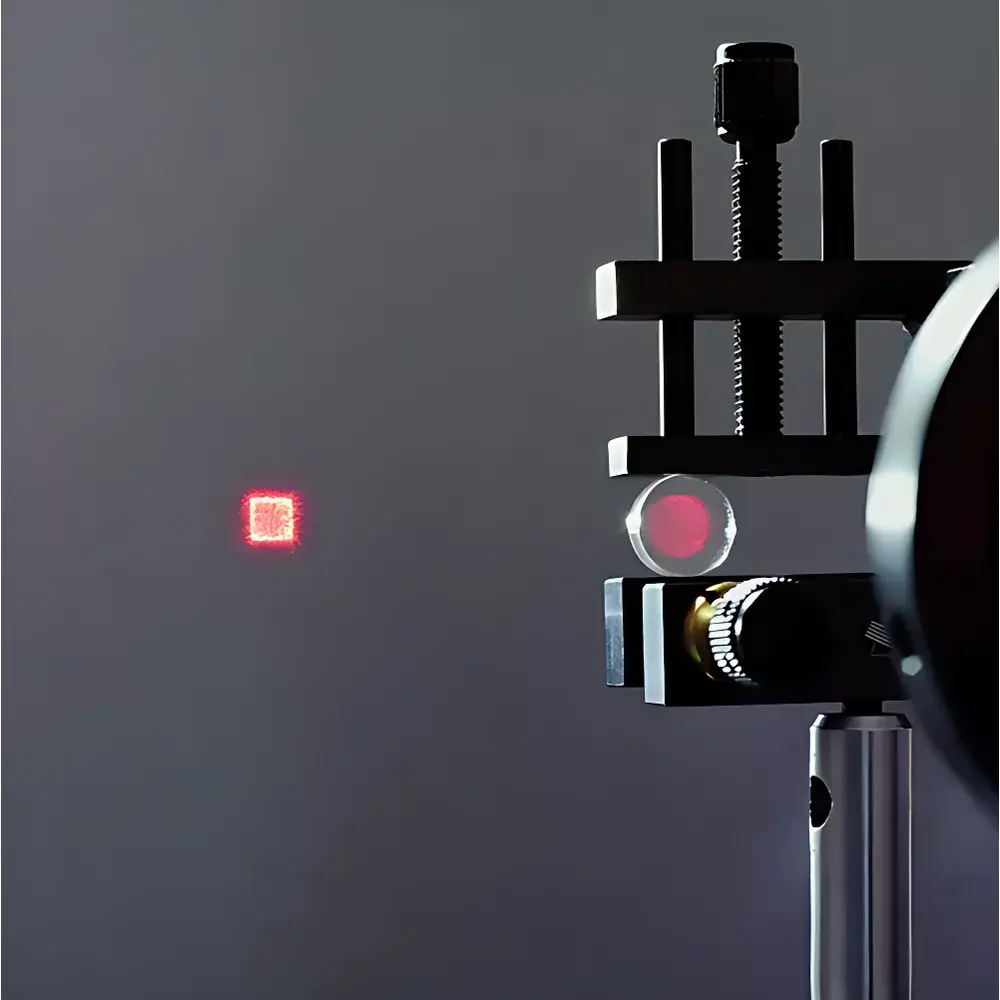
The EKSMA GTH-5-250-4 Gaussian-to-Top-Hat Beam Shaper is a precision diffractive optical element (DOE) engineered to transform incident laser beams with Gaussian intensity profiles into spatially uniform, near-rectangular “top-hat” irradiance distributions. Unlike refractive beam homogenizers or microlens arrays, this device operates on the principle of controlled phase modulation—leveraging a monolithic, custom-designed surface-relief microstructure etched onto high-homogeneity Schott LF5 optical glass. The GTH-5-250-4 is optimized for single-mode or low-order multimode input beams and delivers high energy efficiency (>92% transmission in the specified spectral range) with minimal wavefront distortion. Its design enables consistent beam uniformity (typically ±3% RMS flatness over the central 90% of the top-hat region) across its operational bandwidth—from UV at 365 nm through visible and into the near-infrared up to 1550 nm—making it suitable for applications requiring stable spatial intensity control under varying laser sources.
Key Features
- Monolithic diffractive architecture fabricated on Schott LF5 substrate for thermal and mechanical stability
- Broadband anti-reflection compatibility: uncoated version supports 400–1550 nm; optional V-coating available for specific wavelengths (e.g., 532 nm, 1064 nm)
- High laser-induced damage threshold: >3 J/cm² at 532 nm with 10 ns pulses, enabling integration into Q-switched Nd:YAG and frequency-doubled systems
- Standard 1-inch (25.4 mm) external threading for direct mounting into commercial optomechanical cages, lens tubes, or kinematic mounts
- Effective aperture of Ø11.0 mm ensures compatibility with common collimated beam diameters while minimizing edge diffraction effects
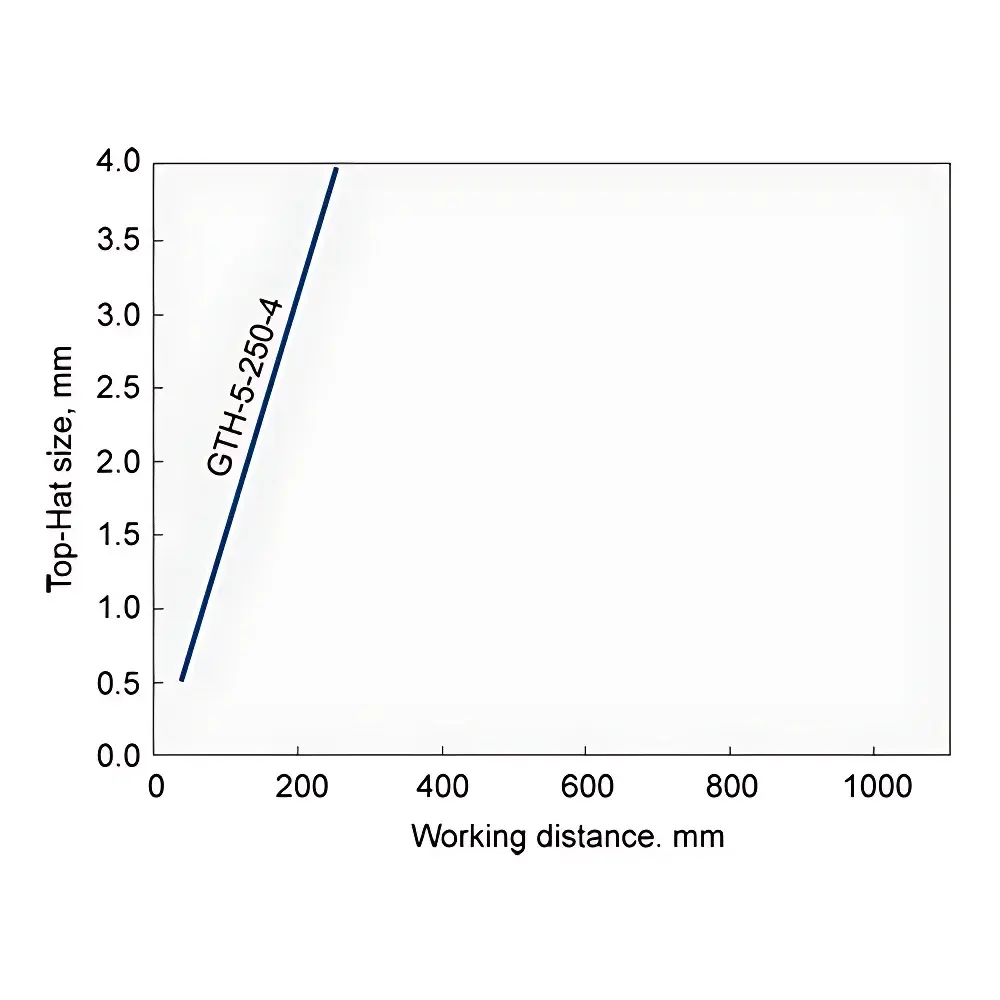
- Design flexibility: output beam size and working distance are tunable via relay optics—adding a focusing lens or microscope objective downstream allows precise scaling of the top-hat spot diameter and propagation distance
Sample Compatibility & Compliance
The GTH-5-250-4 is compatible with continuous-wave (CW) and pulsed laser sources operating within its specified wavelength and fluence limits. It maintains performance under standard laboratory environmental conditions (20–25°C, <50% RH) and conforms to ISO 10110-7 for surface quality (scratch-dig 20–10) and ISO 10110-3 for surface form accuracy (λ/4 @ 633 nm). While not certified to IEC 60825-1 as a standalone safety device, it is intended for integration into Class 3B or Class 4 laser systems compliant with EN 60825-1 and ANSI Z136.1. No regulatory certification (e.g., FDA, CE marking) applies to passive optical components; however, full traceability of material batch, metrology reports, and DOEs fabrication parameters is provided upon request for GLP/GMP-aligned validation protocols.
Software & Data Management
As a passive optical component, the GTH-5-250-4 requires no firmware, drivers, or proprietary software. Its performance is fully characterized prior to shipment using interferometric wavefront analysis (Zygo Verifire™) and far-field intensity profiling (Ophir Spiricon BeamStar™). Customers receive a calibration report including measured M² factor of the transformed beam, uniformity map (RMS and peak-to-valley), and diffraction efficiency spectrum. For system-level integration, beam propagation modeling (e.g., via MATLAB-based Physical Optics Propagation or Python-based LightPipes) is recommended to simulate output profile evolution when combined with relay lenses or scanning optics. All documentation complies with ISO/IEC 17025 traceability requirements for metrological validity.
Applications
- Laser material processing: uniform ablation, thin-film scribing, and annealing where spatial energy consistency directly impacts process repeatability
- Optical trapping and holographic tweezers: generation of homogeneous intensity fields for multi-particle manipulation
- Medical and aesthetic lasers: beam conditioning for dermatological treatments requiring controlled fluence distribution
- Sensor illumination: structured light projection and machine vision lighting with minimized hotspots
- Scientific instrumentation: pump beam homogenization in ultrafast spectroscopy, OPO seeding, and nonlinear frequency conversion setups
- Quantum optics experiments: preparation of spatially defined excitation profiles for cold atom arrays or ion trap loading
FAQ
What is the maximum input beam diameter supported by the GTH-5-250-4?
The recommended maximum collimated input beam diameter is Ø10.0 mm to ensure full utilization of the Ø11.0 mm effective aperture while maintaining diffraction-limited performance.
Can this beam shaper be used with femtosecond lasers?
Yes—provided pulse energy and peak intensity remain below the damage threshold. For ultrashort pulses (<1 ps), consult EKSMA’s technical team for dispersion compensation recommendations, as group delay variation across the DOE structure may affect temporal pulse integrity.
Is custom focal length or output profile shape available?
EKSMA offers OEM design services for application-specific DOEs, including tailored top-hat aspect ratios, elliptical outputs, or hybrid Gaussian-top-hat profiles. Lead time and NRE apply.
Does the device introduce chromatic aberration?
No—being a diffractive element, the GTH-5-250-4 exhibits inherent wavelength-dependent focal properties. However, its phase function is optimized for broadband operation; spectral shifts in output position are predictable and quantifiable using the provided dispersion coefficients.
How should the beam shaper be cleaned and handled?
Use only dry nitrogen purge followed by lens-tissue wiping with spectroscopic-grade acetone or isopropanol. Avoid ultrasonic cleaning or mechanical pressure. Store in a desiccated, particulate-free environment to preserve surface integrity and coating performance.





