
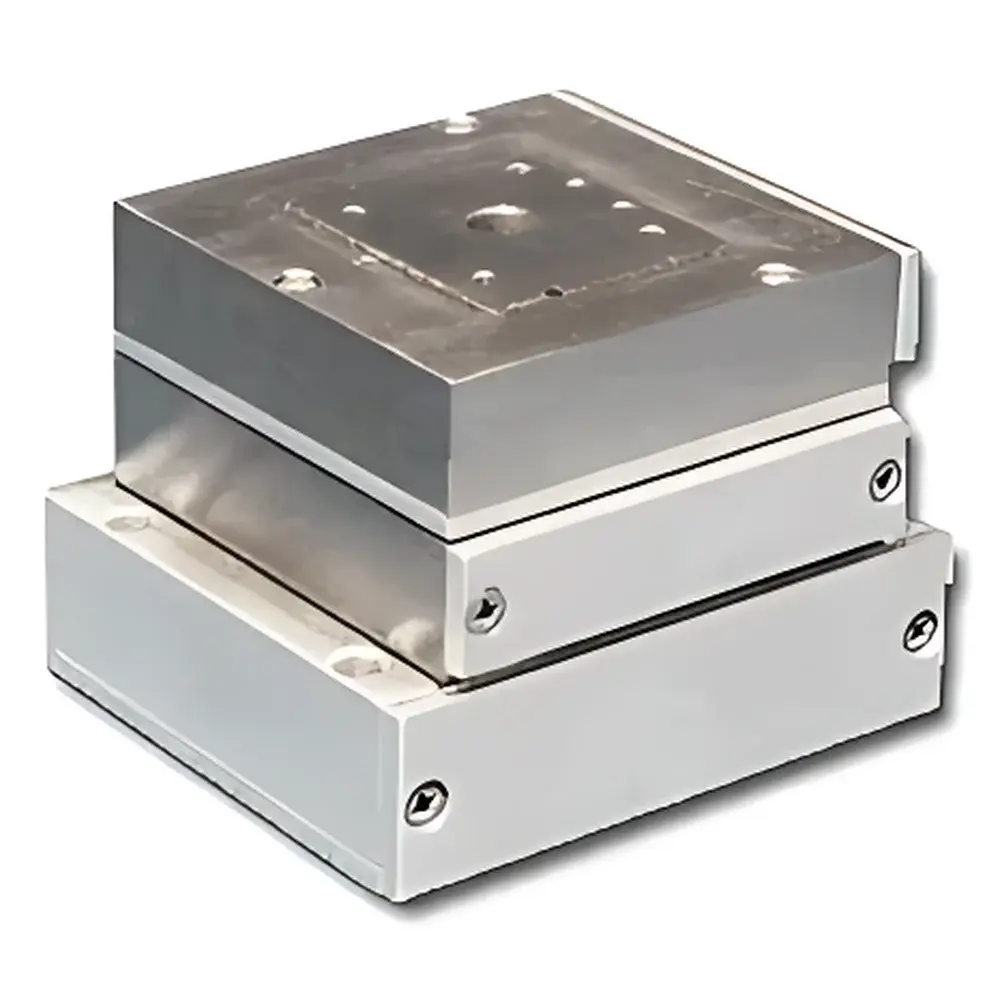
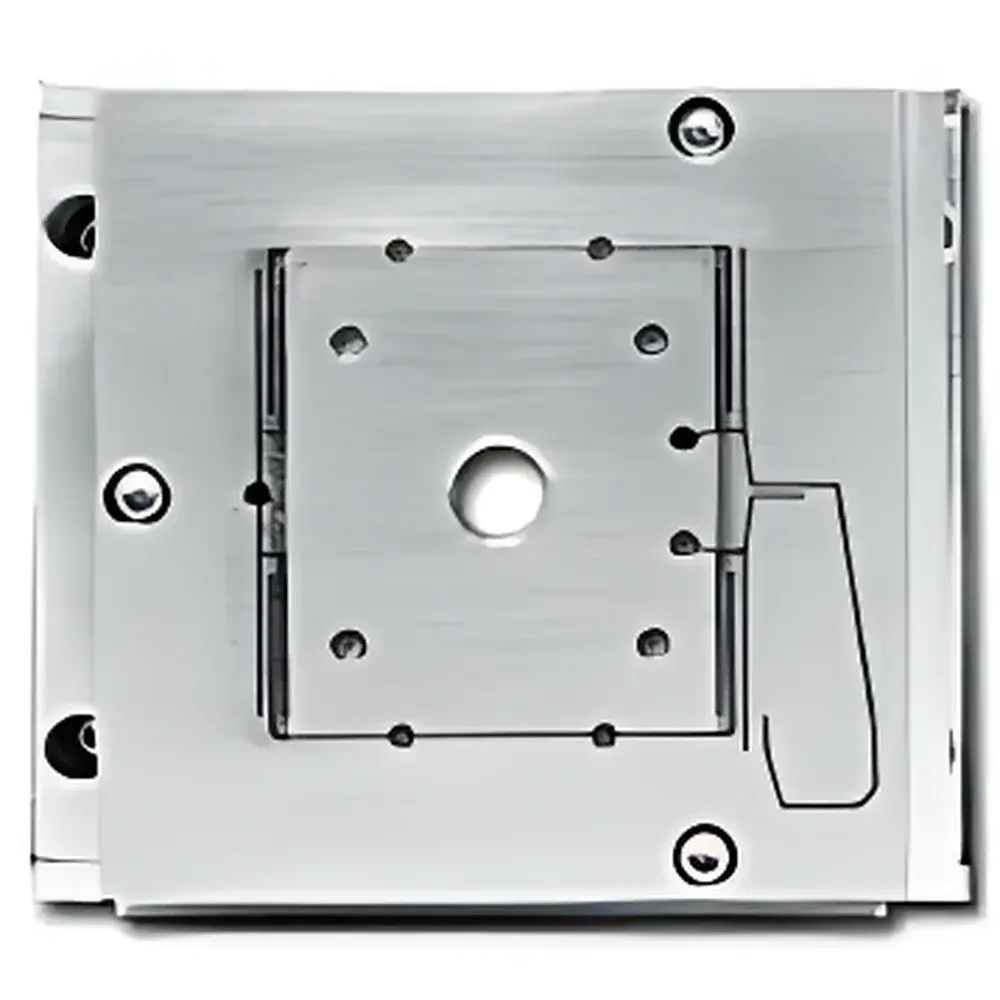
MCL Think Nano Nano-Man5 Five-Axis Piezoelectric Nanopositioning Stage
| Brand | MCL Think Nano |
|---|---|
| Origin | USA |
| Model | Nano-Man5 |
| Motion Axes | X, Y, Z, θX, θY |
| Travel Range | 50 µm × 50 µm × 25 µm × 1 mrad × 1 mrad |
| Center Aperture | 6.35 mm (0.25") |
| Closed-Loop Control | Yes |
| Position Resolution | 0.1 nm (X,Y), 0.05 nm (Z), 2 nrad (θX,θY) |
| Resonant Frequency | 1 kHz (X), 700 Hz (Y,Z) |
| Stiffness | 1.0 N/µm |
| Max Load (Horizontal/Vertical) | 0.2 kg |
| Body Material | Aluminum/Titanium or Invar |
| Vacuum Compatibility | High Vacuum (Non-Bakeable) Option Available |
| Controller | Nano-Drive® |
Overview
The MCL Think Nano Nano-Man5 is a high-precision, five-axis piezoelectric nanopositioning stage engineered for sub-nanometer stability and multi-degree-of-freedom motion control in demanding optical, semiconductor, and nanoscale research environments. Designed around a monolithic flexure architecture with integrated PicoQ® capacitive position sensing, the Nano-Man5 delivers true closed-loop operation across all five degrees of freedom—linear translation along X, Y, and Z, plus angular tip (θX) and tilt (θY) adjustment. Its compact footprint (standardized to match industry instrumentation footprints such as SEM chambers and optical breadboards) and central 6.35 mm (0.25″) aperture enable seamless integration into vacuum-compatible and space-constrained systems. The stage operates on electroceramic actuation principles, leveraging low-voltage, high-bandwidth piezo drivers to achieve rapid, hysteresis-compensated motion without mechanical backlash or stick-slip artifacts—critical for applications requiring deterministic, repeatable alignment under dynamic feedback.
Key Features
- Five-axis coordinated motion (X, Y, Z, θX, θY) with independent closed-loop control per axis
- PicoQ® capacitive sensors providing absolute, drift-free position measurement with picometer-level resolution and nanoradian angular accuracy
- Monolithic aluminum/titanium or Invar construction ensuring thermal stability and mechanical rigidity (1.0 N/µm stiffness)
- Compact form factor optimized for integration into SEM columns, lithography tool stages, interferometric setups, and confocal microscopy platforms
- High-resonance dynamics: 1 kHz (X), 700 Hz (Y/Z) enabling fast settling times (<5 ms typical for 10 µm steps) and real-time trajectory tracking
- Optional high-vacuum (HV) configuration rated to 1×10⁻⁷ Torr (non-bakeable); compatible with UHV feedthroughs upon request
- Native compatibility with MCL’s Nano-Drive® controller, supporting analog voltage input, digital USB/Ethernet command interface, and programmable waveform generation
Sample Compatibility & Compliance
The Nano-Man5 is designed for use with optically transparent, electrically non-interfering, and mechanically compliant samples ranging from MEMS test chips and photonic waveguide arrays to AFM cantilever mounts and nanoimprint stamps. Its low-mass platform and symmetric load distribution support inertial loads up to 200 g in any orientation, provided center-of-gravity remains within the central 8 mm diameter zone. The stage complies with ISO 9022-3 (optical instruments — environmental testing — vibration) and meets electromagnetic compatibility requirements per FCC Part 15 Class A and CE Directive 2014/30/EU. For regulated environments—including GLP-compliant metrology labs and FDA-audited semiconductor process development—the Nano-Drive® controller supports audit-trail logging, user-access control, and 21 CFR Part 11–compliant electronic signatures when deployed with validated firmware versions.
Software & Data Management
Control and data acquisition are managed via the Nano-Drive® software suite (Windows/Linux/macOS), offering both GUI-based point-and-click positioning and script-driven automation through Python, MATLAB, and LabVIEW APIs. Real-time position streaming at up to 10 kHz enables synchronized acquisition with external detectors (e.g., quadrant photodiodes, CCD line scans, or lock-in amplifiers). All sensor data—including raw capacitance values, compensated position outputs, and actuator voltage traces—are timestamped and stored in HDF5 format, ensuring traceability and interoperability with third-party analysis pipelines. Firmware updates preserve calibration coefficients and support field recalibration using NIST-traceable reference standards; full system diagnostics—including sensor health, thermal drift logs, and open-circuit detection—are accessible via command-line interface.
Applications
- Active alignment of single-mode fiber arrays and photonic integrated circuits (PICs) in free-space and butt-coupled configurations
- In situ nanolithography stage positioning for electron-beam and focused ion beam (FIB) systems requiring simultaneous Z-height correction and beam incidence angle tuning
- Dynamic focus and aberration correction in adaptive optics setups using deformable mirror co-registration
- Probe-to-sample alignment in scanning probe microscopy (SPM), particularly for multi-tip electrical transport measurements
- Calibration artifact positioning in primary length metrology systems operating under ISO/IEC 17025-accredited conditions
- Sub-pixel registration of multi-spectral imaging sensors in astronomy and remote sensing instrumentation
FAQ
What vacuum levels is the Nano-Man5 rated for?
The standard model operates in ambient air or dry nitrogen environments. The optional high-vacuum variant is rated to 1×10⁻⁷ Torr and features vacuum-compatible materials, lubricants, and cabling—but is not bakeable above 80 °C.
Can the Nano-Man5 be used in cryogenic environments?
While not certified for cryogenic service, limited operation down to –40 °C has been demonstrated with reduced travel range and increased hysteresis; custom Invar-body variants with low-thermal-expansion actuators are available upon engineering consultation.
Is third-party controller integration supported?
Yes—open-command protocols (ASCII over USB/Ethernet) and register-level memory maps are documented in the Nano-Drive® Programmer’s Manual; EtherCAT and PCIe interfaces are available as OEM options.
How is long-term positional stability ensured?
PicoQ® sensors provide absolute position feedback without reliance on stepper increments or encoder interpolation; thermal drift compensation algorithms are embedded in firmware and updated during each power cycle using onboard temperature sensors.
What maintenance is required?
None under normal operating conditions. The monolithic flexure design eliminates wear-prone components such as ball screws or crossed rollers; periodic verification using an external interferometer is recommended annually for metrology-critical applications.



