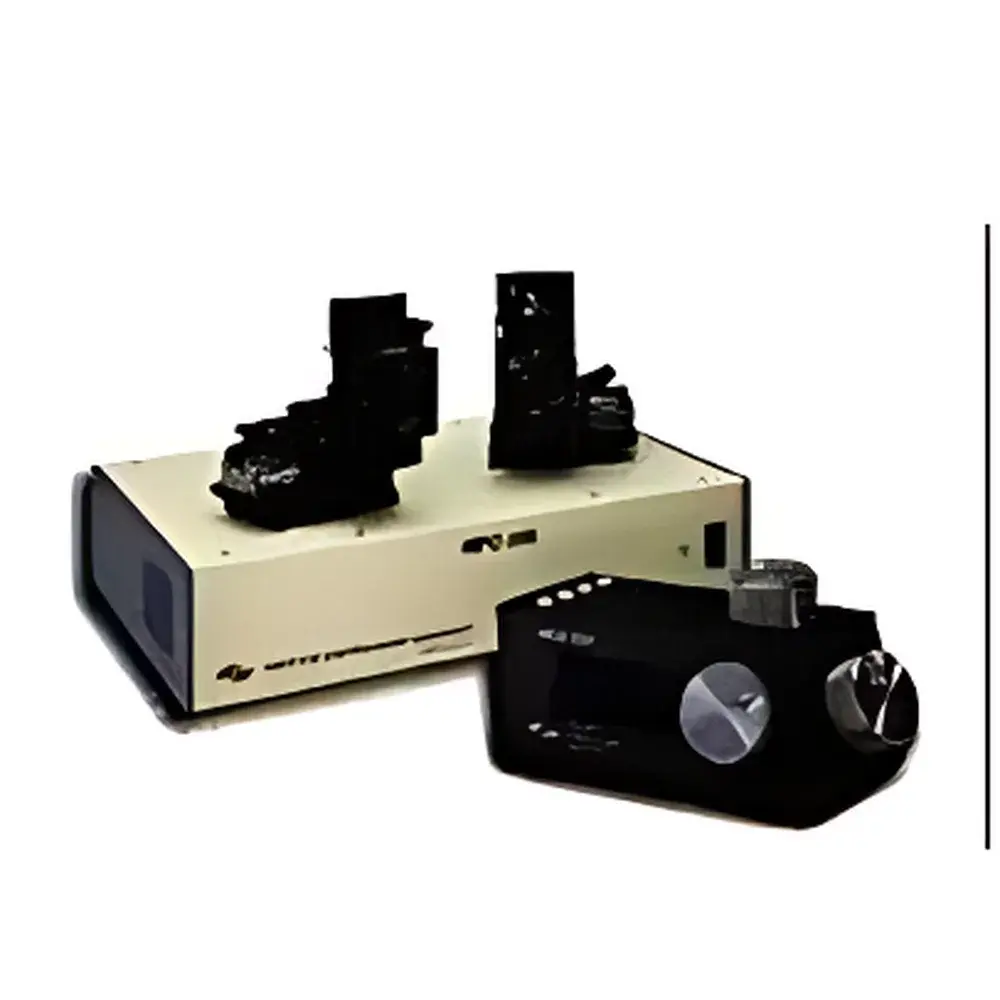
Sutter MPC325-2 Dual-Electrode Motorized Micromanipulator
| Brand | Sutter |
|---|---|
| Origin | USA |
| Model | MPC325-2 |
| Axes | X, Y, Z, and Oblique (4-axis) |
| Travel Range | 25.4 mm per axis |
| Step Resolution | 0.0625–2.0 µm |
| Maximum Speed | 3 mm/s |
| Thermal Drift | ≤10 nm/h at 24°C |
| Drive Mechanism | Precision Lead-Screw |
| Position Display | LCD (µm resolution) |
| Control Modes | ROE200 Rotary Encoder, FSR Piezo Controller, Joystick |
| Repeatability Function | Yes |
| Compatibility | Universal Microscope Mounting |
Overview
The Sutter MPC325-2 Dual-Electrode Motorized Micromanipulator is a high-precision, four-axis electromechanical positioning system engineered for demanding electrophysiological applications—particularly dual- or multi-patch clamp recordings in live tissue, brain slices, and cultured neurons. Built upon the proven mechanical architecture of Sutter’s MP225 and MP285 manipulators, the MPC325-2 integrates two independent MP-225 manipulator arms, a centralized MPC200 controller, and an ROE200 rotary encoder module to enable synchronized yet individually addressable electrode positioning. Its design adheres to the fundamental requirements of intracellular and extracellular electrophysiology: sub-micron positional reproducibility, minimal thermal drift, mechanical rigidity under prolonged loading, and compatibility with upright, inverted, and fixed-stage microscopes. The system operates on a lead-screw drive principle—delivering deterministic, backlash-free motion without reliance on friction-based or piezoelectric hysteresis—making it suitable for long-duration experiments requiring stable electrode placement over hours.
Key Features
- Two fully independent MP-225 manipulator arms mounted on a rigid, vibration-damped baseplate for simultaneous dual-electrode control.
- Four degrees of freedom per arm: orthogonal X, Y, Z translation plus oblique-axis motion for fine-tuned approach angle adjustment during electrode penetration.
- MPC200 central controller with real-time LCD readout showing absolute position of all axes in micrometers (µm), updated continuously at ≥10 Hz.
- Six selectable step sizes (0.0625, 0.125, 0.25, 0.5, 1.0, and 2.0 µm) for precise incremental movement across experimental phases—from coarse targeting to sub-micron seal formation.
- Three distinct control modalities: ROE200 rotary encoder (for intuitive analog-style jog control), FSR-based piezo actuator interface (for ultra-fine sub-step adjustments), and analog joystick (for continuous trajectory navigation).
- Dedicated “return-to-home” function enabling rapid repositioning of electrodes to pre-defined reference coordinates—critical for repeatable electrode reinsertion or inter-trial alignment.
- Thermal stability rated at ≤10 nm/h at constant 24°C ambient, validated per ISO 230-3 guidelines for machine tool positioning accuracy under controlled lab conditions.
Sample Compatibility & Compliance
The MPC325-2 is compatible with standard microscope stages (Nikon, Olympus, Zeiss, Leica) via universal mounting adapters and supports both rigid glass micropipettes (1.0–1.5 mm OD) and flexible patch pipettes with custom holder integration. Its mechanical design conforms to IEC 61000-6-2 (immunity) and IEC 61000-6-4 (emission) standards for laboratory equipment. While not a medical device per FDA 21 CFR Part 820, the system is routinely deployed in GLP-compliant neuropharmacology studies and academic electrophysiology labs adhering to NIH-funded rigor standards. All firmware and controller logic are deterministic and non-networked—eliminating cybersecurity concerns associated with cloud-connected instrumentation.
Software & Data Management
The MPC200 controller operates autonomously without host PC dependency; however, optional RS-232 and USB-C serial interfaces allow integration with third-party acquisition platforms (e.g., Axon pCLAMP, HEKA PatchMaster, or custom Python/Matlab scripts) for time-stamped position logging and closed-loop stimulus coordination. Position data streams include timestamped X/Y/Z/oblique coordinates (µm), active step size, control mode identifier, and encoder pulse count—enabling full auditability of manipulator state changes within experimental metadata. No proprietary software installation is required; ASCII-based command protocols (e.g., “POS?”, “MOVE X=125.3”) support seamless incorporation into existing LabVIEW or Igor Pro workflows.
Applications
- Dual whole-cell patch clamp recordings from synaptically connected neuron pairs in acute brain slices.
- Simultaneous intracellular recording and juxtacellular labeling in vivo rodent preparations.
- Multi-electrode probing of dendritic spine physiology using angled oblique-axis positioning.
- High-precision microinjection into subcellular compartments (e.g., nucleus, axon hillock) under DIC or IR-DIC visualization.
- Calibration and validation of automated patch clamp systems requiring manual benchmarking of electrode trajectory fidelity.
FAQ
Is the MPC325-2 compatible with inverted microscopes?
Yes—the baseplate includes adjustable dovetail and threaded mounting options supporting standard inverted stage configurations (e.g., Zeiss Axio Observer, Nikon Ti2).
Can both manipulators be controlled independently via software?
Yes—each MP-225 arm has its own addressable serial channel; position commands can be issued separately or in lockstep using ASCII protocol.
Does the system support position memory for repeated experiments?
While no onboard non-volatile memory stores positions, the MPC200 retains coordinate values during power cycling, and external software can log and reload full 4-axis states.
What maintenance is required for long-term precision?
Annual recalibration of encoder zero points and lead-screw lubrication (using Dow Corning Molykote 33 Medium) is recommended per Sutter Technical Bulletin TB-MP-004.
Is FDA or CE marking applicable to this instrument?
No—the MPC325-2 is classified as research-use-only (RUO) instrumentation and carries no regulatory clearance; it is not intended for diagnostic or therapeutic use.