
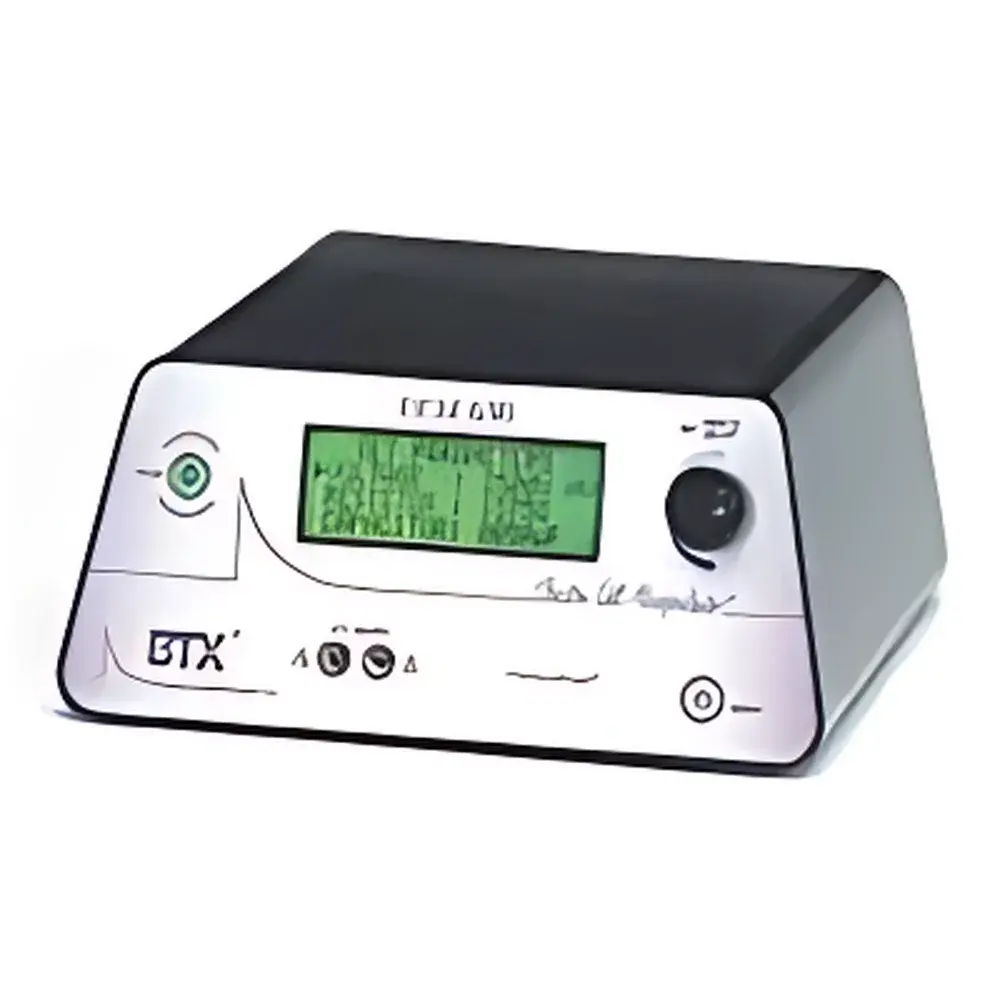
BTX ECM630 Electroporation System
| Brand | BTX |
|---|---|
| Origin | USA |
| Model | ECM630 |
| Voltage Range | 10–500 V (low-voltage mode), 50–2500 V (high-voltage mode) |
| Capacitance | 1 µF, 25–3275 µF (25 µF increments in low-voltage mode) |
| Resistance | 25–1575 Ω (25 Ω increments, high-voltage mode only) |
| Pulse Type | Exponential decay |
| Max. Current Limit | 6000 A (LV), 3000 A (HV) |
| Charge Time | ≤5 s |
| Safety | Short-circuit protection with 10 s max delay |
| Display | 20×4-character LCD |
| Dimensions | 31.8 × 31.1 × 14.0 cm (W×D×H) |
| Weight | 4.5 kg |
Overview
The BTX ECM630 Electroporation System is a precision-engineered, benchtop exponential-decay electroporator designed for reproducible and scalable molecular delivery across diverse biological systems. Operating on the principle of transient membrane permeabilization via controlled high-voltage electric pulses, the ECM630 generates precisely defined electric fields that induce nanoscale pores in cellular membranes—enabling efficient intracellular delivery of nucleic acids (DNA, RNA), proteins, peptides, antibodies, and small molecules. Unlike square-wave systems optimized for specific cell types or high-throughput applications, the ECM630’s tunable RC-based pulse architecture provides broad operational flexibility across suspension and adherent cells, prokaryotes, yeasts, plant protoplasts, and primary mammalian cultures—including human-derived cells used in functional genomics and therapeutic development. Its dual-range voltage control (10–500 V and 50–2500 V), programmable capacitance (1 µF to 3275 µF), and adjustable resistance (25–1575 Ω) allow empirical optimization of field strength (V/cm) and pulse duration (τ = R×C), critical parameters governing transfection efficiency, viability, and cargo integrity.
Key Features
- Two independent operating modes: Low-voltage (10–500 V, 1 V resolution) and high-voltage (50–2500 V, 5 V resolution) for tailored field intensity across cell types.
- Capacitance selection from 1 µF up to 3275 µF in 25 µF increments (low-voltage mode); fixed 50 µF setting in high-voltage mode for rapid, consistent bacterial/yeast transformation.
- Real-time monitoring of peak voltage (Vp) and RC time constant (τ) via integrated 20×4-character LCD display—essential for protocol documentation and GLP-compliant reproducibility.
- Digital user interface with rotary voltage selector, momentary trigger switch, and tactile power activation—designed for glove-compatible operation in biosafety cabinets.
- Integrated short-circuit protection with automatic 10-second delay cutoff; current limiting at 6000 A (LV) and 3000 A (HV) ensures instrument longevity and operator safety.
- Self-diagnostic boot sequence confirms capacitor charging integrity, circuit continuity, and display functionality prior to each use.
Sample Compatibility & Compliance
The ECM630 supports electroporation of bacteria (e.g., E. coli, H. pylori), yeasts (S. cerevisiae, H. polymorpha), plant protoplasts (tobacco, maize, wheat), insect cells, and mammalian cells—including primary human endothelial, neuronal, and lymphoid populations. It is routinely employed in protocols compliant with ISO/IEC 17025 for method validation and referenced in peer-reviewed studies adhering to NIH Guidelines for Recombinant DNA Research. While not FDA-cleared as a medical device, its design aligns with general principles of Good Laboratory Practice (GLP) and supports audit-ready data capture when paired with BTX’s optional software modules. The system accommodates standard 0.1 cm, 0.2 cm, and 0.4 cm electroporation cuvettes, coaxial electrodes (Model 747), tweezer-type electrodes (Tweezertrodes™), and specialized adherent-cell platforms (e.g., PP35-2, Epizap™)—all manufactured to USP Class VI biocompatibility standards.
Software & Data Management
The ECM630 operates as a standalone instrument but integrates seamlessly with BTX’s Electroporation Manager Software (v4.2+) for protocol archiving, parameter logging, and electronic signature-enabled audit trails. When connected via RS-232 or USB-to-serial adapter, the software records timestamped Vp, τ, capacitance, resistance, and user ID per pulse event—supporting compliance with 21 CFR Part 11 requirements for electronic records in regulated environments. Exportable CSV files enable traceability across experiments and facilitate cross-platform analysis in MATLAB, GraphPad Prism, or LIMS environments. All firmware updates are distributed through BTX’s secure customer portal and include cryptographic checksum verification.
Applications
- Bacterial & yeast transformation: Achieves >1010 cfu/µg DNA in Gram-negative strains and ≥106 cfu/µg DNA in Gram-positive species using optimized exponential decay pulses.
- Mammalian cell transfection: Delivers plasmid DNA, siRNA, mRNA, and CRISPR ribonucleoproteins into hard-to-transfect lines (e.g., NIH/3T3, COS-7, primary T cells) without chemical carriers or viral vectors.
- Protein electrodocking: Enables membrane insertion or cytosolic delivery of full-length antibodies and enzymatic proteins—quantified in publications such as J. Biol. Chem. (1998, 273:20851).
- Plant protoplast electroporation: Supports stable GUS reporter expression in maize and tobacco protoplasts; outperforms PEG-mediated methods in reproducibility and cost-per-sample.
- Adherent cell transfection (ACT): Facilitates in situ electroporation on conductive slides or multiwell plates—preserving cell morphology and eliminating trypsinization artifacts.
- High-throughput screening (HTS): Compatible with 96-well coaxial electrode arrays (Model 747/840) for parallelized cDNA library transfection and functional genomics workflows.
FAQ
What distinguishes the ECM630 from square-wave electroporators like the ECM830?
The ECM630 delivers exponential-decay pulses ideal for optimizing transfection across heterogeneous cell populations and for applications requiring fine-tuned field decay kinetics—such as protein electrodocking or primary cell work. Square-wave systems offer higher temporal precision for synchronized pulsing but narrower parameter flexibility.
Can the ECM630 be used for in vivo electroporation?
No—the ECM630 is designed exclusively for in vitro and ex vivo applications. For in vivo delivery, BTX offers dedicated systems (e.g., ECM600F with flow-through chamber) and specialized needle/tweezer electrodes validated under IACUC protocols.
Is calibration required before first use?
The ECM630 performs automated self-calibration during power-up; no external calibration tools or service visits are needed for routine operation. Annual verification using a certified oscilloscope and high-voltage probe is recommended for GLP-regulated labs.
Does the ECM630 support pulse train or multipulse protocols?
No—it generates single exponential-decay pulses per trigger. Multipulse sequences require manual repetition or integration with external timing controllers via TTL input/output ports.
What safety certifications does the ECM630 hold?
The instrument complies with UL 61010-1 (2nd Ed.), CAN/CSA C22.2 No. 61010-1, and EN 61010-1:2010 for laboratory electrical equipment. CE marking applies to the EU market; FDA registration is maintained under U.S. Establishment Identifier 3002815923.
Related Products




