LaVision FlowMaster®-surf Surface PIV System
| Brand | LaVision GmbH |
|---|---|
| Origin | Germany |
| Model | FlowMaster®-surf |
| Measurement Domain | Planar (2D/3D) |
| Measurement Frequency | Low-frequency |
| Velocity Range | 0–2 km/s |
| Accuracy | ±1% of reading |
| Field of View | Up to 1 m × 1 m |
| Camera Requirement | Dual-camera stereo configuration |
| Core Technology | Digital Image Correlation (DIC) + Stereoscopic PIV |
| Software Platform | DaVis® v8.4+ |
| Compliance | ASTM E2847, ISO/IEC 17025-compatible workflows, GLP-aligned data traceability |
Overview
The LaVision FlowMaster®-surf Surface PIV System is a specialized optical metrology platform engineered for non-intrusive, full-field quantification of surface velocity vectors and time-resolved 3D topography evolution on deformable or dynamic interfaces. Unlike conventional volumetric PIV—based on seeding and light-sheet illumination—the FlowMaster®-surf operates via stereoscopic digital image correlation (DIC) combined with surface-adapted particle image velocimetry (PIV) principles. It reconstructs in-plane and out-of-plane displacement components by tracking naturally occurring or applied surface texture features across synchronized dual-camera images. This enables simultaneous acquisition of surface-normal deformation gradients and tangential flow kinematics without requiring embedded tracers, laser sheet alignment, or complex optical access. The system is particularly suited for investigating fluid–structure interaction (FSI) at air–liquid, liquid–solid, or soft-tissue boundaries where traditional bulk-flow measurement techniques fail due to optical occlusion, low seeding density, or interfacial instability.
Key Features
- Stereoscopic dual-camera architecture optimized for surface topology reconstruction with sub-pixel displacement resolution
- Fully integrated surface flow analysis module within the DaVis® software environment (v8.4 or later), supporting automated calibration, self-consistent triangulation, and mesh-based deformation mapping
- Flexible hardware compatibility: supports standard-resolution and high-speed CMOS cameras (up to 1000 fps at full resolution), with native GenICam and GigE Vision protocol support
- Texture-agnostic correlation engine capable of processing low-contrast, non-uniform, or temporally evolving surface patterns—including wave crests, biological tissue wrinkles, and granular agglomerations
- Real-time preview and post-processing pipeline including vector validation (peak ratio, universal outlier detection), temporal filtering, and Lagrangian trajectory integration
- Calibration-free setup assistance via interactive target-guided alignment wizard, reducing commissioning time by >40% compared to manual stereo calibration protocols
Sample Compatibility & Compliance
The FlowMaster®-surf accommodates a broad range of optically accessible surfaces: free-surface water waves (capillary to gravity regimes), compliant biomedical membranes (e.g., synthetic heart valves under pulsatile flow), aerodynamic control surfaces (flaps, spoilers), and granular media undergoing shear-induced surface ripples. All measurements adhere to traceable uncertainty budgets aligned with ISO/IEC 17025 requirements for calibration laboratories. Data provenance—including camera settings, lens distortion parameters, correlation window sizes, and interpolation methods—is automatically embedded in HDF5-formatted output files. When deployed in regulated environments (e.g., medical device R&D), the DaVis® platform supports audit trails, electronic signatures, and 21 CFR Part 11-compliant user access controls upon optional license activation.
Software & Data Management
Analysis is performed exclusively within LaVision’s DaVis® software suite—a modular, scriptable platform built on Qt and Python (PyDaVis API). Surface-specific modules include SurfTrack™ for dynamic region-of-interest definition, TopoMap™ for curvature and strain tensor derivation, and TimeSync™ for phase-locked acquisition across multi-sensor experiments (e.g., synchronizing PIV with pressure transducers or force plates). Raw image sequences, processed vector fields, and 3D point clouds are stored in vendor-neutral HDF5 containers with embedded metadata (EXIF, DICOM-like headers). Batch processing scripts enable automated re-analysis across parameter sweeps (e.g., varying interrogation window size or Gaussian smoothing sigma), ensuring method reproducibility across users and labs.
Applications
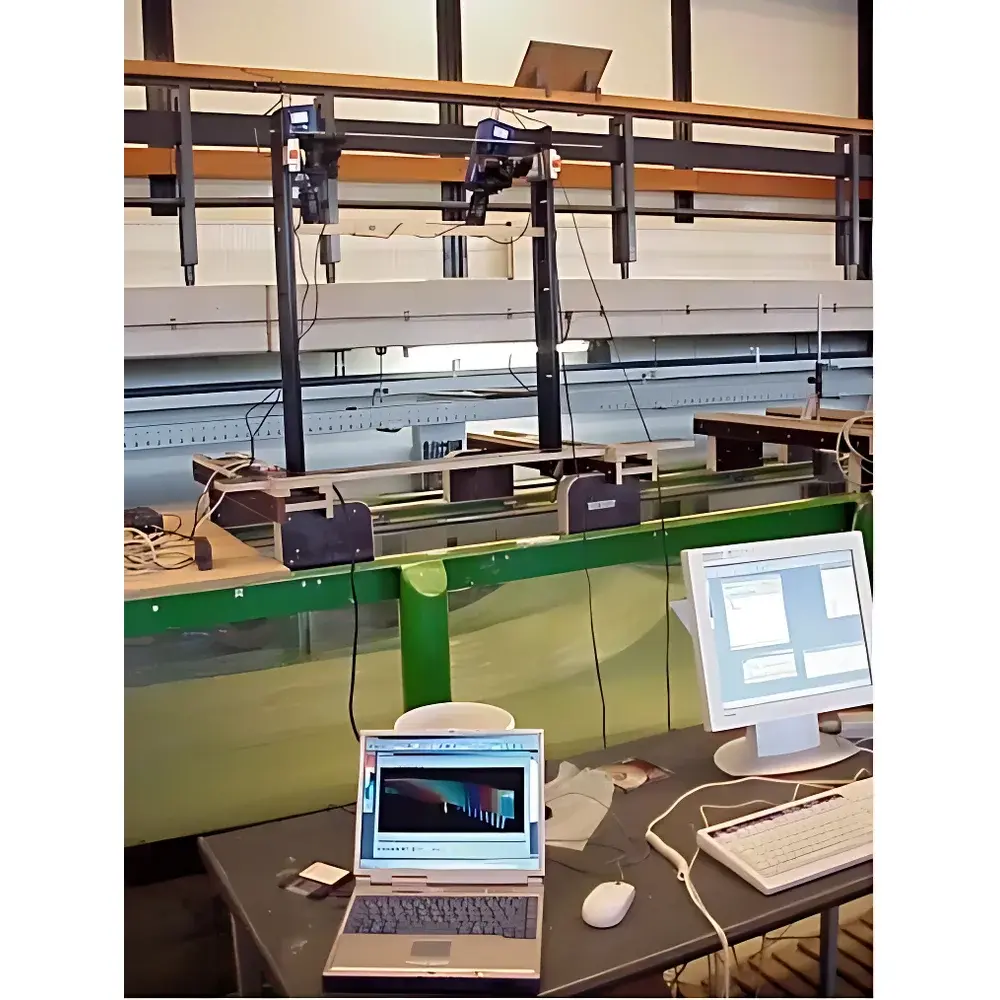
- Quantifying spatiotemporal dynamics of gravity-capillary waves and breaking wave kinematics in open-channel hydraulics
- Characterizing cyclic deformation and strain localization in bioprosthetic heart valves subjected to physiological pulsatile flow
- Mapping surface displacement fields on flexible aircraft control surfaces during wind-tunnel testing to validate FSI CFD models
- Tracking collective motion and surface buckling in dense granular flows under vibrational excitation
- Validating multiphase CFD simulations at gas–liquid interfaces by correlating predicted interfacial shear stress with measured surface velocity gradients
FAQ
Does FlowMaster®-surf require laser illumination or surface seeding?
No. It relies on ambient or structured white-light illumination and natural or applied surface texture—eliminating safety constraints associated with Class IV lasers and avoiding interference from tracer settling or refractive index mismatch.
Can it resolve out-of-plane motion with single-camera operation?
No. True 3D surface displacement reconstruction requires calibrated stereoscopic imaging; monocular operation yields only 2D in-plane components.
Is DaVis® software included with the system?
Yes. The FlowMaster®-surf is supplied with DaVis® v8.4+ including the Surface Flow Analysis Module, calibration utilities, and one year of maintenance updates.
What is the maximum usable field of view?
Up to 1 m × 1 m at 1:1 optical magnification using 25 mm focal-length lenses and 4 MP cameras; larger domains achievable via mosaic stitching with geometric registration.
How is measurement uncertainty quantified and reported?
Uncertainty propagation follows GUM-compliant methodology, incorporating pixel uncertainty, stereo triangulation error, and correlation confidence metrics; final accuracy is validated against NIST-traceable translation stages per ASTM E2847 Annex A3.