
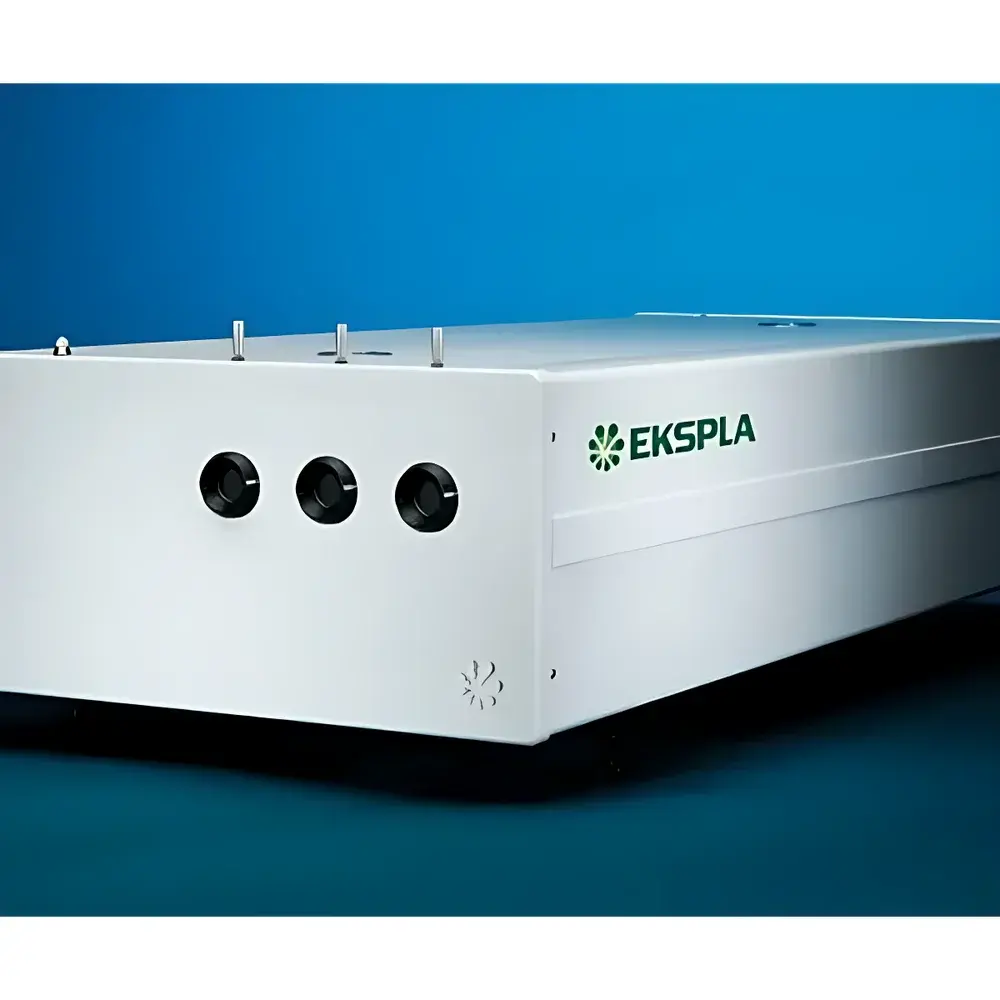
Ekspla ANL SLM Single-Longitudinal-Mode Q-Switched Nd:YAG Laser
| Brand | Ekspla |
|---|---|
| Origin | Lithuania |
| Model | ANL SLM |
| Output Wavelength | 1064 nm |
| Max Pulse Energy | 1 J |
| Repetition Rate | Up to 1 kHz |
| Pulse Duration | 2–4 ns or 5 ns (selectable) |
| Beam Profile | Spatially uniform flat-top |
| Pumping | High-efficiency diode-pumped |
| Footprint | 1 × 2 m |
| Harmonics Options | Optional 532 nm (2nd) and 355 nm (3rd) generation modules |
| Housing | Optional industrial-grade portable enclosure with integrated power supply and closed-loop cooling |
| Diagnostics | Internal real-time system diagnostics |
| Compliance | Designed for integration into ISO/IEC 17025-compliant labs and GLP/GMP environments |
Overview
The Ekspla ANL SLM is a high-performance, single-longitudinal-mode (SLM), actively Q-switched solid-state Nd:YAG laser engineered for applications demanding exceptional temporal coherence, narrow spectral linewidth (< 50 MHz), and high pulse-to-pulse stability. Operating at the fundamental wavelength of 1064 nm, it delivers up to 1 joule per pulse with repetition rates scalable from single-shot to 1 kHz—enabling both high-energy single-pulse experiments and high-throughput industrial processing. Its monolithic resonator design, combined with intra-cavity etalons and precision temperature-controlled optics, ensures stable SLM operation without mode hopping under varying thermal or mechanical loads. The laser’s flat-top spatial beam profile—achieved via optimized rod geometry, intra-cavity beam shaping, and diffraction-limited output coupling—provides uniform energy distribution across the target plane, critical for precision ablation, nonlinear frequency conversion, and pump-probe spectroscopy where intensity homogeneity directly impacts measurement fidelity.
Key Features
- Single-longitudinal-mode operation with linewidth < 50 MHz and long-term frequency stability (±0.5 pm over 8 h)
- Up to 1 J pulse energy at 1064 nm with ≤ ±1.5% pulse energy stability (RMS, 1000 shots)
- Repetition rate continuously adjustable from 1 Hz to 1 kHz, with jitter < 1 ns (rms) relative to external trigger
- Selectably tunable pulse duration: 2–4 ns (standard) or 5 ns (optimized for harmonic generation efficiency)
- Flat-top near-field beam profile (intensity uniformity > 90% across 80% of beam diameter) with M² < 1.3
- Diode-pumped architecture featuring redundant high-efficiency pump chambers, enabling > 15,000 hours mean time between failures (MTBF)
- Compact 1 × 2 m footprint laser head with modular interface for OEM integration or turnkey system deployment
- Integrated diagnostics subsystem monitoring pump diode current/voltage, cavity alignment status, crystal temperature, and Q-switch driver health
Sample Compatibility & Compliance
The ANL SLM is compatible with optically transparent, reflective, and absorptive targets—including fused silica, sapphire, silicon wafers, metallic thin films, and organic crystalline samples—without requiring active beam conditioning for most ablation or excitation protocols. Its pulse parameters meet key requirements for laser-induced breakdown spectroscopy (LIBS) per ASTM E2926-22, time-resolved photoluminescence (TRPL) per ISO 11664-7, and laser calibration standards traceable to NIST SRM 2034. The system supports full audit trail logging and user access control when operated with optional FDA 21 CFR Part 11–compliant software extensions, making it suitable for regulated QC/QA laboratories conducting material certification, thin-film metrology, or pharmaceutical excipient analysis.
Software & Data Management
Control is executed via Ekspla’s LaserStudio v4.2 platform—a Windows-based application supporting remote configuration, real-time parameter monitoring, and automated sequence scripting. All operational data—including pulse energy, repetition rate, cavity temperature, and diagnostic flags—are timestamped and exported in HDF5 format for compatibility with MATLAB, Python (h5py), and LabVIEW environments. Optional API libraries (C/C++, .NET, Python SDK) enable seamless integration into custom automation frameworks. Data integrity is preserved through SHA-256 checksums on all logged files and configurable retention policies aligned with ISO/IEC 17025 clause 7.5.2.
Applications
- Laser-induced damage threshold (LIDT) testing of optical coatings and substrates (per ISO 21254)
- Pump source for optical parametric amplifiers (OPAs) and ultrafast Ti:sapphire oscillator seeding
- Time-of-flight mass spectrometry (TOF-MS) ionization in ambient desorption and MALDI platforms
- Nonlinear optical characterization including second-harmonic generation (SHG) microscopy reference calibration
- Remote LIBS for elemental mapping in nuclear decommissioning or planetary analog studies
- High-resolution photoacoustic spectroscopy requiring narrow linewidth and low amplitude noise
FAQ
What harmonics generation options are supported?
The ANL SLM supports factory-installed or field-upgradable harmonic modules delivering 532 nm (2nd harmonic) with >45% conversion efficiency and 355 nm (3rd harmonic) with >25% efficiency, both maintaining SLM spectral purity and flat-top spatial profile.
Is the laser compliant with CE and RoHS directives?
Yes—the ANL SLM carries full CE marking (2014/30/EU EMC Directive and 2014/35/EU LVD Directive) and conforms to RoHS 2011/65/EU Annex II substance restrictions.
Can the system operate in burst mode?
Burst mode (e.g., 5 pulses @ 5 kHz within a 10 ms window) is supported via external TTL gating; internal firmware limits maximum burst duration to preserve thermal lensing stability.
What cooling infrastructure is required for continuous operation?
The standard air-cooled version operates at ambient temperatures up to 30°C; the optional integrated chiller unit maintains crystal temperature at 22 ± 0.1°C using deionized water circulation (flow rate ≥ 4 L/min, ΔT ≤ 2 K).



