
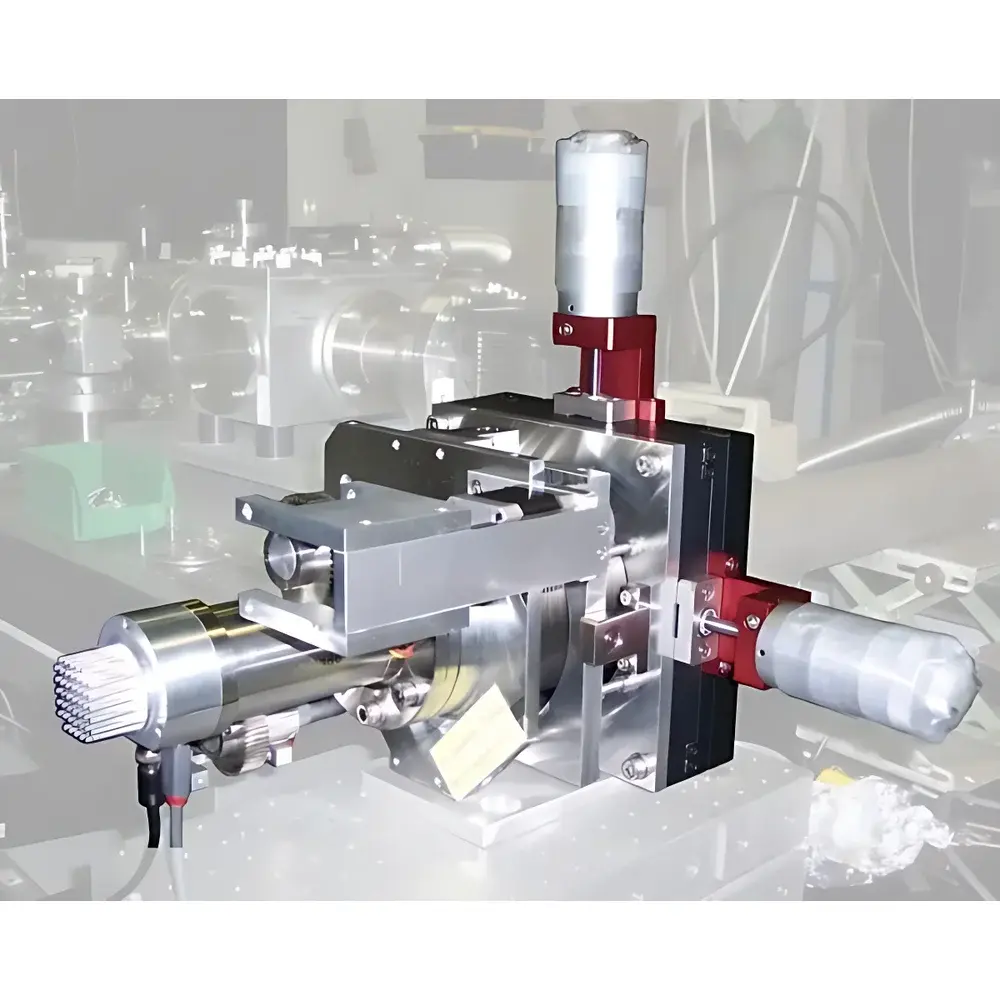
LLG EUV/XUV Hartmann Wavefront Sensor
| Brand | Laser-Laboratorium Göttingen e.V. |
|---|---|
| Origin | Germany |
| Manufacturer Type | Authorized Distributor |
| Origin Category | Imported |
| Model | LLG-EUV/XUV-S |
| Price | Upon Request |
| Wavelength Range | <1 nm to 60 nm (with quantum converter) |
| Field of View | 9.0 mm × 6.7 mm (customizable larger FOV available) |
| Dynamic Range | 14-bit |
| Hartmann Plate Pinhole Diameter | 75 µm |
| Pinhole Pitch | 250 µm |
| Tilt Adjustment Range | ±10° |
| X/Y Translation Range | ±10 mm |
| Vacuum Compatibility | UHV-compatible, mounted on CF63 flange |
| Single-Pulse Wavefront Repeatability | λ/116 rms (at λ = 13.5 nm) |
Overview
The LLG EUV/XUV Hartmann Wavefront Sensor is a precision metrology instrument engineered for quantitative, single-shot wavefront characterization of extreme ultraviolet (EUV) and soft X-ray radiation in the spectral range from <1 nm to 60 nm. Based on the well-established Hartmann test principle—where a planar or spherical wavefront is sampled via an array of precisely spaced pinholes and imaged onto a high-dynamic-range detector—the sensor delivers direct, non-interferometric phase-gradient measurements with high spatial fidelity. Unlike interferometric methods, which require coherent reference beams and are highly sensitive to environmental vibration and temporal coherence, the Hartmann approach is inherently robust for pulsed, low-coherence, and high-intensity sources such as laser-produced plasmas (LPP), free-electron lasers (FELs), and high-harmonic generation (HHG) beamlines. Its actinic operation enables in-situ, source-integrated metrology without optical replication or wavelength conversion artifacts—critical for EUV lithography source development, plasma diagnostics, and beamline commissioning in synchrotron and FEL facilities.
Key Features
- True actinic wavefront sensing across the full EUV/XUV spectrum (<1–60 nm), enabled by a quantum-converter-based detection architecture compatible with photon energies up to ~1.2 keV.
- Compact, self-supporting mechanical design with integrated UHV-compatible mounting (CF63 flange), enabling direct integration into vacuum beamlines without external support structures or alignment optics.
- Achromatic performance: no wavelength-dependent magnification or distortion; calibrated pinhole geometry ensures consistent sampling resolution across the operational band.
- High-precision Hartmann plate fabricated with 75 µm diameter pinholes on a 250 µm pitch—optimized for diffraction-limited spot formation and sub-pixel centroid accuracy at 13.5 nm.
- Real-time, closed-loop feedback capability via integrated tilt (±10°) and lateral translation (±10 mm) stages, supporting active optics alignment and adaptive correction during source operation.
- Single-pulse repeatability of λ/116 rms (measured at 13.5 nm), validated under realistic LPP and FEL pulse conditions—ensuring statistical confidence in transient wavefront analysis.
Sample Compatibility & Compliance
The LLG-EUV/XUV-S is designed for direct interaction with high-brightness, pulsed EUV/XUV sources operating in ultra-high vacuum environments (≤1×10⁻⁹ mbar). It is routinely deployed in EUV lithography R&D labs for plasma source metrology, in FEL endstations (e.g., FLASH, SCS, FERMI) for beam transport optimization, and in HHG laboratories for few-cycle pulse characterization. The sensor complies with standard UHV material outgassing requirements per ISO 10110-7 and is constructed using oxygen-free copper, stainless steel 316L, and ceramic insulators—all certified for bake-out up to 150°C. While not a regulated medical or industrial safety device, its mechanical and electrical interfaces conform to CE marking directives for laboratory equipment (2014/30/EU EMC and 2014/35/EU LVD), and its data acquisition architecture supports audit-trail-ready logging in GLP/GMP-aligned workflows when paired with compliant host software.
Software & Data Management
The sensor operates with LLG’s proprietary WaveSense™ acquisition and analysis suite (v4.2+), a cross-platform application built on Qt and Python-based scientific libraries (NumPy, SciPy, OpenCV). It provides real-time centroid fitting using Gaussian-weighted moment algorithms, Zernike polynomial decomposition (up to 36 terms), and RMS/PV wavefront error reporting with uncertainty propagation. Raw frame data are stored in HDF5 format with embedded metadata (timestamp, vacuum pressure, stage positions, pulse energy estimate if synchronized), ensuring FAIR (Findable, Accessible, Interoperable, Reusable) compliance. Export options include ASCII tables, FITS headers for astronomical interoperability, and XML schemas compatible with Tango control system integration. For regulated environments, optional FDA 21 CFR Part 11-compliant modules are available—including electronic signatures, role-based access control, and immutable audit logs—validated per IQ/OQ protocols.
Applications
- EUV lithography source development: Quantifying wavefront aberrations induced by LPP emitter geometry, collector mirror thermal deformation, and debris-induced surface degradation.
- Free-electron laser beamline commissioning: Diagnosing collective electron beam effects on photon wavefront, evaluating monochromator and focusing optic performance under high peak power.
- High-harmonic generation optimization: Correlating driver laser focus geometry, gas jet density profiles, and phase-matching conditions with output beam quality.
- Plasma diagnostics: Mapping spatially resolved phase gradients to infer electron density gradients in laser-ablated or discharge plasmas via Abel inversion.
- Optics qualification: In-situ testing of multilayer mirrors, zone plates, and grazing-incidence optics under operational flux conditions—avoiding discrepancies introduced by visible-light surrogate measurements.
FAQ
Is the sensor compatible with both pulsed and quasi-continuous EUV sources?
Yes—it is optimized for single-pulse operation but supports averaging over multiple pulses (≥10 Hz repetition rate) for improved SNR in quasi-CW configurations.
Can the field of view be customized beyond 9.0 mm × 6.7 mm?
Yes—larger FOVs (up to 25 mm × 18 mm) are available with modified Hartmann plate designs and extended detector modules; lead time increases by 8–12 weeks.
Does the system require external cooling or water lines?
No—the sensor operates passively; detector thermoelectric stabilization is internal and self-contained, with no external coolant connections required.
How is calibration traceability maintained?
Each unit ships with NIST-traceable pinhole plate certification (via SEM metrology) and factory wavefront flatness verification using a stabilized He-Ne reference interferometer adapted for EUV via Mo/Si multilayer transfer standards.
Is remote operation supported over Ethernet or fiber?
Yes—Gigabit Ethernet interface with TCP/IP command protocol (SCPI-compliant); optional fiber-optic extension kits support distances up to 100 m without signal degradation.





