
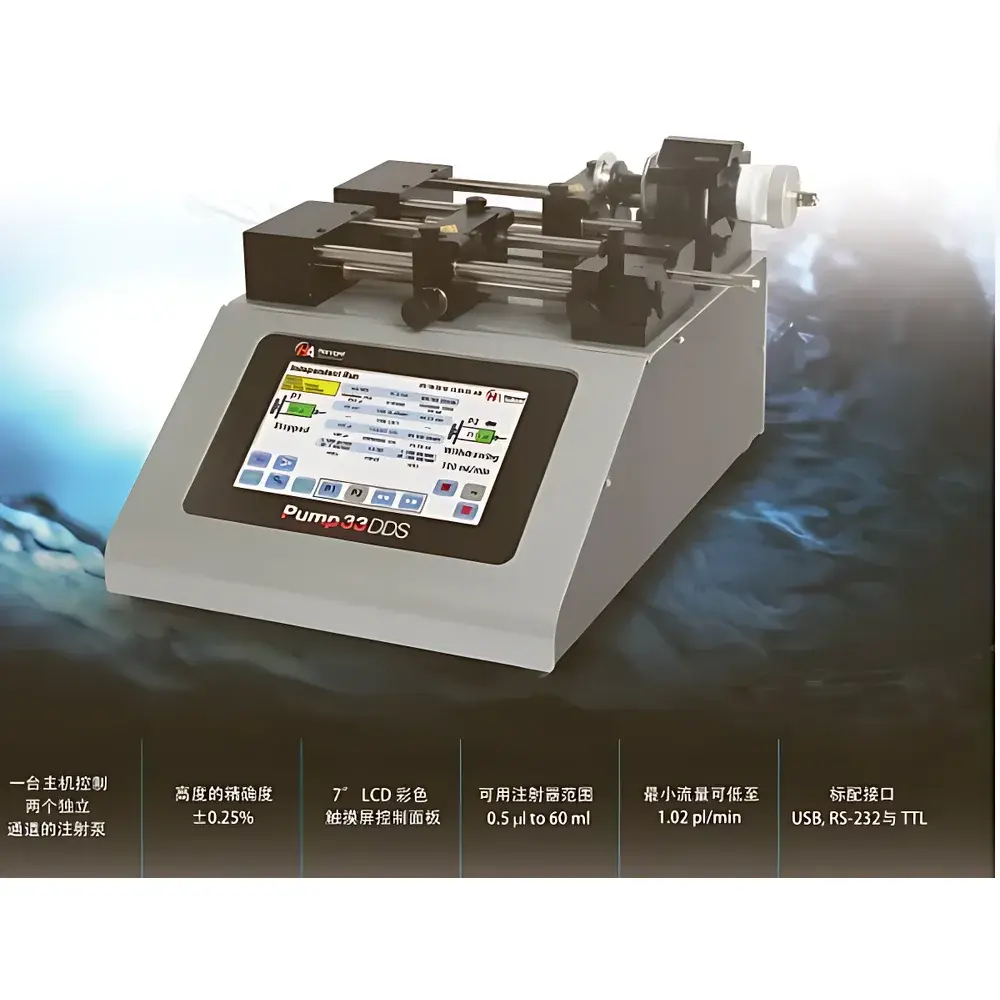
Harvard Apparatus PUMP33 DDS Dual-Channel Independent Syringe Pump
| Brand | Harvard Apparatus |
|---|---|
| Origin | USA |
| Manufacturer Type | Authorized Distributor |
| Origin Category | Imported |
| Model | PUMP33 |
| Quotation | Upon Request |
Overview
The Harvard Apparatus PUMP33 DDS (Dual Drive System) is a microprocessor-controlled, dual-channel syringe pump engineered for high-precision fluid delivery in research laboratories. It operates on the principle of linear motor-driven plunger displacement, enabling accurate volumetric or time-based dispensing through two fully independent channels (P1 and P2). Each channel features isolated control logic, allowing asynchronous operation with distinct syringe types, diameters, flow rates, target volumes, and force profiles. Designed exclusively for non-clinical, in vitro research applications—including neuroscience, pharmacokinetics, microfluidics, organ-on-chip systems, and analytical sample introduction—the PUMP33 DDS delivers exceptional repeatability and long-term stability under continuous duty cycles. Its robust mechanical architecture integrates a precision-machined syringe holder with adaptive clamping force, minimizing slippage and ensuring consistent plunger engagement across injection volumes ranging from nanoliter to milliliter scales.
Key Features
- Dual independent drive system: Two synchronized yet functionally decoupled stepper motor assemblies, each with dedicated firmware control and real-time feedback
- 7-inch full-color resistive touchscreen GUI: Intuitive graphical interface supporting multi-step program creation, parameter validation, and on-device diagnostics
- Three operational modes: Independent mode (P1/P2 operate separately), Reciprocal mode (coordinated push-pull delivery ideal for closed-loop perfusion with valve manifolds), and Synchronized mode (identical parameters across both channels for enhanced throughput)
- Wide dynamic flow range: 1.02 pL/min (with 0.5 µL glass syringe, 0.103 mm ID) to 106 mL/min (with 60 mL syringe, 32.573 mm ID), calibrated per ISO 8536-4 and ASTM D3418
- High-force linear actuation: Up to 70 lbf (31.75 kgf) peak thrust at 100% setting; optimized for viscous media and high-backpressure environments (e.g., capillary electrophoresis, HPLC sample loading)
- Comprehensive I/O infrastructure: Standard RS-232 (9-pin D-sub, bidirectional multiplexed), USB Type-B, RS-485 (for daisy-chained multi-pump networks), TTL digital I/O (15-pin D-sub per channel), and footswitch inputs
Sample Compatibility & Compliance
The PUMP33 DDS accommodates standard Luer-lock and Luer-slip syringes from all major manufacturers—including BD, Hamilton, SGE, and Ito—across a diameter range of 0.103 mm to 32.573 mm (corresponding to nominal volumes from 0.5 µL to 60 mL). Compatible materials include borosilicate glass, polypropylene, polyethylene, and stainless steel. The device complies with IEC 61010-1:2010 (Safety Requirements for Electrical Equipment for Measurement, Control, and Laboratory Use), carries CE marking per EU Directive 2014/30/EU (EMC) and 2014/35/EU (LVD), and is certified to ETL (UL 61010-1 and CSA C22.2 No. 61010-1), CB Scheme, RoHS 2011/65/EU, and WEEE 2012/19/EU. It meets Class I pollution degree and Installation Category II requirements. Not intended for use in clinical, diagnostic, or therapeutic settings per FDA 21 CFR §809.10 and ISO 13485 exclusion clauses.
Software & Data Management
The pump supports ASCII command protocol over serial and USB interfaces, enabling seamless integration with LabVIEW, MATLAB, Python (pySerial), and custom C++ applications. Remote operation includes full parameter readback, real-time status polling (e.g., position, direction, error flags), and programmable event triggers via TTL I/O lines. All user-defined protocols are stored in non-volatile memory with timestamped execution logs. While the onboard interface does not implement FDA 21 CFR Part 11-compliant electronic signatures or audit trails, its deterministic command-response architecture ensures traceability when deployed within validated GLP/GMP workflows using external data acquisition systems.
Applications
- Controlled reagent infusion in electrochemical cells and microreactors
- Sequential multi-analyte loading in mass spectrometry and LC-MS autosamplers
- Long-duration intracerebral microinfusion in rodent behavioral pharmacology studies
- Gradient generation in microfluidic concentration gradient generators
- Automated calibration standard delivery in environmental water analysis (EPA Method 525.3)
- Perfusion support for ex vivo tissue preparations (e.g., Langendorff heart, brain slices)
FAQ
Is the PUMP33 DDS suitable for sterile or GMP-compliant manufacturing environments?
No—it is designed strictly for research use and lacks documentation packages required for pharmaceutical process validation.
Can third-party syringes be used without recalibration?
Yes, provided they conform to ISO 8536 dimensional tolerances; no user calibration is required due to automatic diameter detection via encoder-based position tracking.
Does the pump support pulseless flow during reciprocal mode?
Yes—by eliminating mechanical occlusion and relying on coordinated bidirectional plunger motion, it achieves true continuous flow without pulsation artifacts typical of peristaltic pumps.
What is the maximum backpressure the system can sustain?
While not formally rated for pressure, empirical testing shows stable operation up to 100 psi with 60 mL syringes and 1/16″ PTFE tubing at ≤5 mL/min; higher pressures require pressure-rated syringes and fittings.
Is firmware upgrade capability available?
Yes—field-upgradable via USB stick using Harvard Apparatus-provided .hex files and documented bootloader procedure.



