
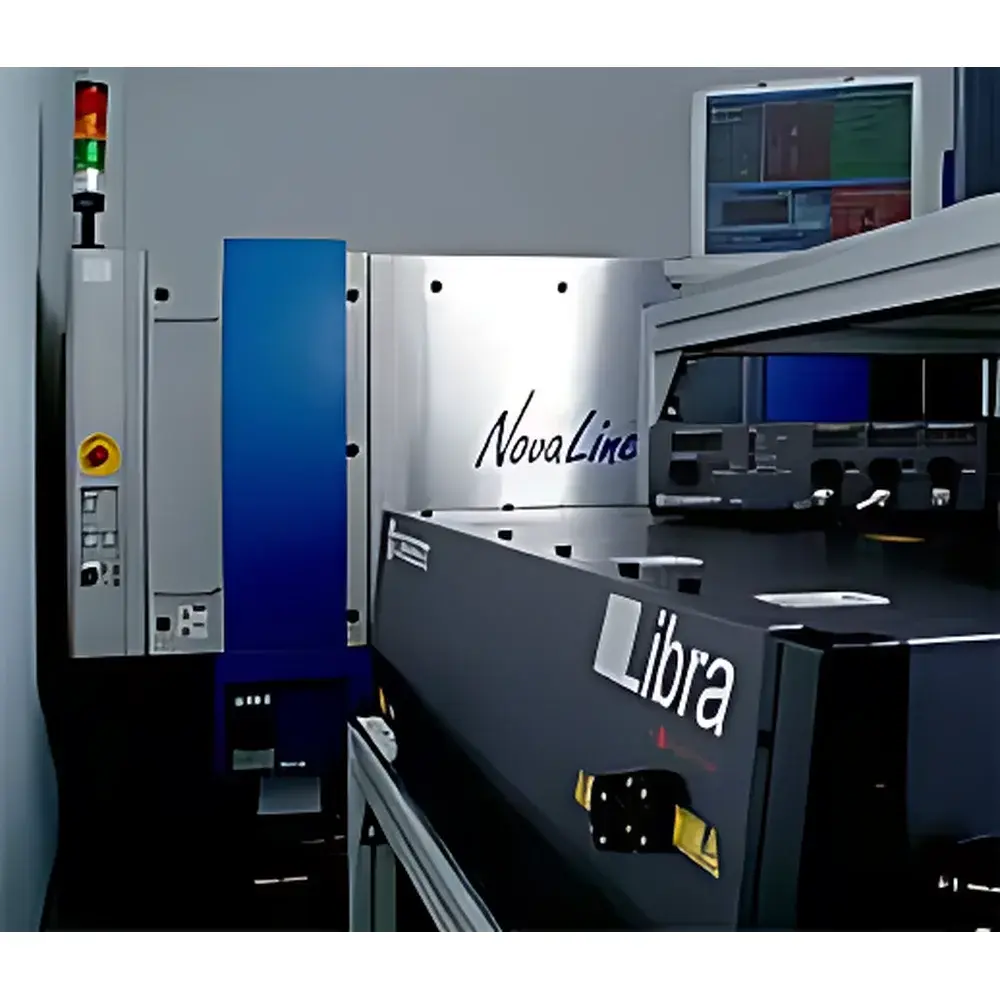
UV-fs-vario Ultraviolet Femtosecond Laser System by Laser-Laboratorium Göttingen e.V.
| Brand | Laser-Laboratorium Göttingen e.V. |
|---|---|
| Origin | Germany |
| Manufacturer Type | Authorized Distributor |
| Origin Category | Imported |
| Model | UV-fs-vario |
| Core Technology | Ti:sapphire-seeded UV femtosecond laser system with automated tripling stage |
| Central Seed Wavelength | 745.5 nm |
| Synchronization | Integrated precision timing module for long-term seed-amplifier synchronization |
Overview
The UV-fs-vario is a turnkey ultraviolet femtosecond laser system engineered for high-precision ultrafast spectroscopy, time-resolved photoelectron imaging, and nonlinear optical studies in academic and industrial research laboratories. It operates on a robust Ti:sapphire oscillator–amplifier architecture, where a commercially sourced, wavelength-stabilized Ti:sapphire oscillator serves as the seed source, emitting at a precisely controlled central wavelength of 745.5 nm. This fundamental output is subsequently frequency-tripled in a compact, vacuum-compatible, motorized third-harmonic generation (THG) stage to deliver tunable ultraviolet pulses centered at 248.5 nm (corresponding to 745.5 nm × 3). The system employs passive and active stabilization techniques—including cavity-length feedback, temperature-controlled harmonic crystal mounts, and beam-pointing correction—to ensure shot-to-shot pulse energy stability better than ±1.5% (RMS) over 8 hours. Pulse durations are maintained below 120 fs (FWHM) after compression and spectral filtering, with typical repetition rates of 1 kHz (adjustable via pulse picker), making it compatible with pump-probe experiments requiring high temporal resolution and low thermal load.
Key Features
- Integrated Ti:sapphire oscillator with active wavelength locking at 745.5 nm—optimized for efficient third-harmonic conversion and minimal group-delay dispersion.
- Automated, alignment-free THG stage incorporating β-BaB2O4 (BBO) crystals with motorized angular and translational positioning for real-time phase-matching optimization.
- Dedicated synchronization unit providing sub-10 ps jitter between seed oscillator trigger and amplifier pump diode current modulation—critical for multi-stage amplification and external experiment gating.
- Vacuum-compatible optical path design (base pressure <10−5 mbar) enabling integration into ultra-high-vacuum (UHV) end-stations for photoemission or ion imaging applications.
- Modular architecture supporting optional amplifier modules (e.g., regenerative or multipass configurations), each retaining full compatibility with the UV-fs-vario’s timing and control interface.
- Comprehensive remote operation via Ethernet-connected embedded controller with LabVIEW and Python SDK support for automated wavelength scanning, pulse energy calibration, and diagnostic logging.
Sample Compatibility & Compliance
The UV-fs-vario is designed for use with gas-phase molecular beams, solid-state photocathodes, thin-film semiconductors, and ultrafast photodetectors. Its 248.5 nm output enables direct excitation of valence-band electrons in wide-bandgap materials (e.g., SiC, AlN, diamond) and resonant transitions in atomic and small-molecular species (e.g., O, N, CO). All optical and electronic subsystems comply with IEC 60825-1:2014 (Class 4 laser safety), CE marking requirements, and EN 61000-6-3:2011 (EMC emission standards). The control firmware supports audit trails and user-access-level configuration logging—facilitating GLP-compliant experimental documentation in regulated R&D environments.
Software & Data Management
System operation is managed through the proprietary LLG Control Suite—a cross-platform application built on Qt and integrated with NI VeriStand for deterministic real-time monitoring. Key capabilities include automated THG efficiency mapping, pulse duration estimation via autocorrelation trace acquisition (via optional SHG-FROG add-on), and synchronized data capture from external detectors (e.g., MCP/TOF, CCD spectrometers). All raw and processed datasets are stored in HDF5 format with embedded metadata (wavelength, energy, delay, ambient temperature, crystal angle), ensuring FAIR (Findable, Accessible, Interoperable, Reusable) data principles. Export options include ASCII, MATLAB .mat, and standardized NeXus format for seamless integration with analysis pipelines compliant with ISO/IEC 17025-accredited labs.
Applications
- Time-resolved photoelectron spectroscopy (TR-PES) of catalytic surfaces and 2D materials under UHV conditions.
- Ultrafast UV-pump / IR-probe studies of excited-state dynamics in organic semiconductors and perovskite thin films.
- Coherent anti-Stokes Raman scattering (CARS) microscopy using UV-Raman resonance enhancement.
- Single-photon ionization mass spectrometry (SPI-MS) of reactive intermediates in combustion and atmospheric chemistry simulations.
- Calibration source for EUV metrology tools requiring stable, sub-150-fs UV pulses at 248.5 nm.
FAQ
Is the 745.5 nm seed wavelength fixed, or can it be tuned?
The oscillator is factory-locked to 745.5 nm to maximize third-harmonic conversion efficiency and minimize temporal broadening; fine-tuning within ±0.2 nm is possible via piezoelectric cavity length adjustment for phase-matching optimization.
What vacuum level is required for integration into an existing UHV chamber?
The THG stage and beam delivery optics are rated for bake-out up to 120 °C and operate continuously at base pressures ≤5×10⁻⁶ mbar; differential pumping is recommended at chamber interfaces.
Does the system support external triggering for pump-probe delay stages?
Yes—the embedded timing module provides TTL-sync outputs with programmable delay (0–100 ns, 1 ps resolution) and jitter <5 ps RMS, fully compatible with commercial mechanical and optical delay lines.
Can the UV-fs-vario be upgraded with a higher-repetition-rate amplifier?
The synchronization architecture supports amplifier modules operating at 1–10 kHz; however, thermal management and THG crystal damage thresholds must be validated per application—contact technical support for OEM integration guidance.
Is FDA 21 CFR Part 11 compliance available for pharmaceutical R&D use?
While not pre-certified, the LLG Control Suite supports electronic signatures, role-based access control, and immutable audit logs—enabling customers to implement Part 11-compliant workflows following internal validation protocols.




