
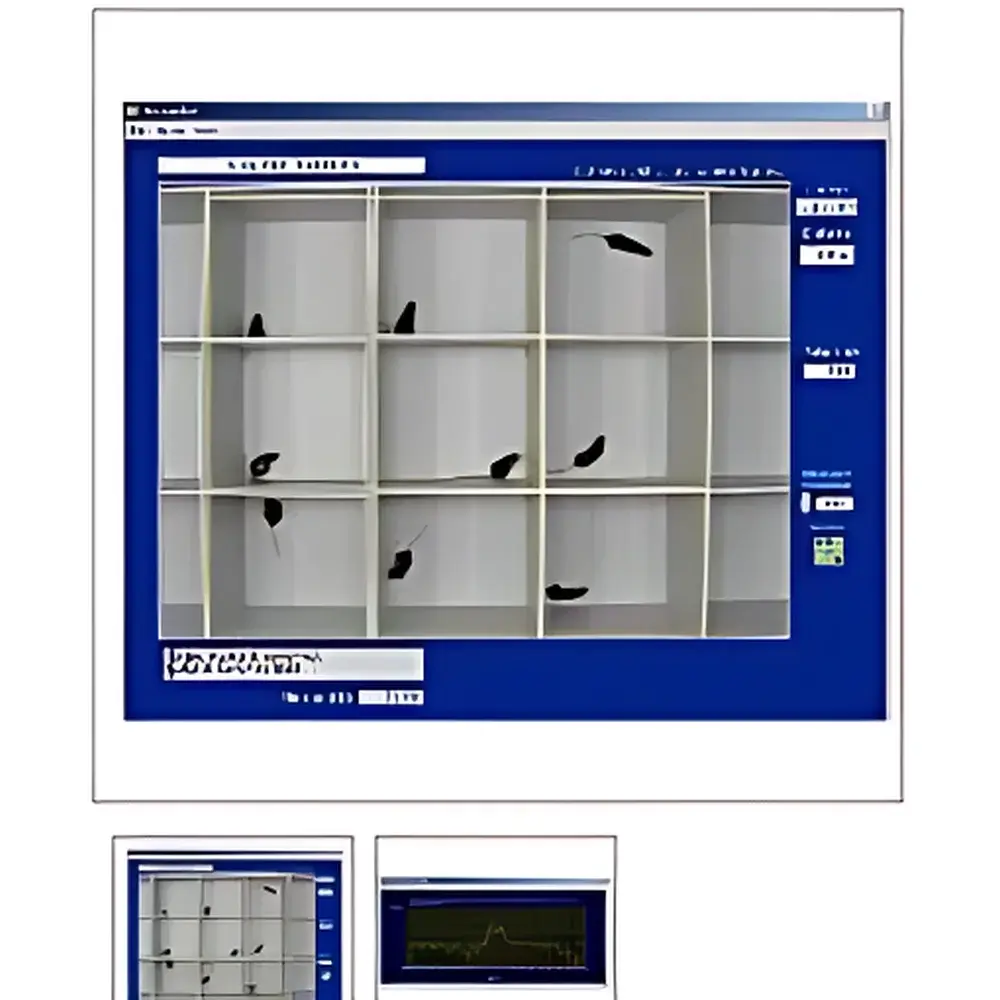
COULBOURN ACT-400 BigBrother Video-Based Activity Monitoring System for Circadian Biology and Behavioral Neuroscience
| Brand | COULBOURN |
|---|---|
| Origin | USA |
| Model | ACT-400 |
| Camera Channels | 1–4 (expandable) |
| Max Simultaneous Subjects | >200 (50+ per camera) |
| Tracking Frequency | 4 Hz per subject (subject-count dependent) |
| Data Output | CSV, Excel-compatible, ClockLab-compatible |
| Event Marking | Multi-channel timestamped annotations |
| ROI Configuration | User-defined arbitrary zones per camera view |
| IR Sensitivity | Near-infrared optimized (750–950 nm), enabling dark-phase monitoring |
| Software Platform | BigBrother Analysis Suite + ClockLab integration |
| Compliance | GLP-supportive audit trail (software-configurable), FDA 21 CFR Part 11 ready (with optional validation package) |
Overview
The COULBOURN ACT-400 BigBrother Video-Based Activity Monitoring System is a high-resolution, non-invasive behavioral phenotyping platform engineered for longitudinal quantification of locomotor activity in circadian biology, behavioral neuroscience, neuropharmacology, and chronobiological toxicology studies. Unlike legacy contact-based systems—such as wheel-running counters, infrared beam breaks, or piezoelectric sensors—the ACT-400 employs real-time computer vision algorithms to track individual subject movement across calibrated video fields. It operates on the principle of pixel-intensity-based motion segmentation and centroid tracking, delivering continuous, frame-synchronized positional data without physical tethering or environmental constraint. This architecture eliminates mechanical failure points, reduces experimental artifact from sensor misalignment or habituation, and supports true multi-subject parallelism under controlled photoperiodic conditions—including full dark-phase monitoring via integrated near-infrared (NIR) illumination compatibility.
Key Features
- High-throughput scalability: Configurable for 1–4 synchronized cameras; each camera independently tracks ≥50 subjects simultaneously, enabling total capacity exceeding 200 animals per system.
- Sub-second spatial resolution: Delivers up to 4 position updates per second per subject, with cumulative distance calculated per minute—supporting both acute behavioral response analysis and long-term rhythm profiling.
- Flexible region-of-interest (ROI) definition: Each camera field can be partitioned into user-drawn, non-overlapping zones; subjects within distinct ROIs are tracked and analyzed separately—ideal for compartmentalized assays (e.g., light/dark box, open field quadrants, multi-well zebrafish plates).
- Event annotation framework: Time-synchronized marker channels allow precise logging of pharmacological administration, light transitions, cage changes, or experimenter interventions—each event tagged with channel-specific or global timestamps.
- Infrared-optimized imaging: Cameras feature enhanced NIR sensitivity (750–950 nm spectral response), permitting unobtrusive monitoring during scotophase without visible-light contamination—critical for endogenous rhythm integrity.
- Open data architecture: Native export to CSV and Excel-compatible formats; direct interoperability with ClockLab v6+ for periodogram analysis, chi-square periodogram, FFT-NLLS, and phase-shift quantification across multi-day time series.
Sample Compatibility & Compliance
The ACT-400 supports diverse model organisms including Mus musculus (C57BL/6, BALB/c, DBA/2), Rattus norvegicus, Drosophila melanogaster (adults and larvae), Danio rerio (larval and adult stages in multi-well or tank configurations), and Caenorhabditis elegans (in agar plate or liquid assay formats). All hardware components comply with FCC Part 15 Class B and CE EMC Directive 2014/30/EU. The software environment supports GLP-aligned operation: audit-trail logging (enabled by default), electronic signature capability (with role-based access control), and configuration change history—fully compatible with FDA 21 CFR Part 11 requirements when deployed with validated installation qualification (IQ) and operational qualification (OQ) documentation packages.
Software & Data Management
The BigBrother Analysis Suite provides real-time visualization of activity heatmaps, trajectory overlays, and per-subject distance/time curves. Batch processing enables concurrent analysis of hundreds of subjects across multiple experiments. Raw coordinate data (x,y,t) is stored in structured binary archives with metadata headers (subject ID, chamber ID, timestamp, ROI assignment). Export modules generate standardized time-series files compliant with MIAME/MINSEQE metadata conventions. ClockLab integration permits automated batch fitting of circadian parameters—including tau, amplitude, acrophase, and rhythm robustness (R2 periodogram)—across cohorts. All software binaries are compiled for Windows 10/11 (64-bit), with support for network-deployed license management and centralized data repository synchronization.
Applications
- Endogenous circadian period determination in wild-type and mutant strains under constant darkness (DD) or constant light (LL)
- Phase-response curve (PRC) construction following scheduled light pulses or drug administration
- Chronopharmacokinetic assessment of CNS-active compounds (e.g., benzodiazepines, melatonin agonists, orexin antagonists)
- Developmental chronobiology studies in zebrafish larvae exposed to environmental entrainment cues
- High-content screening of genetic knockouts affecting locomotor rhythmicity or sleep-wake architecture
- Longitudinal monitoring of neurodegenerative progression in transgenic mouse models (e.g., APP/PS1, TauP301L)
FAQ
What is the minimum recommended lighting condition for reliable tracking during dark-phase experiments?
Near-infrared illumination at ≥5 µW/cm² (measured at subject plane, 850 nm peak) ensures optimal contrast without disrupting melatonin secretion or masking endogenous photoreceptor input.
Can the system distinguish between ambulation and rearing in rodents?
No—centroid-based 2D tracking does not resolve vertical dimension; rearing detection requires supplementary top-down + side-view stereo configuration or integration with depth-sensing add-ons (e.g., Intel RealSense D455, sold separately).
Is ClockLab included with the ACT-400 purchase?
ClockLab is licensed separately by ActiMetrics, LLC; however, the ACT-400 firmware and analysis suite guarantee full backward- and forward-compatibility with ClockLab v5.3 and later.
How is calibration performed for distance accuracy?
A single-pixel-to-mm conversion factor is established per camera using a printed calibration grid placed at the subject plane; the system stores this value per ROI and applies it automatically during distance summation.
Does the software support automated detection of immobility bouts?
Yes—user-definable velocity thresholds (mm/sec) trigger immobility event detection; duration, frequency, and latency metrics are exported alongside activity data.




