
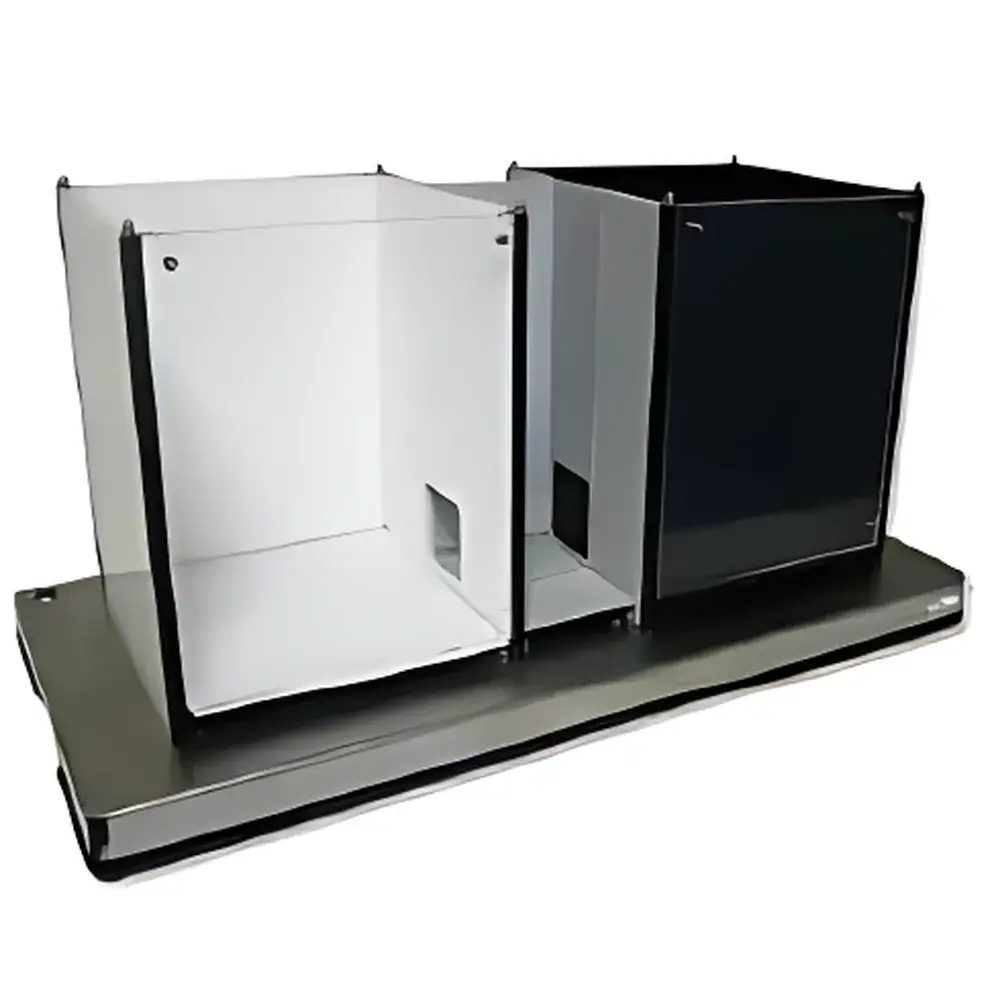
Panlab LE890/LE891 Conditioned Place Preference (CPP) Chamber System
| Brand | Harvard Apparatus |
|---|---|
| Origin | USA |
| Model | LE890 (Rat) / LE891 (Mouse) |
| Chamber Configuration | Three-compartment (Black–Gray–White) |
| Detection Method | Dual-mode (Video-based via SMART 3.0+CPP module OR Load-cell-based gravity sensing via PPCwin software) |
| Max Concurrent Units | 8 chambers per PC |
| Rat Chamber Dimensions | 300 × 300 × 340 mm (L×W×H) |
| Passage | 80 × 100 × 340 mm |
| Door Opening | 100 × 140 mm |
| Mouse Chamber Dimensions | 100 × 130 × 130 mm (L×W×H) |
| Passage | 72 × 72 × 130 mm |
| Door Opening | 60 × 60 mm |
| Wall Material | Optical-grade acrylic |
| Wall Finish | Matte black or high-gloss white |
| Floor Texture Options | Smooth or rough (tactile cue) |
| Software | SMART 3.0 Behavioral Tracking Suite with CPP Module (video mode) OR PPCwin CPP Acquisition & Analysis Software (load-cell mode) |
Overview
The Panlab LE890 (rat) and LE891 (mouse) Conditioned Place Preference (CPP) Chamber Systems are rigorously engineered behavioral neuroscience instruments designed for objective, quantitative assessment of associative learning related to pharmacological reward, aversion, or motivational state modulation. These three-compartment apparatuses operate on the foundational principle of Pavlovian conditioning: animals learn to associate distinct environmental cues—specifically visual (black vs. white walls) and tactile (smooth vs. rough floor textures)—with drug administration or neutral saline control. During testing, unbiased preference is measured as time spent and entries into each compartment, providing a validated metric for incentive salience attribution. The system supports two complementary detection modalities: high-resolution video tracking synchronized with SMART 3.0 software, or precision load-cell–based gravity sensing integrated with PPCwin acquisition firmware—both delivering timestamped, event-logged behavioral outputs compliant with preclinical research reproducibility standards.
Key Features
- Modular three-zone design: Symmetric black, gray (transition), and white compartments ensure balanced spatial bias minimization during habituation and test phases.
- Dual-sensory cue integration: Independent control of wall chromaticity (matte black / glossy white) and floor texture (smooth / abrasive) enables orthogonal manipulation of visual and somatosensory stimuli—critical for dissecting multisensory contributions to contextual memory encoding.
- Scalable acquisition architecture: Up to eight independent chambers can be monitored simultaneously via a single host PC, supporting medium-throughput longitudinal studies without hardware duplication.
- Regulatory-ready data integrity: Both SMART 3.0 and PPCwin generate audit-trail–enabled datasets—including dwell time per zone, latency to first entry, total transitions, and zone-specific entry duration—with export formats compatible with statistical packages (CSV, MATLAB .mat, Excel).
- Physically standardized dimensions: Rat (LE890) and mouse (LE891) configurations adhere to widely cited IACUC and NIH-recommended enclosure proportions, ensuring cross-laboratory comparability and compliance with institutional animal care protocols.
Sample Compatibility & Compliance
The LE890/LE891 systems are validated for use with Sprague-Dawley and Wistar rats (200–350 g) and C57BL/6, BALB/c, or CD-1 mice (20–35 g). All acrylic components meet USP Class VI biocompatibility specifications and are autoclavable for repeated sterilization between subjects. Chamber construction complies with AAALAC International facility inspection criteria for behavioral testing enclosures. Data collection workflows support GLP-aligned documentation: SMART 3.0 includes user authentication, session locking, and electronic signature fields; PPCwin maintains full parameter logging (e.g., threshold sensitivity, sampling rate, calibration date) required for FDA 21 CFR Part 11–governed toxicology programs.
Software & Data Management
Two dedicated software platforms provide methodologically distinct but functionally convergent analysis pipelines. SMART 3.0 leverages real-time centroid tracking at ≥30 fps with sub-pixel motion correction, enabling precise boundary-crossing detection even during rapid locomotion. Its CPP module computes zone-specific occupancy histograms, velocity profiles across zones, and conditional probability matrices for transition sequence analysis. PPCwin operates in closed-loop mode with calibrated load cells embedded beneath each chamber floor, detecting weight displacement with ±0.5 g resolution and temporal precision of ≤10 ms—ideal for low-mobility or sedated cohorts where video occlusion may occur. Both suites generate raw binary logs and summary reports suitable for ANOVA, mixed-effects modeling, or machine-learning–based behavioral phenotyping.
Applications
These systems serve core functions in addiction neuroscience (e.g., opioid, psychostimulant, or cannabinoid reward valuation), affective disorder modeling (anhedonia screening in chronic stress paradigms), and neuropharmacology (evaluating novel compounds’ abuse liability per FDA Guidance for Industry on Abuse Potential Assessment). They are routinely deployed in academic departments of behavioral pharmacology, contract research organizations conducting IND-enabling studies, and pharmaceutical R&D units validating target engagement in transgenic models (e.g., dopamine D3 receptor knockouts). Additional applications include extinction/reinstatement protocol implementation and cue-induced relapse modeling when paired with external stimulus delivery modules (light, tone, odor).
FAQ
What detection method is recommended for high-accuracy locomotor quantification?
Video-based tracking via SMART 3.0 is preferred for comprehensive kinematic profiling (velocity, acceleration, path curvature), while PPCwin excels in environments with limited lighting control or for cohorts exhibiting minimal movement.
Can the same software analyze both rat and mouse datasets?
Yes—SMART 3.0 automatically scales region-of-interest definitions based on selected species template; PPCwin permits manual threshold adjustment per chamber type.
Is calibration required before each experimental session?
Load-cell systems require daily zero-point calibration using certified weights; video systems require lens distortion correction only after hardware repositioning.
How is inter-chamber crosstalk prevented during multi-unit operation?
Each chamber operates on isolated USB/RS-232 channels with unique device IDs; SMART 3.0 assigns dedicated GPU threads per stream to prevent frame buffering conflicts.
Does the system support integration with third-party physiological recorders?
Yes—SMART 3.0 provides TTL pulse output synchronization and accepts external trigger inputs (e.g., from EEG, EMG, or optogenetic controllers) for temporally aligned multimodal data fusion.
Related Products




