
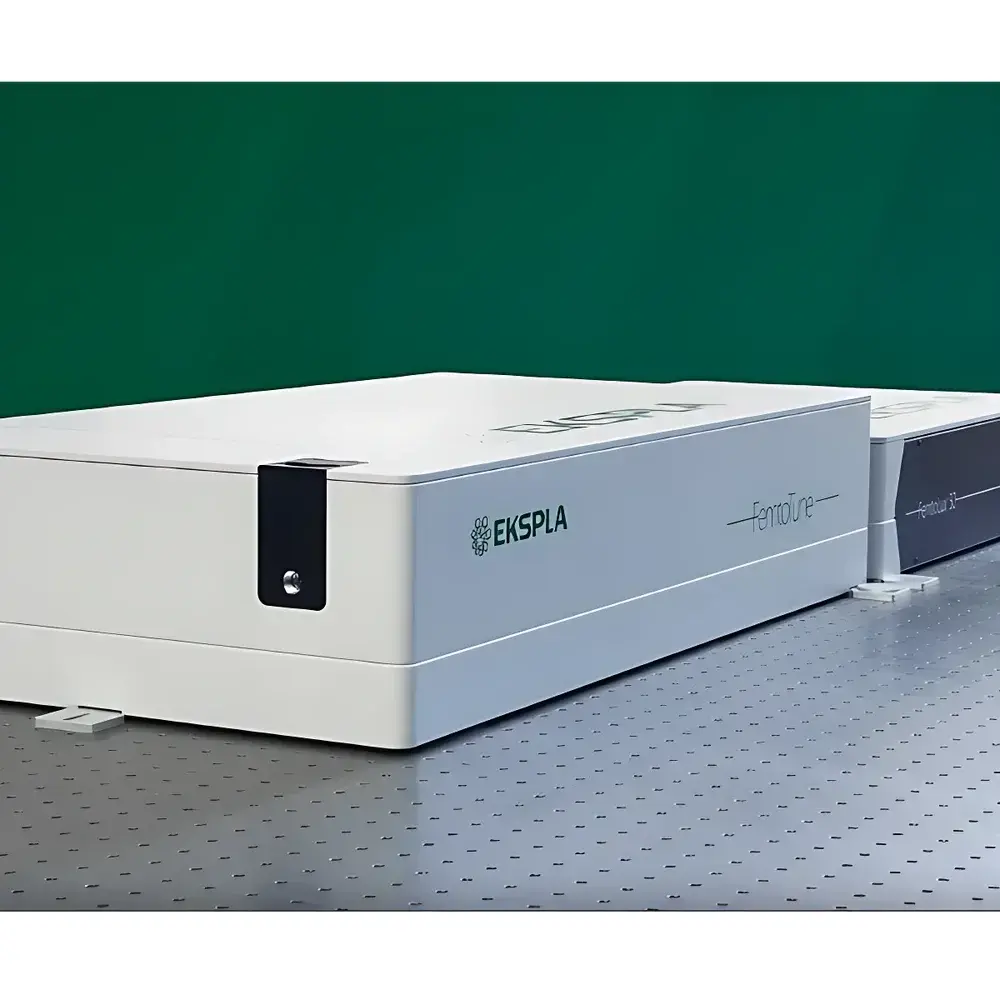
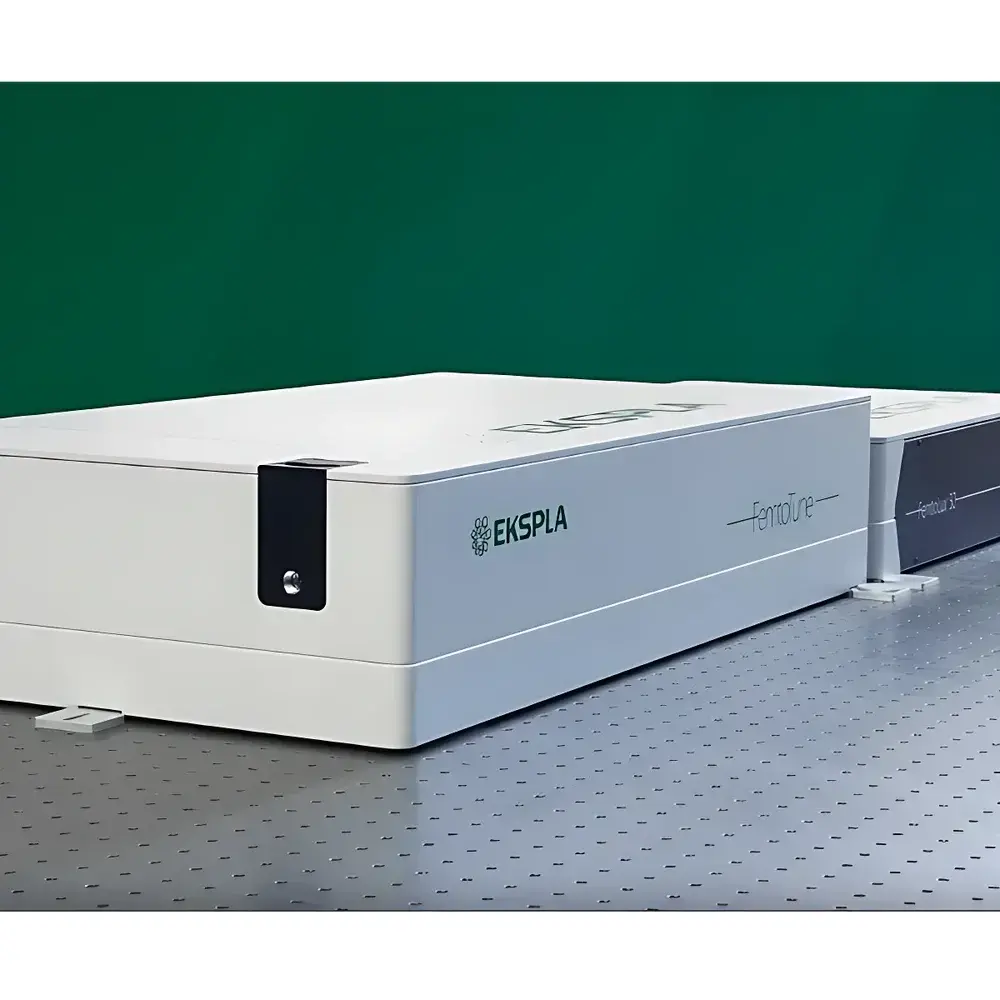
Ekspla FemtoTune Tunable Femtosecond Optical Parametric Amplifier
| Brand | Ekspla |
|---|---|
| Origin | Lithuania |
| Manufacturer Type | Original Equipment Manufacturer (OEM) |
| Product Category | Imported |
| Model | FemtoTune |
| Core Architecture | Solid-State Femtosecond Pumped Optical Parametric Amplifier (OPA) |
| Repetition Rate | Up to 100 kHz |
| Pulse Duration | < 50 fs |
| Tuning Range (Standard) | 650–950 nm & 1000–2000 nm |
| Extended Tuning Options | UV-Vis (330–470 nm, 550–650 nm), Mid-IR (2300–10,000 nm) |
| Synchronization | Fully motorized, time-synchronized wavelength tuning |
| Scan Speed | Full spectral sweep in seconds |
| Narrowband Option | Centered at 1030 nm or 515 nm, spectral bandwidth < 8 cm⁻¹ (down to < 3 cm⁻¹ with synchronized ps pump) |
Overview
The Ekspla FemtoTune is a high-repetition-rate, solid-state femtosecond optical parametric amplifier (OPA) engineered for precision ultrafast spectroscopy, nonlinear microscopy, and time-resolved coherent scattering experiments. Based on a robust, industrial-grade femtosecond pump laser platform—the award-winning Ekspla FemtoLux series—the system delivers sub-50 fs pulses at up to 100 kHz repetition rate, enabling high signal-to-noise acquisition without compromising temporal resolution. Its core architecture leverages noncollinear optical parametric amplification in beta-barium borate (BBO) and potassium titanyl phosphate (KTP) crystals, optimized for broad spectral coverage and high conversion efficiency. Unlike conventional tunable OPA systems requiring manual alignment or external pulse compression, the FemtoTune integrates automated crystal angle control, dispersion compensation, and real-time beam pointing stabilization—ensuring long-term operational stability and hands-free alignment over extended measurement campaigns.
Key Features
- Fully motorized, time-synchronized wavelength tuning across two primary bands: 650–950 nm (visible–NIR) and 1000–2000 nm (NIR–SWIR), with scan completion in under 3 seconds and point-to-point switching in < 0.5 s
- Seamless continuous tuning in the mid-infrared (2.5–10 µm) via optional difference-frequency generation (DFG) modules, supporting applications such as ultrafast vibrational spectroscopy and molecular fingerprinting
- Integrated narrowband output channel with center wavelengths at 1030 nm or 515 nm and intrinsic spectral bandwidth < 8 cm⁻¹—achievable without external pulse shaping or grating compressors
- Sub-3 cm⁻¹ bandwidth achievable when synchronized with Ekspla’s picosecond tunable pump sources, enabling dual optimization of temporal and spectral resolution for SFG, CARS, and transient absorption anisotropy measurements
- Industrial-grade mechanical design compliant with ISO 10110 optical mounting standards; all optomechanical components are vibration-damped and thermally stabilized for laboratory or cleanroom deployment
- Front-panel touchscreen interface with embedded firmware for local operation, plus full remote control via Ethernet (TCP/IP) and USB 3.0 for integration into automated experiment workflows
Sample Compatibility & Compliance
The FemtoTune is compatible with standard ultrafast experimental configurations including collinear and noncollinear pump-probe geometries, time-resolved fluorescence upconversion, and multiphoton excitation platforms. Its output beam characteristics—M² < 1.3, pointing stability < 5 µrad/°C, and pulse-to-pulse energy fluctuation < 0.5% RMS—meet requirements for quantitative ultrafast measurements under GLP-compliant protocols. The system conforms to IEC 60825-1:2014 (laser safety class 4), EN 61326-1:2013 (EMC for laboratory equipment), and supports audit-ready electronic logbook functionality for FDA 21 CFR Part 11 compliance when used with validated third-party data acquisition software.
Software & Data Management
Ekspla provides the FemtoTune Control Suite—a cross-platform application (Windows/Linux/macOS) supporting real-time parameter logging, script-based sequence execution, and hardware synchronization with external devices (e.g., delay stages, detectors, spectrometers). All wavelength, energy, and timing settings are timestamped and stored in HDF5 format, ensuring traceability and compatibility with Python-based analysis pipelines (NumPy, SciPy, h5py). Optional API bindings (C/C++, Python, MATLAB) enable direct integration into LabVIEW, Igor Pro, or custom experiment orchestration frameworks. Firmware updates are delivered via secure HTTPS with cryptographic signature verification.
Applications
- Ultrafast transient absorption and stimulated Raman spectroscopy (TRTS, SRS) across visible to mid-IR domains
- Coherent anti-Stokes Raman scattering (CARS) and sum-frequency generation (SFG) microscopy for label-free chemical imaging of biological tissues and polymer interfaces
- Time-resolved photoelectron spectroscopy (TR-PES) and high-harmonic generation (HHG) seeding in attosecond science facilities
- Nonlinear optical characterization of 2D materials, perovskites, and quantum dots under controlled pump fluence and spectral selectivity
- Mid-IR pump-probe studies of lattice dynamics, phonon lifetimes, and carrier relaxation in semiconductors and correlated oxides
FAQ
What is the minimum pulse duration achievable across the entire tuning range?
The system maintains < 50 fs pulse duration across the primary 650–950 nm and 1000–2000 nm bands. In extended mid-IR regions (2.5–10 µm), pulse durations are typically 80–120 fs due to material dispersion constraints, but remain transform-limited and fully characterized with autocorrelation and FROG diagnostics.
Can the FemtoTune be integrated with existing ultrafast laser infrastructure?
Yes. It accepts external synchronization signals (TTL or sine wave) at 1–100 kHz and provides programmable trigger outputs for delay generators, gated detectors, and camera shutters. Standard 3U rack-mount chassis facilitates co-location with Ti:sapphire oscillators or fiber-based pump lasers.
Is spectral calibration traceable to NIST standards?
Wavelength calibration is performed using HeNe and Hg/Ar lamp references during factory acceptance testing, with user-accessible recalibration routines. Spectral accuracy is ±0.2 nm in visible/NIR and ±2 nm in mid-IR (2.5–10 µm), certified per ISO/IEC 17025-accredited procedures.
What maintenance is required during routine operation?
The system is designed for zero-user-maintenance operation. No optical realignment, gas replenishment, or consumable replacement is needed. Annual preventive maintenance includes thermal drift verification, timing jitter measurement, and firmware validation—performed remotely or on-site by Ekspla-certified engineers.



