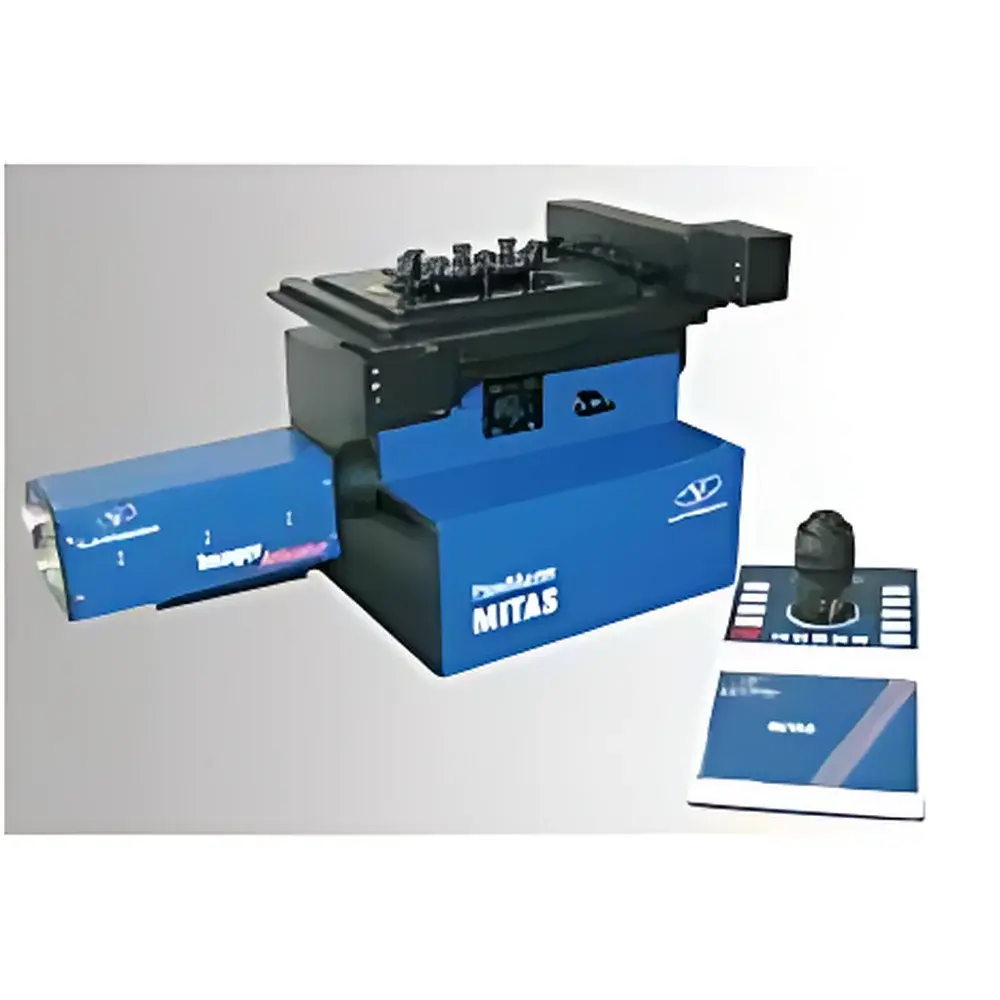
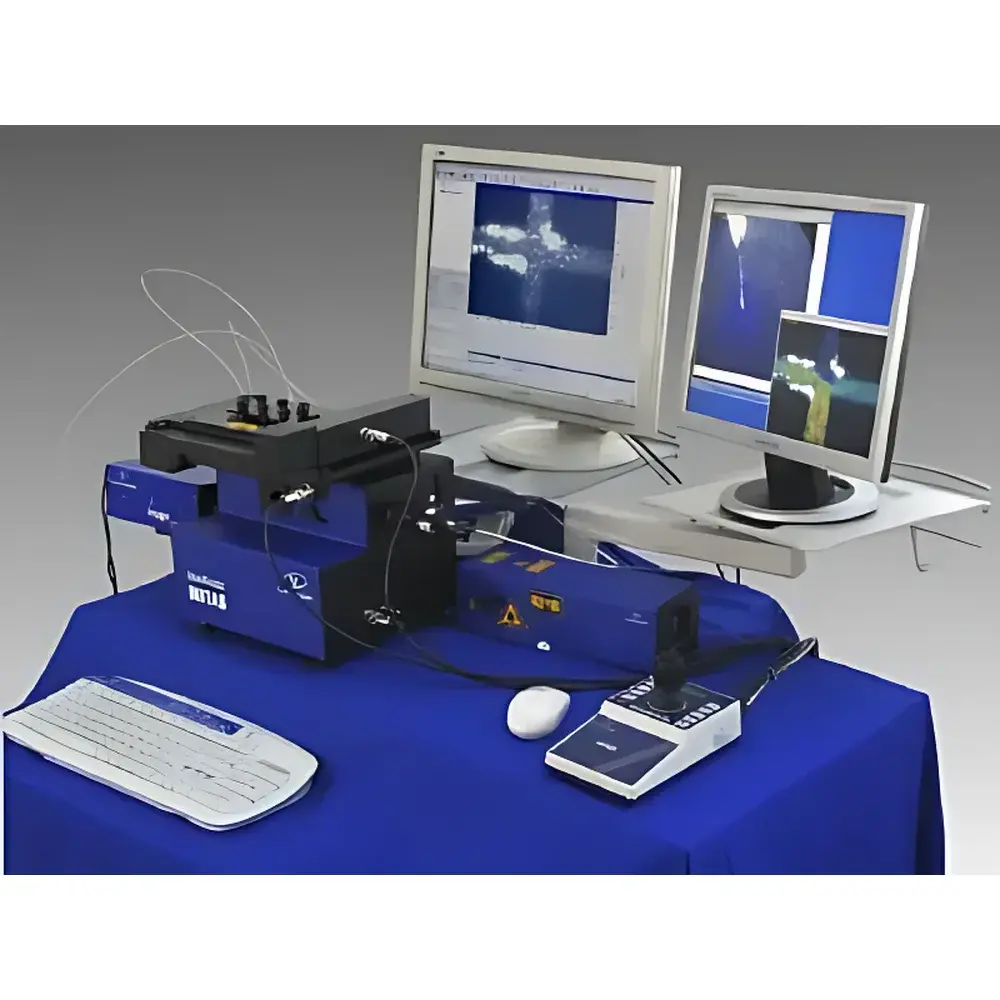
FlowMaster®-Mitas Laser-Based Tomographic Micro-PIV System
| Brand | LaVision GmbH |
|---|---|
| Origin | Germany |
| Model | FlowMaster®-Mitas |
| Measurement Domain | Planar (2D/3D) |
| Measurement Frequency | Low-Frequency |
| Velocity Range | 0–20 m/s |
| Accuracy | ±1% |
| Measurement Field Size | 0–1 mm |
| Microscope Objective Magnification | 5×–40× |
| CCD Resolution | 1376 × 1040 pixels |
| Quantum Efficiency | 65% @ 500 nm |
| Interframe Time (min) | 500 ns |
| Spatial Resolution (XYZ Stage) | 0.05 µm |
| Positioning Accuracy (XYZ Stage) | ±3 µm |
| Travel Range (X/Y) | 120 mm |
| Travel Range (Z) | 20 mm |
| Sample Opening | 84 × 70 mm |
Overview
The FlowMaster®-Mitas is a high-precision, laser-based tomographic micro-particle image velocimetry (micro-PIV) system engineered for quantitative fluid velocity field characterization at microscopic scales. Unlike conventional macro-PIV systems relying on single-plane illumination and 2D cross-correlation, the FlowMaster®-Mitas integrates a motorized three-axis translational stage with synchronized pulsed laser illumination and multi-frame CCD imaging to enable volumetric (3D) reconstruction of flow structures within confined domains—such as microfluidic channels, porous media, or biological capillaries. Its core measurement principle is based on time-resolved double-pulse laser sheet illumination combined with stereoscopic or tomographic reconstruction algorithms applied to particle-seeded flow fields. The system leverages LaVision’s proprietary DaVis software platform for hardware synchronization, image acquisition, and vector field computation using advanced iterative multigrid cross-correlation and volume self-calibration techniques.
Key Features
- Motorized XYZ translation stage with sub-micron repeatability (±3 µm accuracy, 0.05 µm resolution) and large travel range (X/Y: 120 mm; Z: 20 mm), enabling precise positioning and reproducible re-acquisition across multiple experimental sessions.
- Integrated DPSS pulsed laser source coupled via optical fiber to the microscope head, delivering stable, low-jitter illumination synchronized with camera exposure timing.
- Dedicated long-working-distance, flat-field fluorescence objectives (5×–40× magnification) optimized for high numerical aperture and minimal spherical aberration in aqueous and index-matched environments.
- High-sensitivity interline CCD camera (1376 × 1040 pixels, 65% QE at 500 nm) capable of dual-frame acquisition with minimum interframe intervals down to 500 ns—supporting velocity measurements up to 20 m/s under standard 5× objective configuration.
- Modular optical filter box for flexible spectral separation of excitation and scattered light, compatible with various fluorescent tracer particles (e.g., Rhodamine B, FITC-labeled beads) and non-fluorescent seeding agents.
- Onboard LED navigation light and real-time focus-assist functionality for rapid alignment and depth-of-field optimization during setup.
Sample Compatibility & Compliance
The FlowMaster®-Mitas supports transparent, semi-transparent, and optically cleared samples mounted on standard glass slides or custom microfluidic chips with accessible optical ports. It is routinely deployed in applications requiring conformance with ISO/IEC 17025-compliant calibration practices, ASTM D7565 for microfluidic flow validation, and GLP-aligned experimental protocols. While not intrinsically certified for FDA 21 CFR Part 11, its DaVis software architecture supports audit-trail logging, user access control, and electronic signature modules—facilitating integration into regulated R&D environments where traceability and data integrity are mandated.
Software & Data Management
LaVision’s DaVis software serves as the unified control and analysis environment for the FlowMaster®-Mitas. It provides real-time hardware synchronization between laser pulses, camera triggers, and stage motion; supports batch acquisition across predefined position lists; and enables post-processing via adaptive window deformation, sub-pixel peak fitting, and 3D tomographic reconstruction (using MART or MLOS algorithms). All raw images, metadata, and processed vector fields are stored in HDF5 format with embedded calibration parameters and timestamped provenance records—ensuring full FAIR (Findable, Accessible, Interoperable, Reusable) data handling per modern scientific infrastructure standards.
Applications
- Quantitative mapping of laminar and transitional flows in microchannels (e.g., lab-on-a-chip devices, fuel cell flow plates).
- Velocity profiling across pore throats in synthetic and natural porous media for reservoir engineering and filtration studies.
- In vivo hemodynamics analysis in zebrafish embryos or mouse retinal vasculature using fluorescent microspheres.
- Validation of CFD simulations at micrometer-scale Reynolds numbers (Re < 100).
- Time-resolved vortex shedding and boundary layer development in MEMS-scale actuators and thermal management systems.
FAQ
What is the minimum resolvable velocity gradient in micro-PIV mode?
The system achieves spatial velocity resolution down to ~0.1 pixel displacement per interrogation window, translating to local gradient resolution dependent on seeding density and interrogation window size—typically < 100 s⁻¹ in 5× objective configuration.
Can the FlowMaster®-Mitas perform time-resolved 3D-3C measurements?
Yes—when configured with dual-camera stereoscopy or multi-view tomography and appropriate pulse sequencing, it delivers volumetric three-component velocity fields at frame rates limited by laser repetition rate and camera readout speed.
Is calibration traceable to national metrology institutes?
Stage positioning is factory-calibrated against interferometric references; PIV scale calibration uses NIST-traceable micrometer rulers or diffraction gratings—full uncertainty budgets can be generated per ISO 5725 guidelines.
Does the system support automated focus stacking for extended depth-of-field reconstruction?
Yes—the DaVis Stage Manager allows scripted Z-series acquisition with auto-focus routines, enabling volumetric image stacks for subsequent deconvolution or light-field PIV processing.
Are third-party objective lenses supported?
The system accepts standard RMS-threaded objectives; however, optimal performance—including telecentricity, working distance, and chromatic correction—is guaranteed only with LaVision-qualified long-working-distance fluorescence objectives.