
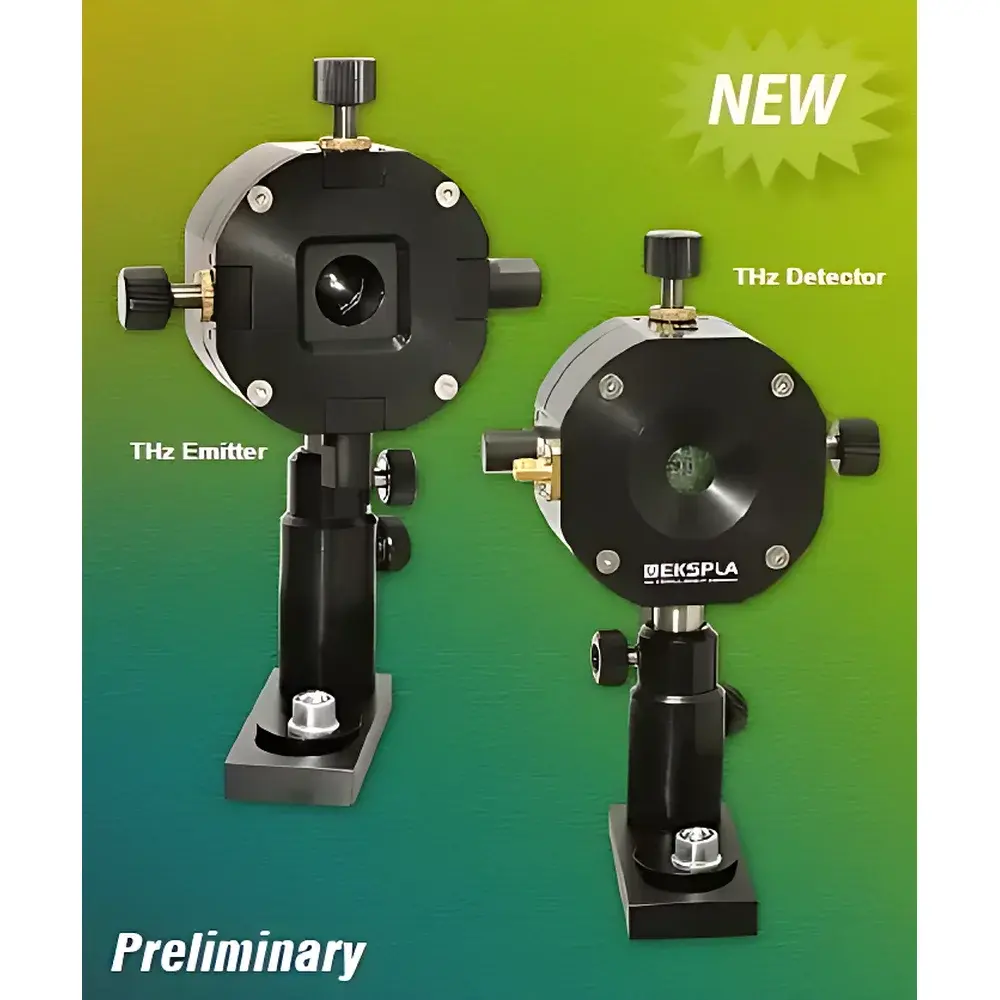
Ekspla THz-1000 Laser-Driven Terahertz Emitter and Detector System
| Brand | Ekspla |
|---|---|
| Origin | Imported (Lithuania) |
| Model | THz-1000 |
| Wavelength Compatibility | 1030 nm and shorter (optimized for 1000 nm pump) |
| Emitter Material | Low-Temperature-Grown GaBiAs |
| Detector Material | GaBiAs Epitaxial Layer |
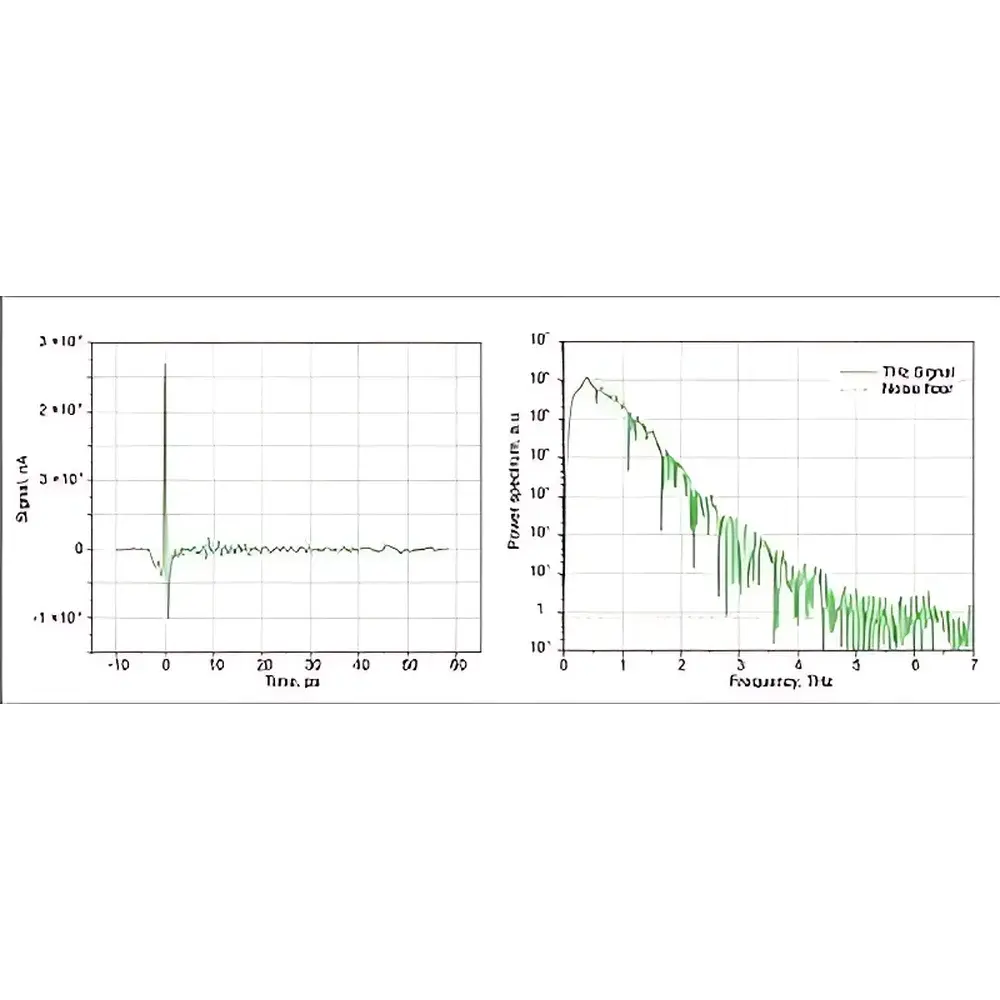
| Spectral Range | 0.2–5 THz |
| Emitter Antenna | Coplanar Hertzian dipole, 70 µm arm width, 20 µm photosensitive gap |
| Detector Electron Mobility | ~5000 cm²/V·s |
| Detector Carrier Lifetime | < 0.5 ps |
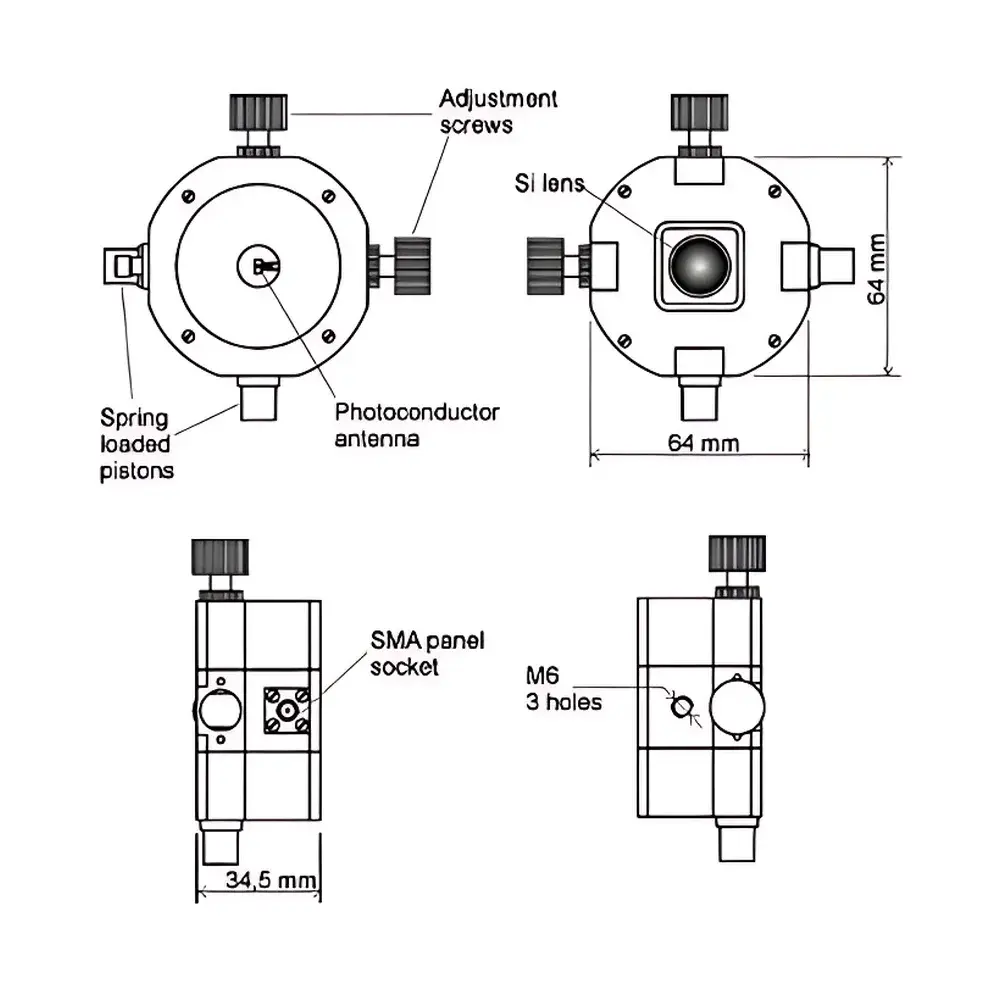
| Integrated Optics | Hemispherical high-resistivity silicon lens (Ø15 mm) |
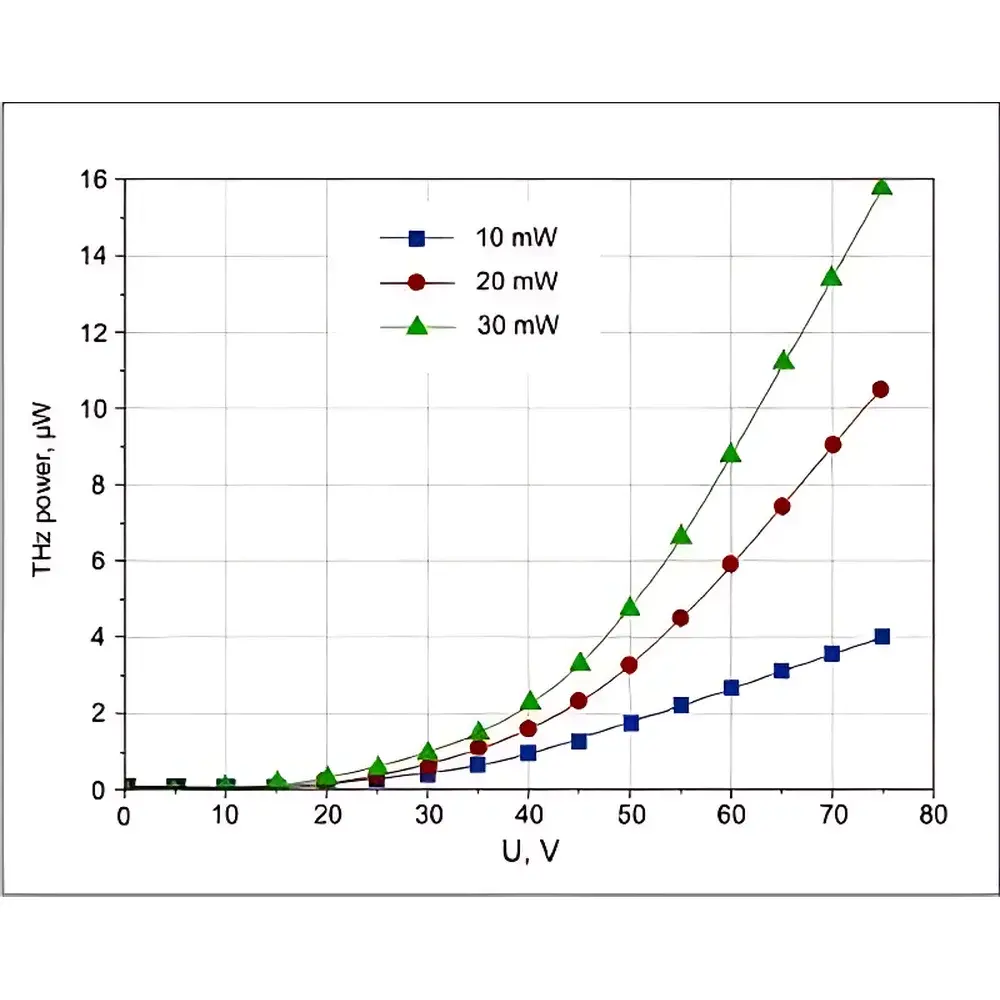
| Bias Voltage Range (Emitter) | Adjustable DC bias (typ. 0–30 V) |
| THz Power Conversion Efficiency | 7×10⁻⁴ |
| Detector Mounting | In-plane micro-positioning optomechanical holder with SMA RF output |
| Compliance | Designed for ultrafast laser-driven THz time-domain spectroscopy (TDS) systems |
Overview
The Ekspla THz-1000 is a fully integrated, laser-driven terahertz (THz) emitter and detector system engineered for high-fidelity time-domain spectroscopy (TDS) and coherent imaging applications. It operates on the photoconductive principle: ultrashort optical pulses—typically from fiber-based or solid-state femtosecond lasers emitting at 1000 nm or shorter wavelengths (e.g., 1030 nm Yb-doped systems)—illuminate low-temperature-grown gallium bismide arsenide (LT-GaBiAs) active layers, generating and detecting broadband THz transients via transient photocurrents in coplanar antenna structures. Unlike conventional LT-GaAs emitters, the GaBiAs material platform offers significantly enhanced optical absorption at 1000–1060 nm, enabling efficient excitation with low-average-power (<50 mW), cost-effective fiber lasers—eliminating the need for Ti:sapphire or OPO-based pump sources. The system delivers a usable spectral bandwidth spanning 0.2 to 5 THz, with phase-coherent detection capability essential for quantitative dielectric property extraction and layered-material depth profiling.
Key Features
- Optimized LT-GaBiAs photoconductive architecture for 1000–1060 nm pump lasers—enabling compatibility with industrial-grade femtosecond fiber laser systems
- Emitter integrates a monolithic coplanar Hertzian dipole antenna (70 µm arm width, 20 µm gap) fabricated on mesa-etched GaBiAs epilayer to maximize dark resistance (>10⁶ Ω) and simplify optical alignment
- Detector features ultrafast carrier dynamics (<0.5 ps electron lifetime) and high electron mobility (~5000 cm²/V·s), yielding broad-band sensitivity from 200 GHz to 5 THz
- Integrated hemispherical high-resistivity silicon lens (Ø15 mm) mounted directly to both emitter and detector chips for efficient THz collimation and coupling
- Optomechanical housing with in-plane micropositioning stage ensures sub-10 µm alignment precision between laser focus, antenna gap, and THz beam path
- DC-biased emitter design supports stable, reproducible THz generation across variable bias voltages (0–30 V); measured optical-to-THz power conversion efficiency reaches 7×10⁻⁴—exceeding standard LT-GaAs benchmarks by >3×
Sample Compatibility & Compliance
The THz-1000 is designed for non-contact, non-ionizing characterization of dielectrics, semiconductors, polymers, pharmaceutical tablets, and layered composites. Its broadband output enables thickness mapping, crystallinity assessment, and hydration analysis without sample preparation. The system complies with standard laboratory safety protocols for Class IV laser operation (when integrated with external fs-laser sources) and conforms to electromagnetic compatibility (EMC) directives per IEC 61326-1. While not a standalone analytical instrument, it is validated for use in GLP-compliant THz-TDS configurations when paired with traceable delay-stage controllers and calibrated reference standards (e.g., polyethylene, quartz). Data acquisition workflows support audit-trail generation compatible with FDA 21 CFR Part 11 requirements when implemented within validated software environments.
Software & Data Management
The THz-1000 operates as a hardware module within third-party THz-TDS control platforms (e.g., TeraView’s TeraPulse, Menlo Systems’ Tera K15, or custom LabVIEW/Matlab-based acquisition suites). It outputs analog THz waveforms via SMA-connected low-noise amplifiers, supporting digitization at ≥100 MS/s sampling rates. Raw time-domain traces are processed using standard Fourier transform algorithms to extract amplitude/phase spectra. Built-in lens positioning and bias control interfaces enable automated parameter sweeps (e.g., voltage-dependent emission studies or polarization-resolved measurements). Export formats include HDF5, MAT, and CSV—ensuring interoperability with spectroscopic databases and machine learning pipelines for spectral classification or anomaly detection.
Applications
- Terahertz time-domain spectroscopy (THz-TDS) for complex permittivity extraction of thin films and bulk materials
- Non-destructive testing (NDT) of polymer coatings, paint layers, and composite laminates
- Pharmaceutical solid-state analysis: polymorph identification, tablet coating uniformity, and API distribution mapping
- Ultrafast carrier dynamics studies in 2D materials (e.g., graphene, TMDCs) via optical pump–THz probe configurations
- Security screening: concealed object detection through non-polar packaging materials
- Plasma diagnostics and semiconductor wafer metrology in research cleanrooms
FAQ
What laser specifications are required to drive the THz-1000 emitter?
A femtosecond laser with central wavelength ≤1060 nm, pulse duration <150 fs, repetition rate 10–100 MHz, and average power ≥20 mW is recommended. Fiber lasers (e.g., Yb-doped) are fully compatible.
Can the THz-1000 be used in vacuum or cryogenic environments?
The standard optomechanical housing is rated for ambient air operation. Custom vacuum-compatible versions with CF flanges and low-outgassing materials are available upon request.
Is the detector sensitive to polarization state of incident THz radiation?
Yes—the coplanar antenna geometry provides linear polarization sensitivity aligned with the dipole axis; rotation of the detector mount enables full polarization-resolved measurements.
How is calibration performed for quantitative spectroscopy?
Calibration requires reference measurements using known THz-transparent standards (e.g., high-resistivity silicon wafers or polyethylene slabs) and deconvolution of system impulse response using established TDS post-processing methods.
Does the system support synchronization with external delay stages or pump-probe triggers?
Yes—SMA TTL sync inputs/outputs are provided for precise timing coordination with mechanical delay lines, optical choppers, or secondary laser systems.





