
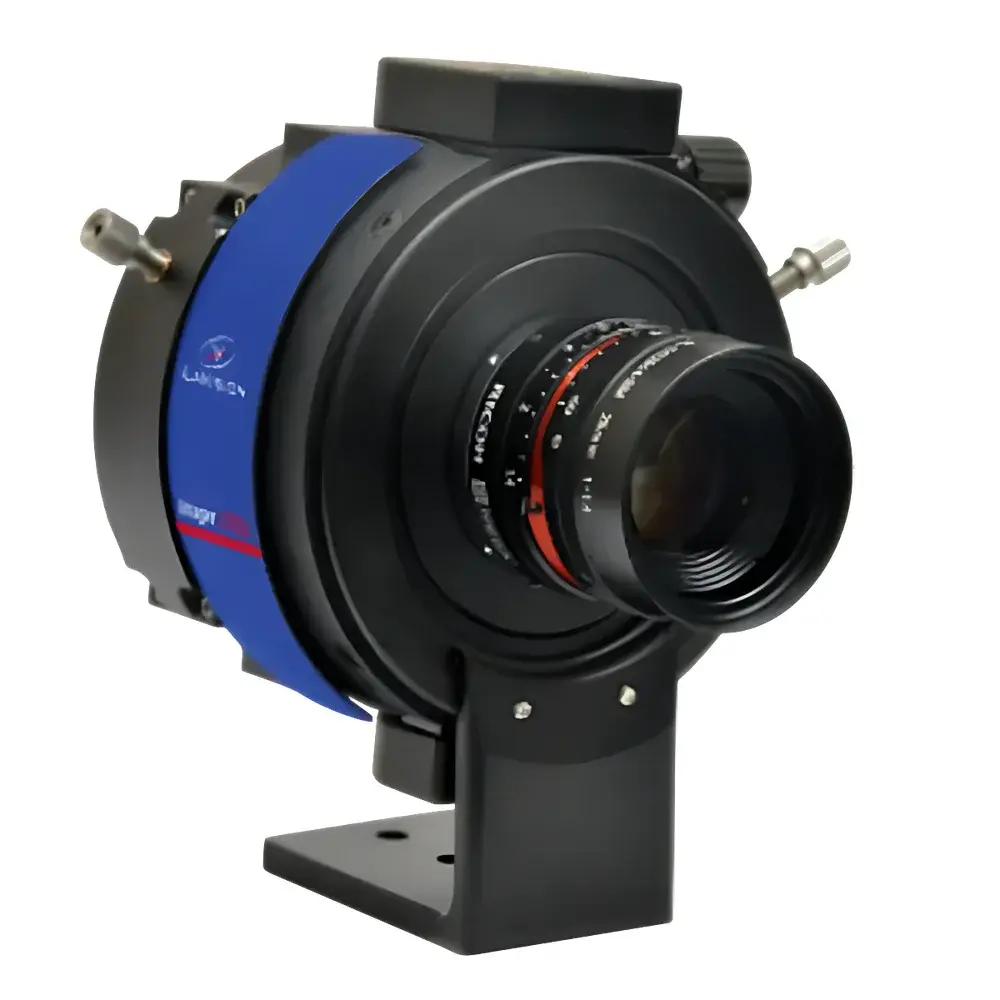
LaVision imager CX3p CMOS Camera
| Brand | LaVision GmbH |
|---|---|
| Origin | Germany |
| Model | imager CX3p |
| Image Resolution | 5312 × 4608 |
| Pixel Size | 54 µm × 54 µm |
| Sensor Dimensions | 14.6 mm × 12.6 mm |
| Readout Speed | 96 Hz |
| Dynamic Range | 12-bit |
| Quantum Efficiency | ~70% @ 510 nm |
Overview
The LaVision imager CX3p is a high-performance scientific CMOS camera engineered for precision optical imaging in demanding experimental environments—particularly in planar laser-induced fluorescence (PLIF), particle image velocimetry (PIV), schlieren imaging, and other quantitative flow visualization applications. Its core architecture integrates a large-format, low-noise CMOS sensor with an optomechanically optimized Scheimpflug mount, enabling rigorous alignment control between the imaging plane, lens focal plane, and object plane. This design directly addresses the fundamental challenge of achieving sharp, distortion-free focus across non-parallel or tilted sample geometries—such as flame fronts, shock waves, or microfluidic channels—without requiring custom optics or iterative mechanical realignment. The imager CX3p operates on the principle of Scheimpflug condition compliance: by allowing independent adjustment of sensor tilt, rotation, and angular orientation relative to the lens axis, it ensures that the object plane, lens plane, and sensor plane intersect along a common line—maximizing depth of field and spatial fidelity in off-axis or inclined-field configurations.
Key Features
- Integrated three-axis Scheimpflug mounting system with independent tilt, rotation, and sensor orientation adjustments—enabling rapid, repeatable optical alignment without disassembly.
- High-resolution 5312 × 4608 active pixel array with uniform 54 µm × 54 µm square pixels, delivering a physical sensor area of 14.6 mm × 12.6 mm for wide-field coverage and minimal magnification constraints.
- Real-time 96 Hz full-frame readout at 12-bit dynamic range, supporting time-resolved acquisition in transient phenomena while maintaining sufficient quantization for intensity-based measurements (e.g., concentration mapping in PLIF).
- Peak quantum efficiency of ~70% at 510 nm—optimized for common laser wavelengths used in fluorescence and scattering diagnostics—and maintained across a broad visible spectrum (400–700 nm) via anti-reflection coated microlens array.
- Native C-mount and F-mount compatibility, permitting seamless integration with standard industrial and scientific lenses—including telecentric, macro, and UV-transmitting optics—without adapter-induced vignetting or back-focus drift.
- Low dark current and high intra-sensor gain uniformity, ensuring stable baseline performance during long-exposure acquisitions required for low-light chemiluminescence or weak-scatter imaging.
Sample Compatibility & Compliance
The imager CX3p is designed for use in controlled laboratory and industrial test environments where optical path geometry deviates from conventional perpendicular imaging setups. It supports rigid and semi-rigid samples mounted at oblique angles (e.g., combustion chambers, wind tunnel windows, MEMS devices), as well as dynamic interfaces such as liquid–gas boundaries or thermal gradients. Mechanical stability meets ISO 10110-7 standards for optical mounting repeatability, and thermal drift is minimized through passive aluminum housing design. While not certified for intrinsically safe or explosion-proof operation, the camera complies with CE marking requirements for electromagnetic compatibility (EMC Directive 2014/30/EU) and low-voltage safety (LVD Directive 2014/35/EU). Its firmware and hardware architecture are compatible with GLP-compliant workflows when paired with DaVis software’s audit-trail-enabled acquisition modules.
Software & Data Management
The imager CX3p is fully integrated into LaVision’s DaVis 10.x software platform, which provides dedicated graphical tools for Scheimpflug alignment validation—including live overlay of theoretical focus line projections, real-time contrast gradient analysis, and automated tilt-angle reporting. All camera parameters (exposure, gain, ROI, trigger mode) are programmatically accessible via TCP/IP and LabVIEW-compatible DLLs. Raw image data is saved in vendor-neutral HDF5 format with embedded metadata (timestamp, exposure settings, lens ID, calibration checksums), facilitating traceability in regulated environments. DaVis supports FDA 21 CFR Part 11-compliant user authentication, electronic signatures, and immutable acquisition logs when deployed with optional validation packages.
Applications
- Planar Laser-Induced Fluorescence (PLIF) in turbulent combustion studies, where precise focus across curved flame surfaces is critical for quantitative OH* or CH* radical concentration mapping.
- Stereoscopic and tomographic PIV in complex geometries—e.g., internal combustion engine ports or aerodynamic test sections—with multi-camera synchronization and geometric calibration traceability.
- Schlieren and background-oriented schlieren (BOS) imaging of density gradients in supersonic flows or thermal plumes, leveraging the camera’s high dynamic range and low noise floor.
- Microscopic flow diagnostics in lab-on-a-chip devices, where chip substrate tilt necessitates Scheimpflug correction to maintain focus across entire channel networks.
- Time-resolved emission spectroscopy in plasma diagnostics, utilizing the camera’s high frame rate and spectral response to capture transient excited-state decay profiles.
FAQ
What lens mounts are supported by the imager CX3p?
The camera features native C-mount and F-mount interfaces, with mechanical and optical specifications compliant with ANSI/ISO 8537 and DIN 12200 standards. Adapters for M42, T-thread, or proprietary mounts are available upon request.
Is the Scheimpflug adjustment mechanism motorized or manual?
All three degrees of freedom (tilt, rotation, sensor orientation) are manually actuated via precision-machined kinematic screws with 10-µm resolution indicators; no motors or encoders are included, ensuring zero electromagnetic interference and maximum mechanical rigidity.
Can the imager CX3p be synchronized with external laser pulses or pressure transducers?
Yes—it supports TTL-level input/output triggering with sub-microsecond jitter, including master/slave modes, delay programming, and burst acquisition sequences synchronized to external event markers.
Does the camera support on-sensor binning or region-of-interest (ROI) readout?
ROI readout is fully supported in DaVis and third-party SDKs; however, hardware binning is not implemented—the sensor reads out all pixels natively to preserve spatial sampling integrity and avoid aliasing artifacts in quantitative imaging.
What calibration documentation is provided with the imager CX3p?
Each unit ships with factory-applied flat-field and dark-frame calibration maps, a certificate of conformance to specified resolution and QE values, and traceable sensor characterization reports aligned to NIST-traceable reference sources.





