
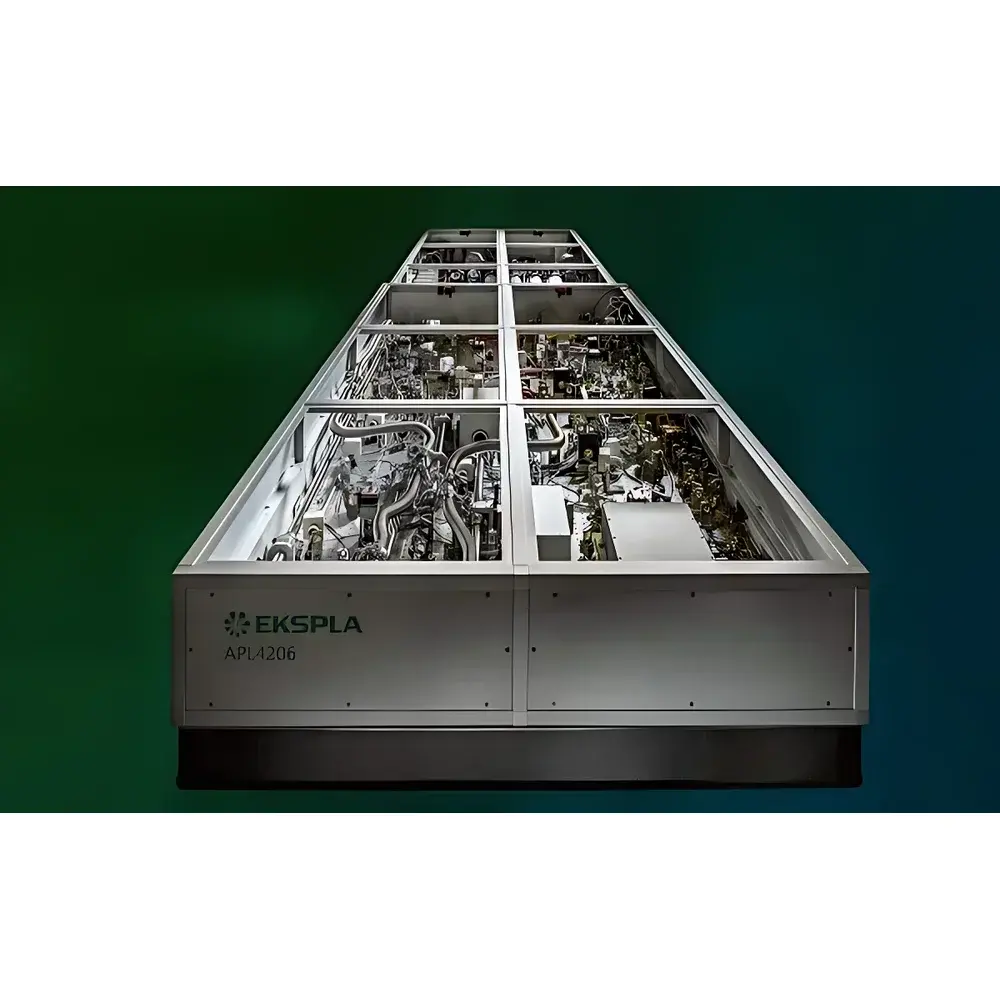
APL4206 Series High-Energy Diode-Pumped Picosecond Laser Amplifier
| Brand | Ekspla |
|---|---|
| Model | APL4206 |
| Pulse Energy | up to 130 mJ per channel (8 channels) |
| Pulse Duration | 90 ps |
| Repetition Rate | 1 kHz |
| Pump Source | Diode-pumped solid-state (DPSS) |
| Cooling | Integrated water-to-water chiller |
| Control Interface | USB with LabVIEW™ drivers |
| Harmonic Generation | Optional temperature-stabilized SHG, THG, and FHG modules |
| Compliance | CE-marked, RoHS-compliant, designed for Class 4 laser operation per IEC 60825-1 |
Overview
The APL4206 Series is a high-energy, diode-pumped picosecond laser amplifier system engineered for demanding ultrafast science applications requiring robust temporal stability, high pulse energy, and multi-channel synchronization. Based on master oscillator–power amplifier (MOPA) architecture, the system utilizes a regenerative amplifier seeded by a mode-locked oscillator and amplified in Nd:YAG or Nd:YLF gain media. Its 90 ps pulse duration—maintained across full energy range—and stable 1 kHz repetition rate enable precise control of peak power (exceeding 1.4 GW per channel at maximum output), making it suitable for pump-probe experiments, optical parametric chirped-pulse amplification (OPCPA) seeding, and high-field nonlinear optics where deterministic photon–matter interaction is critical.
Key Features
- Eight independently configurable amplifier channels, each delivering ≥130 mJ pulse energy at 1064 nm with <±1.5% pulse-to-pulse energy stability (RMS, 1 hr)
- Diode-pumped solid-state (DPSS) architecture ensures long-term reliability, reduced thermal lensing, and elimination of flashlamp-related maintenance cycles
- Integrated water-to-water chiller maintains gain medium temperature within ±0.1 °C, enabling continuous operation over extended duty cycles without drift in beam pointing or pulse contrast
- USB-based PC control with native LabVIEW™ drivers supports automated parameter sweeping, interlock monitoring, and real-time diagnostics via ASCII command protocol
- Optional harmonic generation modules—temperature-stabilized for SHG (532 nm), THG (355 nm), and FHG (266 nm)—provide wavelength flexibility while preserving pulse duration and spatial beam quality (M² < 1.3)
- Comprehensive safety architecture compliant with IEC 60825-1:2014 Ed.3, including key-switched interlocks, shutter control, and emission indicator LEDs synchronized to laser enable signals
Sample Compatibility & Compliance
The APL4206 is not a sample-contacting instrument; rather, it serves as a primary excitation source for downstream optical systems—including vacuum UV spectrometers, time-resolved fluorescence setups, and high-harmonic generation beamlines. Its beam parameters (near-diffraction-limited TEM₀₀, ellipticity 100:1) ensure compatibility with off-axis parabolic mirrors, grating compressors, and electro-optic modulators used in ultrafast metrology. The system meets CE marking requirements for electromagnetic compatibility (EN 61326-1) and low-voltage directive (2014/35/EU). For GLP/GMP environments, optional audit-trail logging and user-access-level configuration (via password-protected firmware menus) support 21 CFR Part 11 readiness when integrated into validated laboratory workflows.
Software & Data Management
Control is implemented through Ekspla’s proprietary APL Control Suite—a Windows-based application providing graphical configuration of pulse delay, energy attenuation (via motorized neutral density wheels), and harmonic selection. All operational parameters are timestamped and exportable in CSV or HDF5 format. LabVIEW™ drivers include VIs for synchronous triggering of external detectors (e.g., streak cameras, photodiodes) and integration with National Instruments PXI platforms. Firmware supports SCPI-like command syntax for remote orchestration in Python or MATLAB environments, facilitating reproducible experiment scripting and integration into automated optical alignment routines.
Applications
- Multi-stage OPCPA pumping: Synchronized dual-channel output enables independent seeding of signal and idler amplifiers in broadband few-cycle pulse generation systems
- Time-resolved transient absorption spectroscopy: High pulse energy permits single-shot acquisition in low-repetition-rate pump–probe geometries with sub-100 ps temporal resolution
- High-order harmonic generation (HHG): Stable 1064 nm fundamental output drives gas-jet HHG sources with improved cutoff photon energy reproducibility
- Nonlinear microscopy: Frequency-doubled (532 nm) output supports multi-photon excited fluorescence (MPEF) and second-harmonic generation (SHG) imaging in thick-tissue preparations
- Laser-induced breakdown spectroscopy (LIBS): Multi-mJ pulses at 266 nm enable ablation of refractory materials (e.g., ceramics, alloys) with minimized thermal diffusion artifacts
FAQ
What is the maximum average power per channel at full energy?
At 130 mJ and 1 kHz, each channel delivers 130 W average power. Total system average power (8 channels) is 1.04 kW, requiring dedicated HVAC-rated cooling infrastructure.
Can the APL4206 be operated in burst mode?
No—this system is optimized for steady-state 1 kHz operation. Burst-mode capability requires custom firmware and thermal management upgrades, available under Ekspla’s OEM engineering services program.
Is remote diagnostics supported?
Yes. Via optional Ethernet interface module (EKS-ETH-01), users can access real-time status telemetry—including diode current, chiller flow rate, cavity alignment feedback, and interlock state—for predictive maintenance scheduling.
What beam delivery options are available?
Standard output is free-space collimated beam (Ø12 mm, adjustable divergence ±0.2 mrad). Fiber-coupled variants (with large-core multimode fiber, NA 0.22) are available upon request, subject to pulse broadening constraints.
Does the system comply with FDA laser product requirements for US import?
Yes. The APL4206 carries FDA accession number DRL-XXXXX and conforms to 21 CFR 1040.10/1040.11 for Class 4 laser products, including mandatory labeling, protective housing, and variance documentation for clinical research use.




