
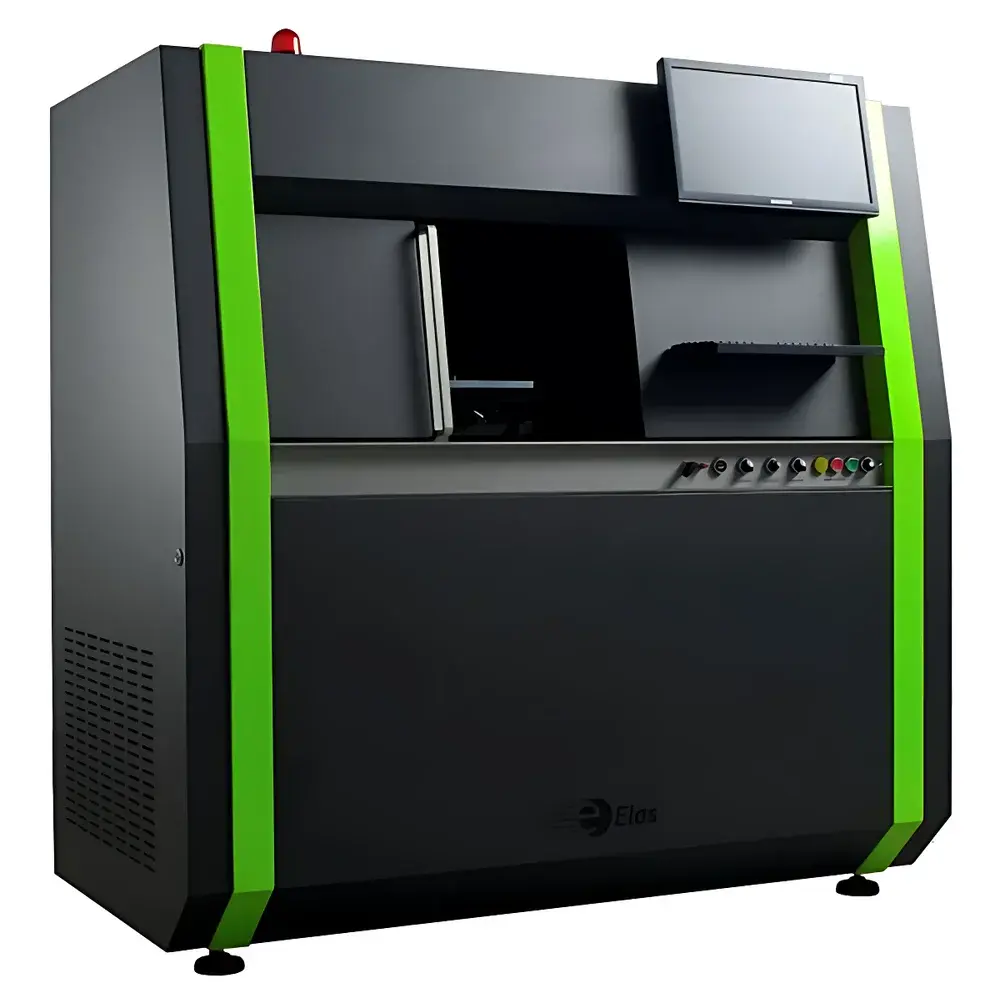
ELAS PicoLAB Series Picosecond Laser Micro-Machining Workstation
| Brand | ELAS |
|---|---|
| Model | PicoLAB Laboratory Systems |
| Type | Picosecond DPSS Laser Micro-Machining Workstation |
| Laser Source | Nd:YVO₄ (1064 nm / 355 nm) |
| Pulse Duration | < 10 ps |
| Avg. Power | 16 W @ 1064 nm / 4 W @ 355 nm |
| Repetition Rate | Single Shot to 500 kHz |
| Beam Quality (M²) | < 1.5 |
| Spatial Mode | TEM₀₀ |
| Positioning Stages | X/Y Travel 600 mm × 400 mm |
| Stage Accuracy | ±4.5 µm |
| Repeatability | ±0.5 µm |
| Resolution | 0.1 µm |
| Galvo-Scanner | Dual-Axis, Synchronized with Stages |
| Safety Class | IEC 60825-1 Class 1 Enclosed System |
| Vision System | High-Resolution Machine Vision with Sample Recognition |
| Operating Temp. | 18–27°C (±1°C stability) |
| Power Supply | 240 VAC, 50–60 Hz, < 3 kW |
Overview
The ELAS PicoLAB Series is a fully integrated picosecond laser micro-machining workstation engineered for high-precision material processing at the micrometer scale. Built upon the physical principles of ultrafast laser–matter interaction—where energy deposition occurs faster than thermal diffusion—the system enables cold ablation, minimal heat-affected zones (HAZ), and sub-5 µm feature resolution across conductive, dielectric, and composite substrates. Its core architecture combines a diode-pumped solid-state (DPSS) Nd:YVO₄ laser source emitting at fundamental (1064 nm) and third-harmonic (355 nm) wavelengths, a high-stability optical train, and a synchronized motion control platform integrating precision motorized stages with dual-axis galvanometric beam steering. Designed for both R&D laboratories and pilot-line process development, the PicoLAB meets stringent requirements for reproducibility, traceability, and operational safety in regulated environments.
Key Features
- Ultrafast picosecond laser source (<10 ps pulse duration) enabling non-thermal ablation and nanoscale surface structuring
- Multi-wavelength capability (1064 nm and 355 nm) with optional harmonic generation for optimized coupling with diverse materials (e.g., polymers, ceramics, thin-film metals)
- High-accuracy X-Y positioning system (600 × 400 mm travel) with ±4.5 µm absolute accuracy, ±0.5 µm repeatability, and 0.1 µm resolution
- Synchronous control architecture linking stage motion, galvo-scanner deflection, and laser triggering for spatiotemporally coherent patterning
- Class 1 laser enclosure compliant with IEC 60825-1:2014, featuring interlocked access doors, laser-safe observation window, and integrated dust extraction
- Dedicated industrial control computer running real-time deterministic firmware for deterministic pulse-on-demand operation and jitter-free synchronization
- High-resolution machine vision subsystem with automated sample recognition, fiducial alignment, and in-process metrology support
Sample Compatibility & Compliance
The PicoLAB supports a broad spectrum of sample geometries and material classes—including silicon wafers, sapphire substrates, polyimide films, stainless steel foils, and glass-ceramic composites—without requiring vacuum or inert gas environments. Sample holding is facilitated via vacuum chuck with programmable pressure control, accommodating flat and slightly warped specimens up to 300 mm in diameter. All configurations adhere to ISO 13849-1 (PL e) for functional safety, CE marking per Machinery Directive 2006/42/EC and EMC Directive 2014/30/EU, and are designed to support GLP/GMP-aligned workflows. Optional audit trail logging, user role management, and electronic signature capabilities align with FDA 21 CFR Part 11 requirements when integrated with validated software modules.
Software & Data Management
Control and data acquisition are managed through ELAS’ proprietary PicoControl Suite—a modular, Windows-based application framework supporting script-driven job sequencing, parameter mapping, and multi-layer process recipes. Raw laser pulse logs (timestamp, energy, repetition rate), stage coordinates, galvo angles, and vision frame captures are stored in HDF5 format with embedded metadata (ISO/IEC 11179-compliant). Export interfaces include CSV, XML, and direct OPC UA connectivity for integration into MES or LIMS platforms. Firmware updates are delivered via signed package files with SHA-256 verification; configuration backups retain full system state including optical calibration matrices and vision model parameters.
Applications
- Microvia drilling and trenching in PCB and HDI substrate manufacturing
- Surface texturing of medical implants for enhanced osseointegration
- Patterning of transparent conductive oxides (TCOs) and thin-film photovoltaic layers
- Direct-write fabrication of microfluidic channel networks in PMMA and COC
- Trimming and scribing of thin-film resistors and capacitive sensor arrays
- Prototyping of metamaterial unit cells and plasmonic nanostructures
- Failure analysis cross-sectioning of advanced packaging (e.g., Fan-Out Wafer-Level Packaging)
FAQ
What laser wavelengths are standard on the PicoLAB system?
The base configuration includes 1064 nm (fundamental) and 355 nm (third harmonic) outputs. Second-harmonic generation (532 nm) is available as an optional add-on module.
Can the PicoLAB be upgraded to support five-axis motion?
Yes—rotary and tilt stages can be integrated with factory calibration to extend the platform to full 5-axis coordinated motion for 3D micro-structuring of curved surfaces.
Is remote operation supported?
Remote monitoring and limited job queue management are enabled via secure TLS-encrypted VNC; however, real-time laser control requires local network access due to deterministic timing constraints.
What maintenance intervals are recommended for the laser source?
The DPSS laser module is rated for >20,000 hours of operation; annual preventive maintenance includes optical alignment verification, cooling system inspection, and galvo mirror reflectivity measurement.
Does the system comply with cleanroom compatibility standards?
While not rated for ISO Class 5 environments, the PicoLAB’s sealed optical path, low-outgassing materials, and optional HEPA-filtered air purge make it suitable for ISO Class 7–8 cleanrooms with prior validation.




