
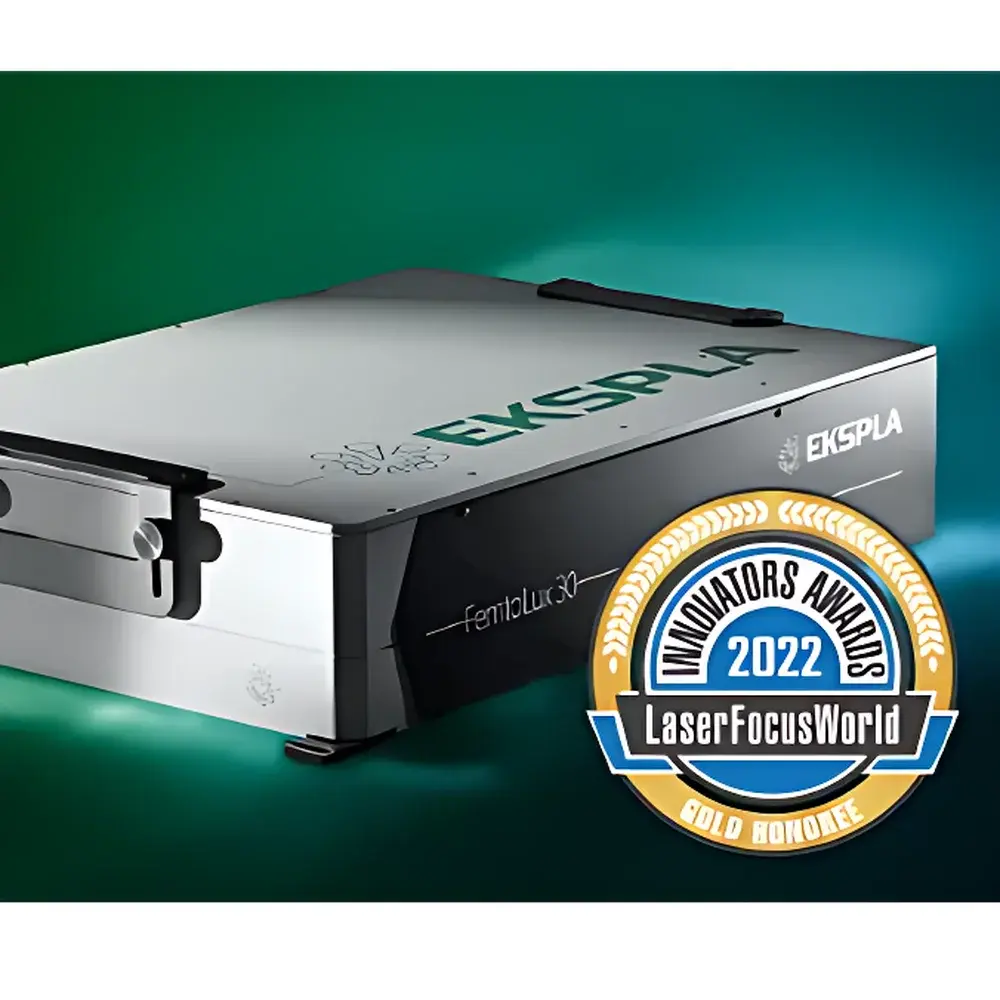
Ekspla FemtoLux30 Industrial Femtosecond Laser
| Brand | Ekspla |
|---|---|
| Origin | Lithuania |
| Manufacturer Type | Original Equipment Manufacturer (OEM) |
| Product Category | Imported Industrial Femtosecond Laser System |
| Model | FemtoLux30 |
| Core Technology | Diode-Pumped Solid-State (DPSS) Yb-based Femtosecond Oscillator + Amplifier |
| Output Wavelengths | 1030 nm (fundamental), 515 nm (SHG), 343 nm (THG) |
| Avg. Power | ≥27 W @ 1030 nm, ≥11 W @ 515 nm, ≥6 W @ 343 nm |
| Pulse Energy | >90 µJ @ 1030 nm (single pulse), >250 µJ in MHz burst mode |
| Repetition Rate | Single shot to 4 MHz (AOM-controlled) |
| Pulse Duration | Tunable <350 fs – 1 ps (FWHM) |
| Beam Quality | M² < 1.2, Beam Circularity > 0.85 |
| Cooling | Integrated Direct Refrigerant Cooling (dry, hermetically sealed, no water) |
| Control Interface | RS232 / LAN with REST API |
| Form Factor | 4U rack-mounted PSU + detachable laser head (total system weight: 15 kg) |
| Compliance | CE, RoHS, IEC 60825-1:2014 (Class 4 Laser Product), ISO 9001-certified manufacturing |
Overview
The Ekspla FemtoLux30 is an industrial-grade, diode-pumped solid-state (DPSS) femtosecond laser system engineered for high-reliability micromachining in production environments. Based on a Yb-doped fiber oscillator and regenerative amplifier architecture, it delivers ultrashort pulses with tunable duration (90,000-hour MTBF under continuous 24/7 operation.
Key Features
- Tunable Pulse Duration: Adjustable from sub-350 fs to 1 ps via internal dispersion compensation—enabling optimization of nonlinear absorption efficiency across material classes (e.g., shorter pulses for dielectric breakdown threshold control; longer pulses for reduced plasma shielding in metals).
- Multi-Wavelength Output: Simultaneous or selectable emission at 1030 nm (≥27 W avg.), 515 nm (≥11 W), and 343 nm (≥6 W), supporting wavelength-specific interaction mechanisms without external harmonic separation optics.
- Burst Mode Flexibility: MHz, GHz, and MHz+GHz burst architectures with programmable intra-burst spacing (2–10 pulses per burst); total burst energy exceeding 250 µJ enables high-throughput volume ablation in glass and crystalline substrates.
- Pulse-on-Demand (PoD) Architecture: Sub-20 ns peak-to-peak timing jitter and <1 µs trigger-to-pulse delay ensure synchronization with galvanometric scanners, polygon mirrors, and position-sensitive optical (PSO) controllers for contour-aligned processing.
- Zero-Maintenance Thermal Management: Hermetically sealed refrigerant loop with integrated compressor-condenser unit—no water filtration, draining, or particulate filter replacement required. Power consumption is >45% lower than equivalent water-cooled systems.
- Industrial Control Integration: Native REST API over RS232/LAN supports cross-platform command execution (Windows/Linux/macOS); compatible with LabVIEW, Python, MATLAB, and PLC-based motion controllers via standard HTTP methods.
Sample Compatibility & Compliance
The FemtoLux30 is validated for non-thermal ablation of optically transparent and reflective materials including borosilicate glass, fused quartz, sapphire, alumina ceramics, polyimide, PET, copper, stainless steel, and ITO-coated substrates. Its beam parameters (M² 0.85, divergence < 1 mrad) meet ISO 11146-1 requirements for beam propagation characterization. The system complies with IEC 60825-1:2014 Class 4 laser safety standards and carries CE marking per EU Machinery Directive 2006/42/EC and EMC Directive 2014/30/EU. All firmware and control logic adhere to GLP/GMP-aligned audit trail principles: every parameter change, power cycle, and error event is timestamped and logged internally for traceability. While not FDA-cleared as a medical device, its output stability (<0.5% RMS power drift over 100 h) satisfies ASTM F2792-21 criteria for laser-based additive manufacturing qualification protocols.
Software & Data Management
Ekspla provides the FemtoLux Control Suite—a modular software framework supporting both local GUI operation and headless remote orchestration. Key modules include Pulse Parameter Manager (for real-time AOM frequency, burst envelope, and energy attenuation tuning), Diagnostic Logger (continuous monitoring of pump diode current, thermal sensor readings, and interlock status), and API Command Builder (auto-generating cURL/Python snippets for integration testing). All logs are stored in SQLite format with SHA-256 checksums to prevent tampering—supporting 21 CFR Part 11-compliant electronic record retention when deployed on validated IT infrastructure. Firmware updates are delivered as signed binary packages with cryptographic verification prior to installation.
Applications
- Glass and sapphire cutting, drilling, and intra-volume waveguide inscription for photonics packaging and microfluidic device fabrication.
- High-precision patterning of OLED and micro-LED display substrates—including pixel isolation trenching and encapsulation layer scribing.
- Microvia drilling and flex PCB depaneling in polyimide and FR-4 laminates with <5 µm positional accuracy.
- Surface texturing of biomedical implants (e.g., Ti-6Al-4V) to enhance osseointegration without altering bulk mechanical properties.
- Thin-film removal (e.g., ITO, MoS₂, perovskite layers) in R&D cleanrooms where particulate generation must remain below ISO Class 5 thresholds.
FAQ
Is the FemtoLux30 suitable for cleanroom integration?
Yes. Its dry cooling architecture eliminates water vapor ingress risks, and particulate emission during operation conforms to ISO 14644-1 Class 5 when installed with appropriate air filtration. The laser head meets ISO 9 (room air) ambient contamination tolerance.
Can pulse duration be fixed at custom values (e.g., 50 fs)?
Yes. While standard tuning spans <350 fs to 1 ps, Ekspla offers factory-configured fixed-duration variants—including 50 fs, 100 fs, and 300 fs—subject to optical path recalibration and extended lead time.
What is the maximum achievable pulse energy in single-shot mode at 1030 nm?
The standard configuration delivers >90 µJ; a high-energy option (1 mJ at 10 kHz) is available with modified amplifier staging and thermal management—requiring separate quotation and mechanical reconfiguration.
Does the system support third-party motion controller synchronization?
Yes. Native PSO triggering, hardware TTL inputs for external clock gating, and sub-microsecond jitter enable deterministic coordination with Aerotech, Newport, and PI motion platforms without intermediate timing hardware.
How is long-term power stability verified?
Each unit undergoes a 120-hour burn-in test under controlled ambient conditions (20 ± 0.5 °C, 45 ± 5% RH), with RMS deviation calculated per ASTM E2302-19 Annex A2 methodology using NIST-traceable photodiode calibration.




