
LaVision ParticleMaster inspex Laser-Based Particle & Droplet Sizing, Shape, and Velocity Analyzer
| Brand | LaVision GmbH |
|---|---|
| Origin | Germany |
| Manufacturer Type | Authorized Distributor |
| Origin Category | Imported |
| Model | ParticleMaster Inspex |
| Dispersion Method | Dry & Wet Dispersion |
| Instrument Type | Laboratory Laser Imaging Analyzer |
| Measurement Range | 10–5000 µm |
| Repeatability | ±1% (relative) |
| Measurement Speed | Transient imaging at 25–50 Hz frame rate |
Overview
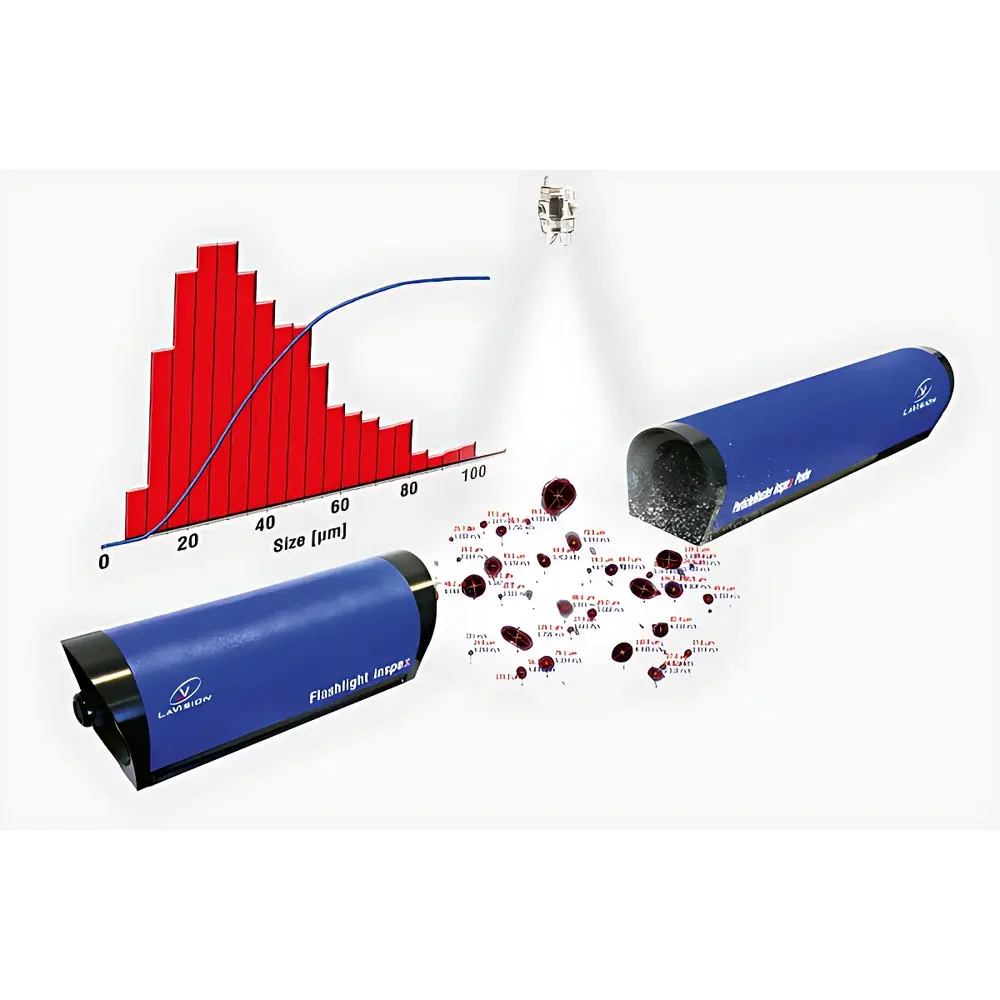
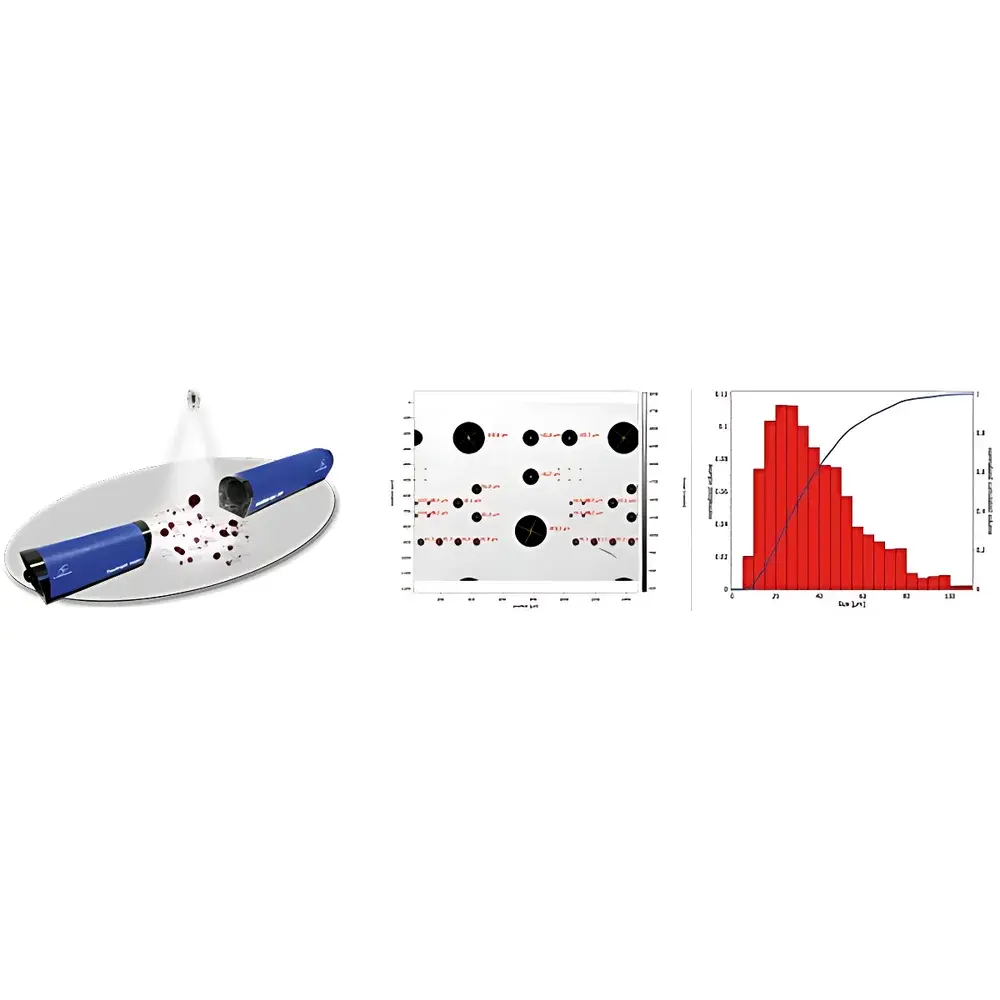
The LaVision ParticleMaster inspex is a high-resolution, laser-based imaging system engineered for simultaneous, non-intrusive measurement of particle and droplet size, two-dimensional shape descriptors (e.g., circularity, aspect ratio, convexity), and instantaneous velocity in laboratory environments. Unlike conventional ensemble-averaging laser diffraction analyzers, the inspex platform employs digital in-line holography and high-speed micro-imaging principles—leveraging pulsed LED illumination and telecentric optics—to resolve individual particles and droplets across a broad dynamic range (10–5000 µm). Its core architecture follows a single-shot, snapshot-based acquisition paradigm, enabling true transient characterization of polydisperse sprays, fluidized beds, atomization processes, and aerosol dynamics without time-averaging artifacts. The system operates on deterministic image segmentation and sub-pixel edge detection algorithms, delivering traceable, ISO 13322-2 compliant morphological data directly tied to physical pixel calibration.
Key Features
- Integrated IP54-rated probe head with built-in telecentric lens, high-sensitivity CMOS sensor (≥4 MP), and synchronized pulsed LED illumination—ensuring eye-safe operation (IEC 62471 Class 1) and exposure times as short as 100 ns for motion blur suppression.
- Modular probe design: Multiple working distance (WD = 50 mm to 500 mm) and field-of-view (FOV = 0.5 mm² to 250 mm²) configurations available to match nozzle geometry, spray cone angle, or powder flow path dimensions.
- Real-time acquisition at 25–50 frames per second (configurable), with onboard buffering for burst-mode capture of transient events (e.g., ignition-induced droplet breakup, pneumatic conveying surges).
- Factory-calibrated optical path and geometric scaling; includes NIST-traceable calibration slides for user verification prior to GLP-compliant testing.
- Rugged, self-contained controller unit with embedded Linux OS, GigE Vision interface, and hardware-triggered synchronization for integration with external sensors (e.g., pressure transducers, piezoelectric injectors).
Sample Compatibility & Compliance
The ParticleMaster inspex accommodates both dry particulates (metal powders, pharmaceutical granules, catalysts) and liquid-phase dispersions (fuel sprays, emulsions, inhaler aerosols, cooling mists) without requiring refractive index assumptions or Mie theory approximations. Its label-free, intensity-based segmentation avoids optical model dependency—making it suitable for opaque, absorbing, or irregularly shaped particles where traditional light-scattering methods fail. The system conforms to ISO 13322-1 (static image analysis) and ISO 13322-2 (dynamic image analysis) standards. Full audit trail support—including operator ID, timestamped raw image archives, parameter change logs, and versioned analysis scripts—is provided to meet FDA 21 CFR Part 11 requirements for regulated laboratories. All firmware and software updates undergo IEC 62304-compliant validation protocols.
Software & Data Management
ParticleMaster software (v5.2+) provides a validated, scriptable analysis environment supporting batch processing of >10⁴ images per session. Core outputs include volumetric diameter distributions (D10, D32, Dv50, Dv90), shape factor histograms (roundness, elongation, solidity), and vector velocity fields derived from particle tracking velocimetry (PTV) or cross-correlation PIV modes. Export formats include CSV (with metadata headers), HDF5 (for MATLAB/Python interoperability), and PDF reports embedding annotated images and statistical summaries. Raw data storage follows FAIR principles: each dataset carries embedded EXIF tags (exposure, gain, WD, magnification), and the software enforces hierarchical folder structuring aligned with ALCOA+ (Attributable, Legible, Contemporaneous, Original, Accurate, Complete, Consistent, Enduring, Available) data integrity criteria.
Applications
- Fuel injector development: Quantifying Sauter mean diameter (SMD), droplet trajectory dispersion, and ligament-to-droplet transition in gasoline direct injection (GDI) and diesel common-rail systems.
- Inhalation product qualification: Measuring aerodynamic particle size distribution (APSD) of pressurized metered-dose inhalers (pMDIs) per USP & Ph. Eur. guidelines.
- Pharmaceutical powder flow characterization: Correlating particle shape indices (e.g., convexity < 0.95) with hopper discharge rates and blend uniformity stability.
- Battery electrode slurry analysis: Monitoring agglomerate size evolution and aspect ratio shifts during high-shear mixing and coating processes.
- Environmental aerosol monitoring: Field-deployable sizing of PM₁₀ and PM₂.₅ analogs under controlled wind tunnel conditions.
FAQ
Does the ParticleMaster inspex require laser safety interlocks or certified laser operator training?
No. The system uses a Class 1 pulsed LED illumination source compliant with IEC 62471, eliminating regulatory requirements for laser safety officers or controlled access zones.
Can the inspex be integrated with existing CFD simulation workflows?
Yes. ParticleMaster exports particle position, velocity, and size data in standard ASCII format compatible with ANSYS Fluent’s DPM import, OpenFOAM’s cloud input, and CONVERGE’s spray initialization modules.
Is GMP-compliant validation documentation available for IQ/OQ/PQ protocols?
Yes. LaVision provides a full validation toolkit including URS, FDS, test scripts, and blank protocol templates aligned with Annex 11 and ASTM E2500-13.
What is the minimum detectable particle concentration for reliable sizing?
The lower limit depends on FOV and magnification; typical operational thresholds range from 10³ to 10⁵ particles/cm³, validated per ISO 20998-2 Annex B for sparse-field imaging.
How is focus drift compensated during long-duration measurements?
The system supports optional motorized Z-stage feedback control linked to real-time image sharpness metrics (Laplacian variance), enabling autonomous refocusing at user-defined intervals.



