LaVision DaVis Intelligent Imaging Software Platform
| Brand | LaVision GmbH |
|---|---|
| Origin | Germany |
| Model | DaVis |
| Software Type | Laser Imaging & PIV Analysis Software |
| Architecture | Native 64-bit |
| Integrated Hardware | >100 camera and laser models |
| Data Dimensionality Support | 2D, 3D, 4D (time-resolved volumetric) |
| Compliance Framework | Designed for GLP/GMP-aligned experimental workflows, audit-trail-ready data handling, ISO/IEC 17025-compatible metadata logging |
Overview
LaVision DaVis is a native 64-bit intelligent imaging software platform engineered for high-fidelity, multi-dimensional experimental diagnostics in fluid mechanics, combustion science, spray dynamics, and solid-surface deformation analysis. Built upon over 25 years of domain-specific expertise in laser-based optical metrology, DaVis implements core physical measurement principles—including Particle Image Velocimetry (PIV), Tomographic PIV (Tomo-PIV), Laser-Induced Fluorescence (LIF), Planar LIF (PLIF), Stereo-PIV, and Digital Image Correlation (DIC)—within a unified, hardware-agnostic computational environment. Unlike generic image-processing suites, DaVis embeds physics-informed algorithms that preserve quantitative rigor across acquisition, reconstruction, vector field computation, and temporal volumetric rendering. Its architecture supports real-time synchronization of multi-camera arrays, pulsed laser systems, programmable timing units (e.g., PTU X), and motion-controlled stages—enabling strict adherence to experimental repeatability requirements defined in ASTM E2935 (Standard Practice for PIV Measurements) and ISO 20457 (Optical Measurement of Fluid Flow).
Key Features
- Fully integrated control of >100 commercial and scientific-grade cameras and laser systems—including high-speed CMOS, sCMOS, ICCD, and ultrafast burst-mode devices—via standardized drivers and vendor-agnostic APIs.
- Native 64-bit software architecture optimized for large-scale data throughput; supports real-time streaming from multi-gigapixel camera clusters at sustained frame rates exceeding 1 kHz per channel.
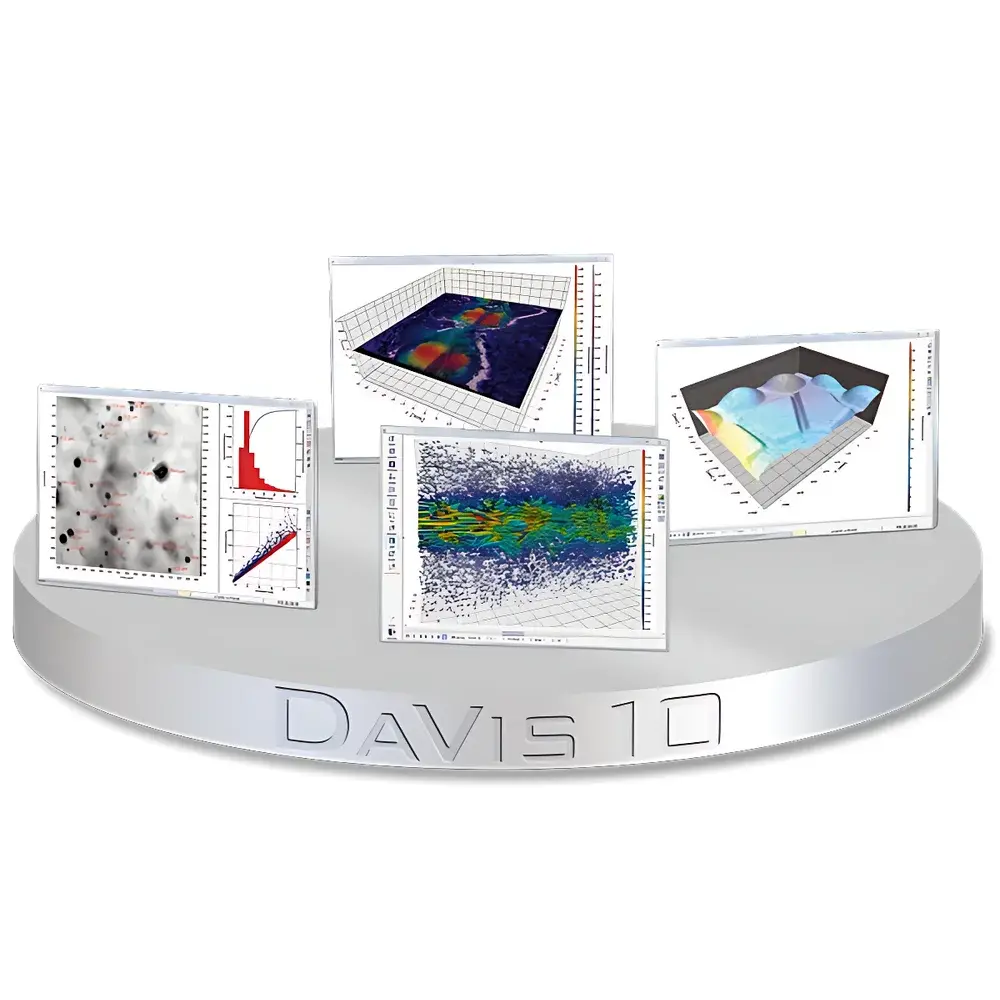
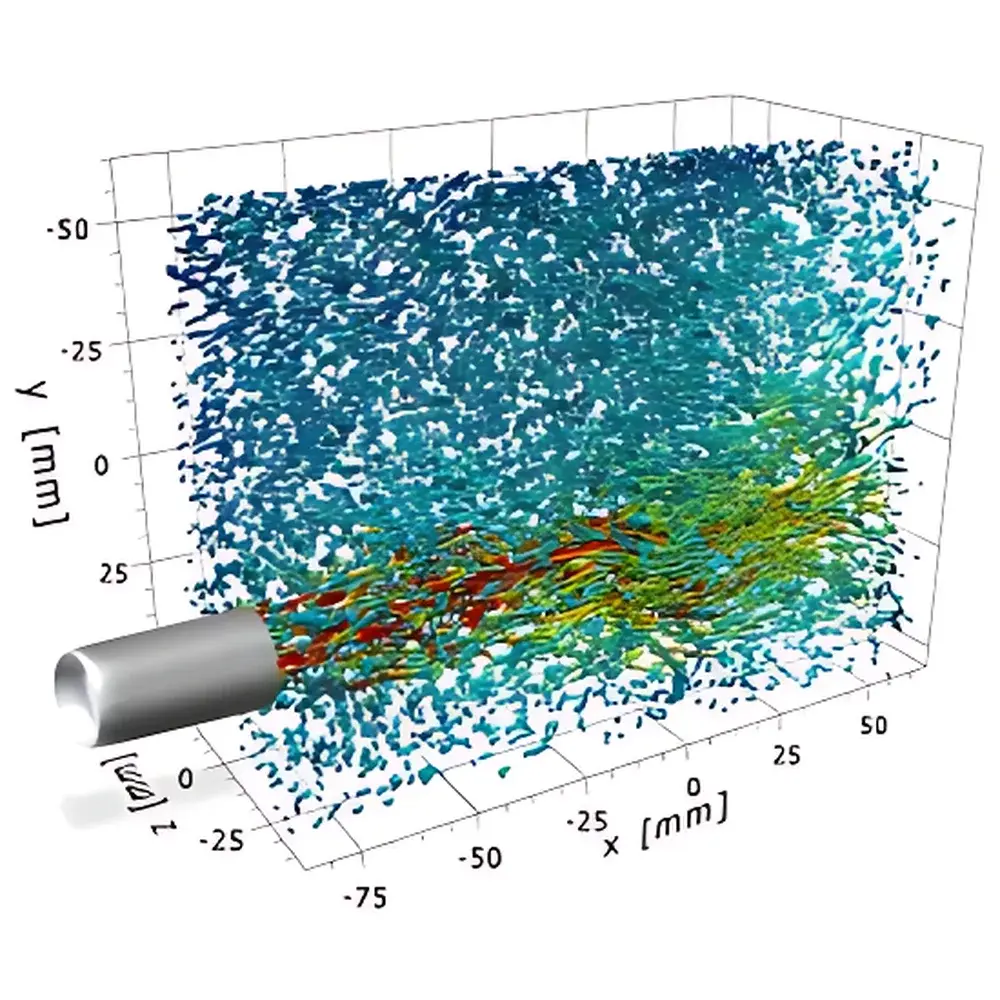
- Advanced 3D/4D visualization engine with GPU-accelerated volume rendering, interactive iso-surface extraction, animated vector field overlays, and synchronized multi-panel time-series playback.
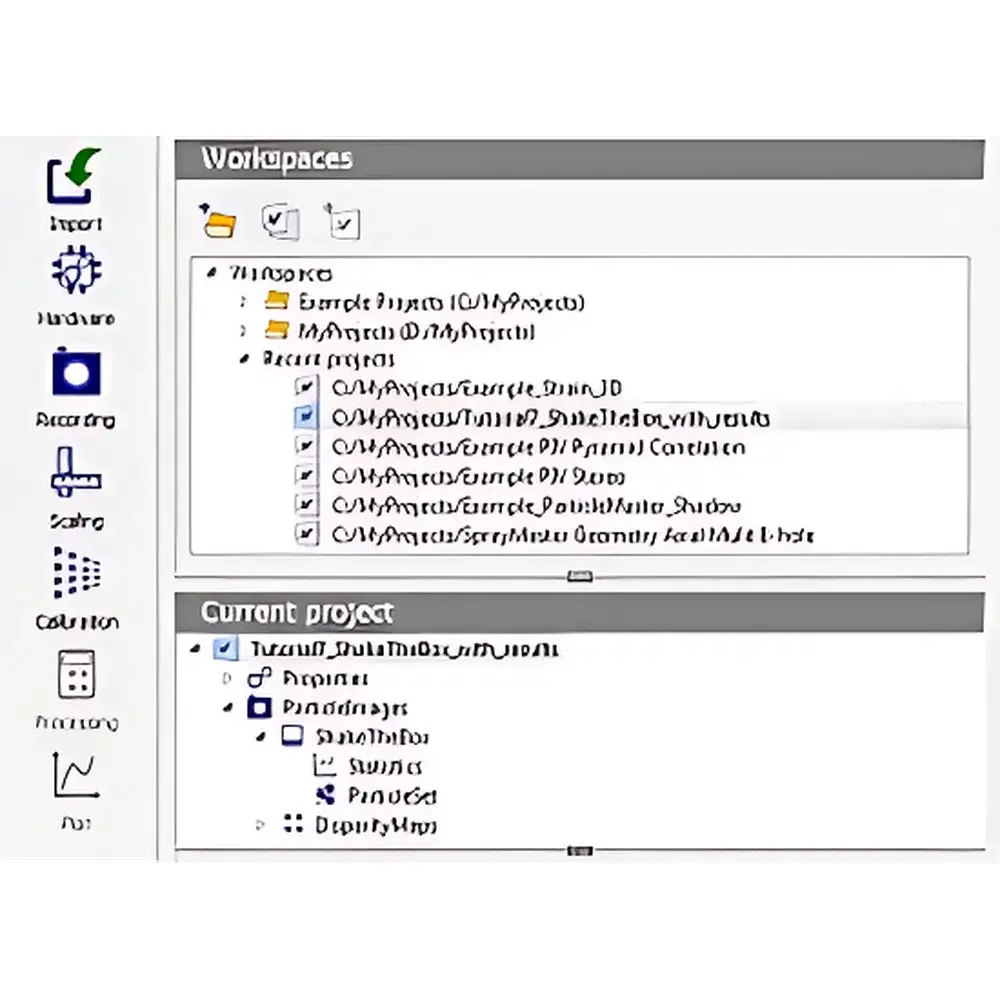
- Intelligent data management framework featuring hierarchical metadata tagging (per acquisition, calibration, and processing step), automatic versioning of analysis pipelines, and configurable export to HDF5, TIFF stack, or NetCDF-4 formats compliant with FAIR data principles.
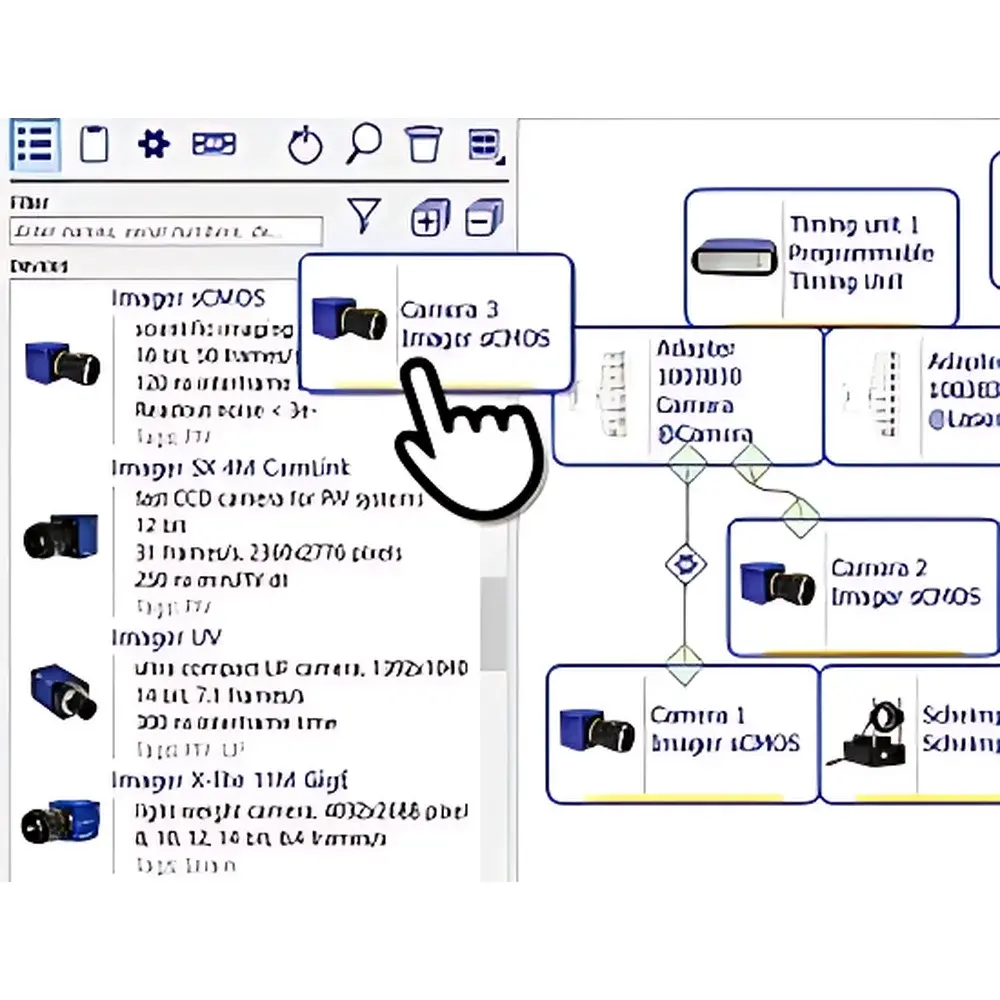
- Graphical hardware configuration interface with drag-and-drop device mapping, auto-detection of connected peripherals, and visual timing diagram generation for complex multi-pulse experiments.
- Embedded algorithm suite including Shake-the-Box (STB) for high-density Lagrangian particle tracking, Pressure from PIV (PnP) solvers based on Poisson pressure reconstruction, and Tomographic LIF reconstruction with MLEM regularization.
Sample Compatibility & Compliance
DaVis does not interact directly with physical samples but serves as the central orchestration layer for optical diagnostic systems operating across gas-phase combustion chambers, liquid-phase hydrodynamic tunnels, spray test rigs, and material testing frames. It ensures traceability and reproducibility by enforcing calibrated spatial scaling (pixels-to-mm), temporal synchronization (ns-level jitter control via PTU X), and uncertainty-aware post-processing. The software’s internal logging system records full provenance—including laser energy logs, camera gain settings, lens distortion corrections, and user-applied filters—supporting audit readiness under FDA 21 CFR Part 11 (electronic records/signatures) and ISO/IEC 17025:2017 Clause 7.7 (result reporting). All calibration procedures follow NIST-traceable protocols, and DIC modules comply with ASTM E837 (Strain Gauge Calibration) and ISO 10365 (Digital Image Correlation Standards).
Software & Data Management
DaVis employs an extensible plugin architecture supporting third-party algorithm integration (e.g., custom turbulence spectra calculators or machine learning–based flow feature classifiers) while maintaining backward compatibility with legacy DaVis 8.x project files. Data storage leverages a proprietary binary container format (.dvs) that embeds raw images, processed fields, metadata, and processing history in a single file—eliminating file fragmentation and enabling deterministic reprocessing. Batch processing pipelines can be scripted in Python (via official DaVis SDK) or executed through GUI-driven workflow templates. All user actions—including ROI definition, filter application, and vector validation—are logged with timestamps, operator ID, and parameter sets, satisfying GLP audit trail requirements. Free lifetime updates and technical support ensure long-term software sustainability without license expiration or forced migration cycles.
Applications
- Turbulent flow characterization in wind tunnels and engine intake manifolds using multi-plane stereo-PIV and time-resolved Tomo-PIV.
- Combustion front propagation analysis via simultaneous PLIF of OH*/CH*/CO₂ and dual-plane PIV in optically accessible IC engines.
- High-speed fuel spray breakup dynamics quantification using backlight imaging, Mie scattering, and phase Doppler anemometry (PDA) fusion.
- Thermo-mechanical strain mapping on turbine blades under thermal cycling via high-resolution DIC coupled with infrared thermography synchronization.
- Microfluidic droplet interaction studies employing confocal LIF and adaptive focus tracking across 4D spatiotemporal volumes.
FAQ
Is DaVis compatible with non-LaVision hardware?
Yes—DaVis supports third-party cameras and lasers via GenICam, GigE Vision, and USB3 Vision standards, as well as custom DLL-based drivers. Over 100 models are pre-certified; others may be integrated upon request.
Does DaVis support automated calibration routines?
Yes—it includes guided calibration workflows for PIV (multi-grid cross-correlation), DIC (subset-based displacement fitting), and stereo-vision (target-based epipolar rectification), all generating NIST-traceable uncertainty reports.
Can DaVis process data offline without connected hardware?
Absolutely—the software operates in full offline mode for post-processing, visualization, and report generation using previously acquired .dvs or HDF5 datasets.
What programming interfaces are available for automation?
DaVis provides a documented Python SDK, MATLAB wrapper functions, and COM/ActiveX interfaces for Windows-based lab automation and integration into larger LIMS or test-bench control systems.
How is data security and user access managed?
Role-based access control (RBAC) is enforced via Windows Active Directory integration; project-level encryption and digital signature options are available for regulated environments requiring 21 CFR Part 11 compliance.