
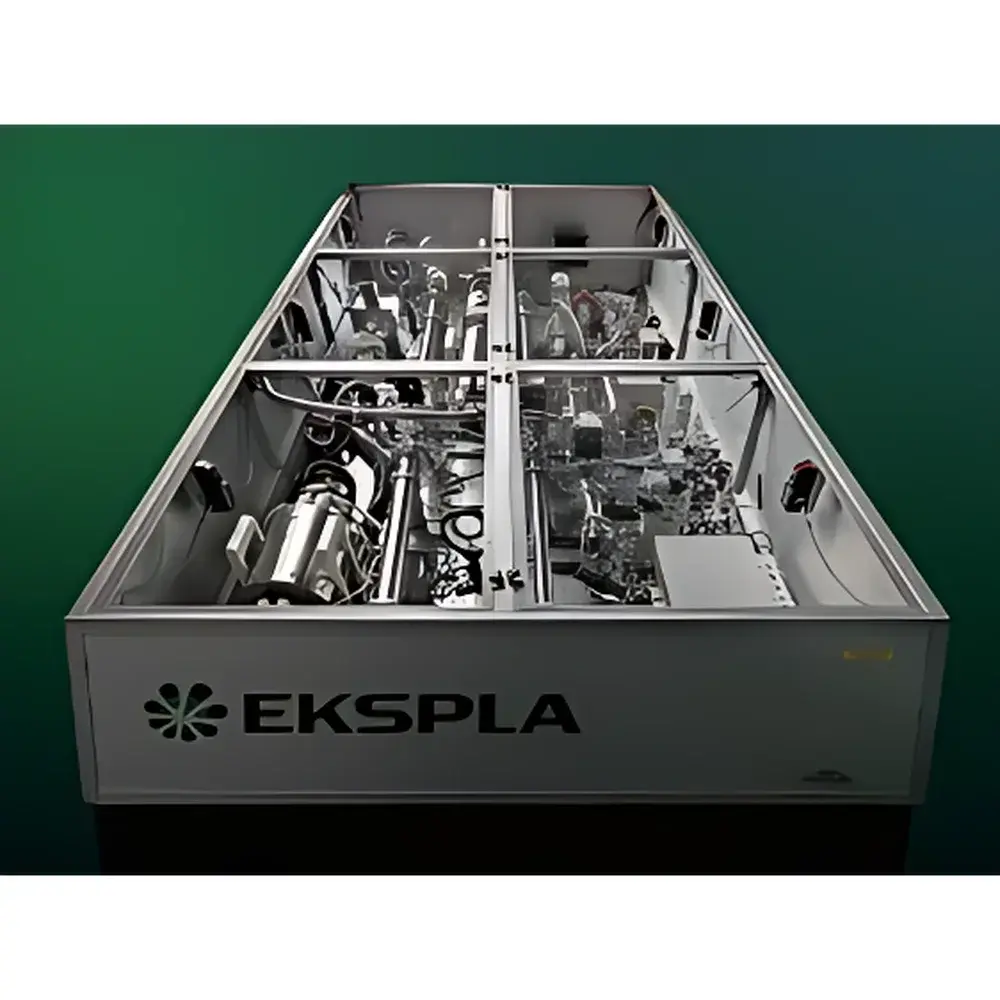
Ekspla UltraFlux HR Series High-Repetition-Rate Tunable-Wavelength Femtosecond OPCPA System
| Brand | Ekspla |
|---|---|
| Origin | Lithuania |
| Manufacturer Type | Original Equipment Manufacturer (OEM) |
| Product Category | Imported Scientific Laser System |
| Model | UltraFlux HR |
| Core Technology | Optical Parametric Chirped Pulse Amplification (OPCPA) |
| Tuning Ranges | 750–960 nm (signal), 375–480 nm (SH), 250–320 nm (TH), 210–230 nm (FH) |
| Max Pulse Energy | 14 mJ @ 1 kHz |
| Pulse Duration | 40 ± 20 fs |
| Pulse Energy Stability | ≤1 % RMS |
| Long-Term Power Stability | ≤1.5 % RMS (8 h) |
| Temporal Contrast (APFC) | >10¹⁰:1 (±50 ps) |
| Beam Profile | Gaussian / Super-Gaussian (6th–11th order) |
| Beam Pointing Stability | ≤30 µrad (RMS) |
| Optical Jitter (with PLL option) | ≤2 ps |
| Harmonic Outputs | Optional, non-simultaneous SH/TH/FH modules |
| Cooling | Air-cooled or Air-Water hybrid (no external chiller required) |
| Compliance | CE-marked, RoHS-compliant, designed for GLP/GMP-adjacent research environments |
Overview
The Ekspla UltraFlux HR Series is a high-repetition-rate, wavelength-tunable femtosecond laser system engineered for advanced ultrafast photonics research. Built upon Optical Parametric Chirped Pulse Amplification (OPCPA) architecture, it eliminates conventional regenerative amplifiers and replaces them with a dual-output picosecond fiber laser front-end—patented under EP2827461 and EP2924500. This design seeds both the picosecond DPSS pump laser and the femtosecond parametric amplifier simultaneously, achieving intrinsic synchronization (<2 ps jitter with PLL option) and eliminating active pulse timing alignment. The system delivers carrier-envelope-phase (CEP)-capable output across four spectral bands: 750–960 nm (signal), 375–480 nm (second harmonic), 250–320 nm (third harmonic), and 210–230 nm (fourth harmonic), enabling broadband nonlinear excitation without external wavelength conversion stages. All models operate at a fixed 1 kHz repetition rate and are assembled on rigid optical breadboards to ensure long-term mechanical and thermal stability—critical for time-resolved spectroscopy and pump-probe experiments requiring sub-100-fs temporal fidelity.
Key Features
- Patented OPCPA front-end architecture with dual-output picosecond fiber seed laser, enabling zero-jitter synchronization between fs and ps channels
- Four independently tunable output bands: signal (750–960 nm), SH (375–480 nm), TH (250–320 nm), FH (210–230 nm), with discrete scanning steps (2–5 nm)
- Pulse energy up to 14 mJ at 840 nm (UltraFlux FT141k), scalable across models (FT031k to FT141k)
- Exceptional pulse-to-pulse stability: ≤1 % RMS pulse energy fluctuation; ≤1.5 % RMS long-term average power drift over 8 hours
- High temporal contrast: >10¹⁰:1 amplified parametric fluorescence contrast (APFC) within ±50 ps window; no pre-pulses; post-pulses suppressed via wedged transmission optics
- Modular, air-cooled platform with optional Air-Water (AW) thermal management—no external chiller required
- Beam quality optimized for nonlinear applications: Gaussian or Super-Gaussian (6th–11th order) spatial profile; beam pointing stability ≤30 µrad (RMS)
- CEP stabilization option (≤400 mrad) and <10-fs pulse duration option (F10) available—note: F10 disables wavelength tunability
Sample Compatibility & Compliance
The UltraFlux HR series is compatible with vacuum-compatible, UHV-grade optical tables and standard ultrafast experimental chambers. Its harmonic outputs meet spectral requirements for gas-phase high-harmonic generation (HHG), while its broad tunability supports solid- and liquid-phase nonlinear spectroscopies including CARS, SFG, and transient absorption. The system complies with CE marking directives (2014/30/EU EMC, 2014/35/EU LVD), RoHS 2011/65/EU, and conforms to ISO Class 7 cleanroom operation standards. While not certified for clinical or industrial GMP production, its stability metrics (≤1.5 % RMS 8-h drift), audit-trail-capable software logging, and hardware-triggered synchronization interfaces support GLP-aligned laboratory workflows. Harmonic generation modules are validated per ISO 11146-1:2005 (laser beam parameters) and ASTM E275-21 (UV-Vis-NIR spectral characterization).
Software & Data Management
Control is managed via Ekspla’s proprietary UltraFlux Control Suite—a Windows-based application supporting real-time monitoring of pulse energy, wavelength position, repetition rate, and thermal status. All operational parameters are timestamped and exportable in CSV or HDF5 format for traceability. The software implements hardware-level interlocks and enables remote configuration of harmonic module selection, pulse duration presets, and scan sequences. For regulated environments, optional FDA 21 CFR Part 11-compliant audit trail extension provides electronic signature support, user access tiers, and immutable log archiving. Integration with LabVIEW, MATLAB, and Python (via TCP/IP or USB-VCP APIs) allows full automation of wavelength sweeps, delay-stage triggering, and synchronized data acquisition in pump-probe configurations.
Applications
- Femtosecond pump-probe spectroscopy across UV–NIR, including carrier dynamics in 2D materials and perovskites
- Broadband coherent anti-Stokes Raman scattering (CARS) and sum-frequency generation (SFG) microscopy
- High-harmonic generation (HHG) in noble gases for attosecond pulse synthesis and XUV metrology
- Nonlinear optical parametric amplification seeding for mid-IR OPCPA systems
- Time-resolved photoelectron spectroscopy (TR-PES) requiring phase-stable, multi-color excitation
- Strong-field physics experiments requiring high-contrast, high-energy few-cycle pulses at kHz rates
FAQ
Is the UltraFlux HR system suitable for vacuum-based HHG experiments?
Yes—the system’s high temporal contrast (>10¹⁰:1 APFC), low beam pointing drift (≤30 µrad), and harmonic outputs at 210–230 nm (FH) and 250–320 nm (TH) are optimized for gas-phase HHG in differentially pumped chambers.
Can multiple wavelengths be generated simultaneously?
No—harmonic outputs (SH/TH/FH) are sequential and mutually exclusive with the fundamental signal output; switching requires mechanical reconfiguration of harmonic modules.
What cooling infrastructure is required?
Air-cooling suffices for all models; optional Air-Water (AW) hybrid cooling eliminates need for external chillers and maintains stable thermal load even during extended 8-hour acquisitions.
Does the system support CEP stabilization out of the box?
CEP stabilization is an optional add-on (CEP option), delivering ≤400 mrad residual phase noise—required for isolated attosecond pulse generation and field-resolved spectroscopy.
How is long-term stability verified?
Stability metrics are measured per ISO 13694:2021 (laser beam stability) after 30-min warm-up under controlled ambient conditions (22 ± 2 °C, ≤80 % RH, ISO Class 7 environment), normalized to 60-s RMS averages over 8 hours.






