
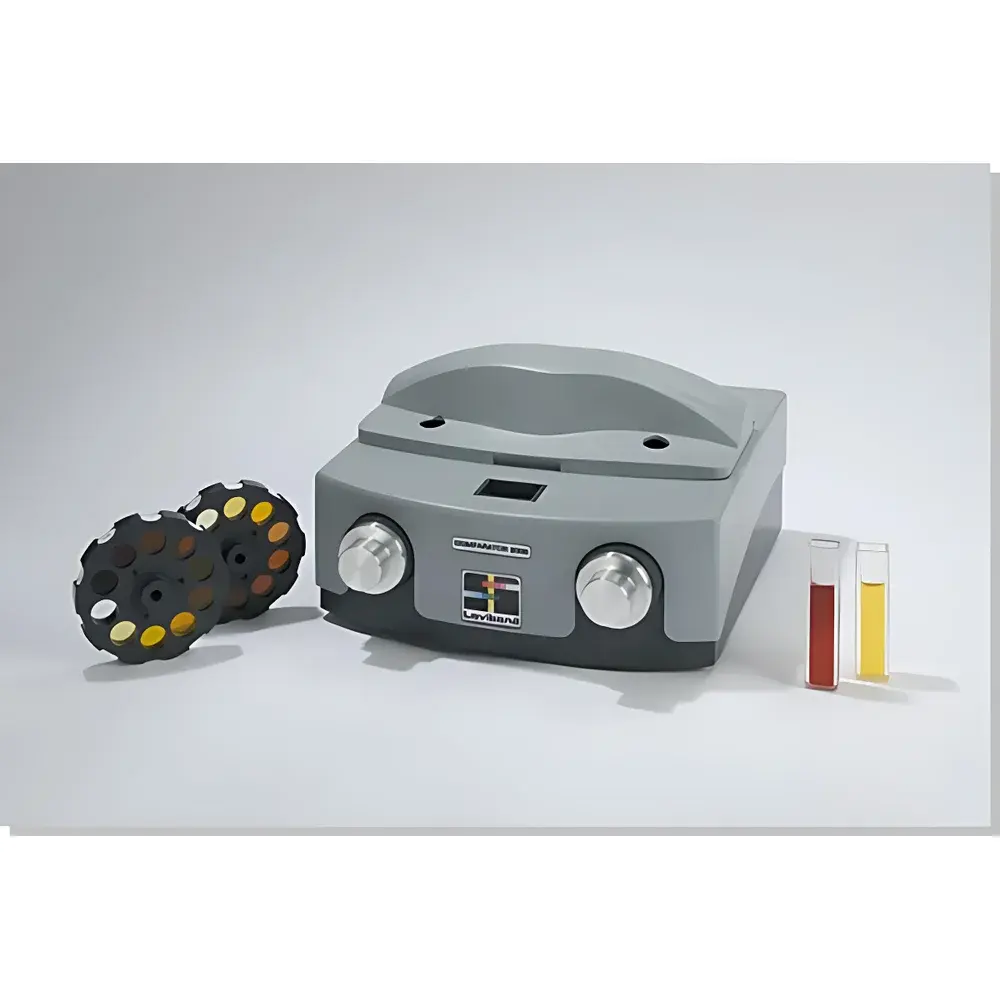
Lovibond AF229 Deep Fat (FAC) Colorimeter
| Brand | Lovibond (Tintometer) |
|---|---|
| Origin | United Kingdom |
| Model | AF229 |
| Light Source | CIE Illuminant C (Tungsten-Halogen Lamp) |
| Color Scale | FAC (Fats Analysis Committee) Scale |
| Measurement Method | Visual Tristimulus Comparison |
| Compliance | AOCS Official Method Cd 13b-92 |
| Configuration | Standard Unit with Dual Reference Discs |
Overview
The Lovibond AF229 Deep Fat (FAC) Colorimeter is a precision visual tristimulus color comparison instrument engineered for the objective assessment of color in highly pigmented lipid-based materials. Designed in accordance with AOCS Official Method Cd 13b-92, it implements the Fats Analysis Committee (FAC) scale—a standardized odd-numbered numerical color grading system specifically developed for deep-colored fats, edible oils, tallow, lard, fish oils, and rendered animal greases. Unlike electronic spectrophotometers, the AF229 relies on human visual perception under controlled photometric conditions, eliminating spectral interpolation artifacts and preserving traceability to primary reference standards. Its optical architecture features a three-field viewing system: the central field displays the sample cell, while left and right fields present independently adjustable Lovibond glass color standards mounted on rotating discs. This arrangement enables direct side-by-side chromatic matching without digital conversion or algorithmic interpolation—ensuring metrological transparency and operator repeatability across shifts and laboratories.
Key Features
- Tristimulus visual comparison design with precisely aligned 3-field optical path for simultaneous sample–standard evaluation
- CIE Illuminant C-compliant tungsten-halogen light source (2856 K), stabilized via constant-voltage regulation to maintain consistent spectral power distribution regardless of ambient lighting or time of day
- Dual calibrated Lovibond glass reference discs containing certified FAC color standards (odd-numbered series from FAC 1 to FAC 40), each traceable to NPL (UK National Physical Laboratory) reference materials
- Integrated neutral density filters and aperture diaphragms to minimize glare and optimize contrast sensitivity for low-luminance, high-saturation samples
- Mechanically robust aluminum alloy housing with anti-reflective black interior finish to suppress stray light and enhance chromatic discrimination accuracy
- No software dependency or calibration drift—performance remains invariant over decades when maintained per AOCS guidelines
Sample Compatibility & Compliance
The AF229 accommodates standard 10.65 mm pathlength cylindrical glass cells (included), compatible with viscous, opaque, or thermally sensitive fat specimens requiring minimal preparation—no dilution, filtration, or heating is necessary. It is routinely employed in QC laboratories adhering to AOCS, ISO 17932:2016 (Animal and vegetable fats and oils — Determination of colour — Lovibond method), and ASTM D156 (Standard Test Method for Saybolt Color of Petroleum Products). The FAC scale is formally recognized in Codex Alimentarius standards for edible tallow and marine oil specifications. Instrument use supports GLP-compliant documentation workflows when paired with paper-based observation logs meeting FDA 21 CFR Part 11 record-keeping expectations for manual analytical methods.
Software & Data Management
The AF229 operates as a fully analog, non-digital measurement system; therefore, no firmware, drivers, or proprietary software are required. Color assessments are recorded manually using standardized AOCS reporting templates. For laboratories integrating digital LIMS environments, FAC values may be entered directly into validated electronic lab notebooks (ELN) or quality management systems (QMS) as discrete integer data points. Traceability is maintained through physical logbooks referencing disc serial numbers, lamp service hours (tracked via built-in hour meter), and analyst initials—fully auditable under ISO/IEC 17025 and GMP Annex 11 requirements for manual instrumentation.
Applications
- Quality control of refined and unrefined animal fats (tallow, lard, poultry fat) during rendering and refining processes
- Batch release testing of marine oils (e.g., cod liver oil, krill oil) where oxidation-induced browning correlates with peroxide value and anisidine number
- Monitoring thermal degradation in frying oils used in food manufacturing and catering operations
- Raw material acceptance testing for cocoa butter substitutes and hydrogenated vegetable shortenings
- Regulatory compliance verification for export shipments subject to EU Commission Regulation (EU) No 2019/1793 on edible fats
- Research applications in lipid oxidation kinetics where FAC serves as a stable, low-cost endpoint indicator alongside GC-FAME and TBARS assays
FAQ
What does FAC stand for, and why is it used for deep-colored fats?
FAC stands for Fats Analysis Committee—the technical subcommittee of the American Oil Chemists’ Society (AOCS) that established this empirically derived, odd-numbered color scale to address limitations of the traditional Lovibond Yellow/Red scale in highly saturated, oxidized, or thermally degraded lipid matrices.
Is the AF229 compliant with international standards?
Yes—it conforms to AOCS Cd 13b-92, ISO 17932:2016, and ASTM D156. Its optical design and reference standards are validated against NPL-traceable colorimetric references.
Can the AF229 measure samples other than fats and oils?
While optimized for lipid matrices, it may be applied to other dark, translucent liquids (e.g., molasses, rosin, certain resins) provided they meet minimum clarity and pathlength transmission requirements per AOCS guidelines.
How often must the lamp and reference discs be replaced?
The tungsten-halogen lamp is rated for ≥2,000 operating hours; discs require no recalibration but should be inspected quarterly for scratches or haze—replacement recommended every 5 years under continuous use.
Does the AF229 require annual third-party calibration?
No—calibration is intrinsic to the physical Lovibond glass standards. Verification consists of routine visual checks against certified reference discs and lamp output validation using a photometric integrator per AOCS Procedure Cd 1a-92.





