
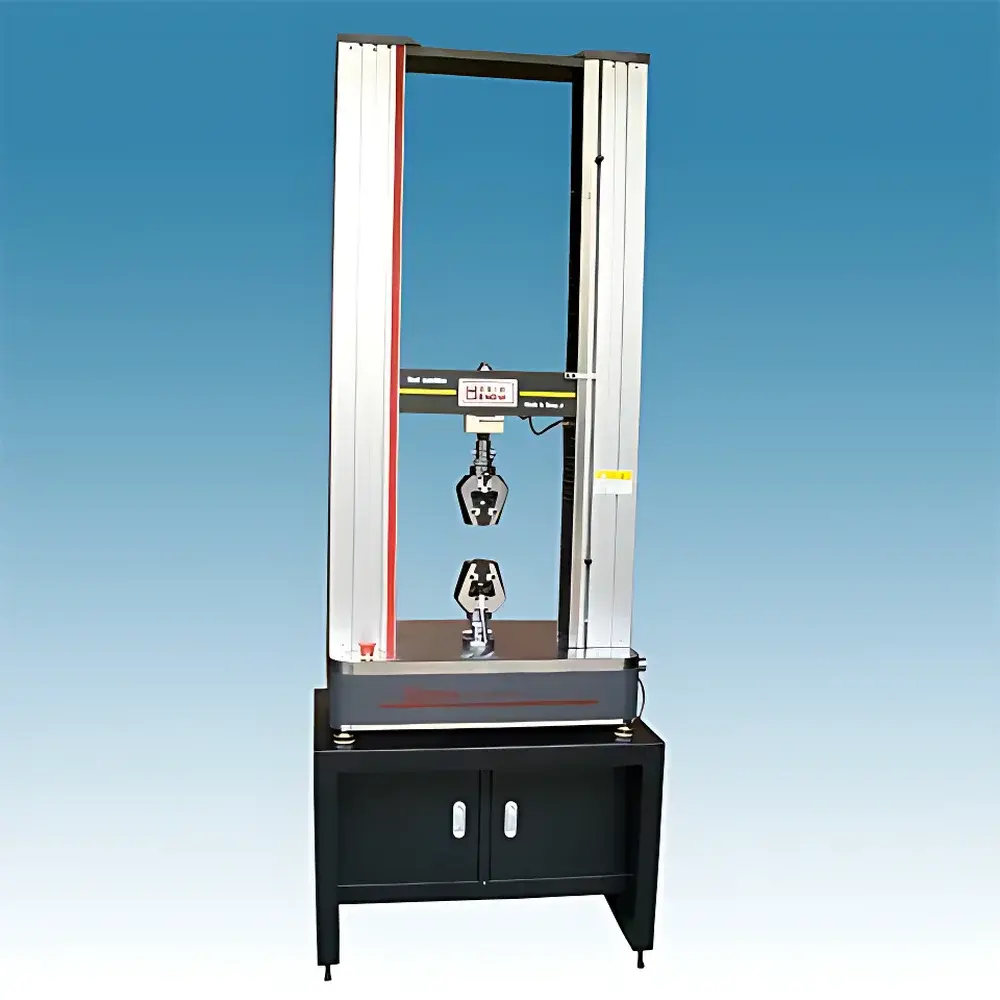
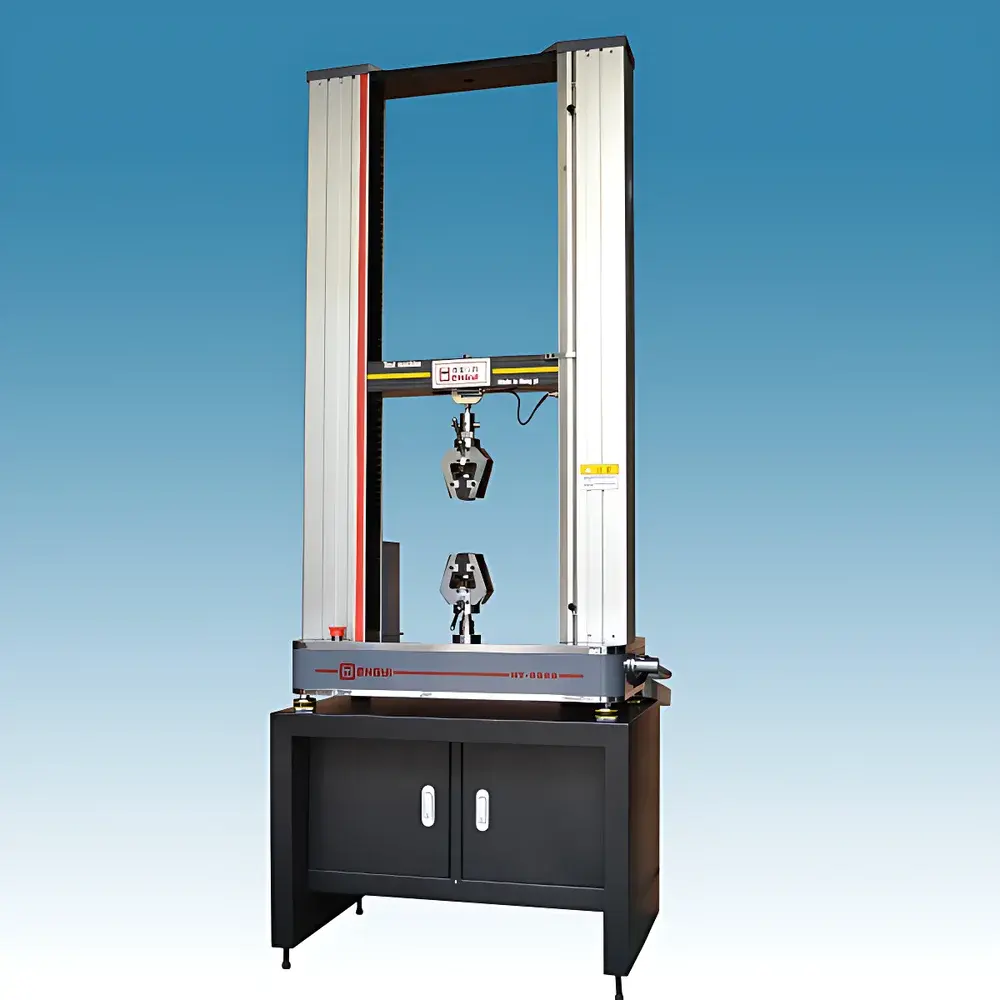
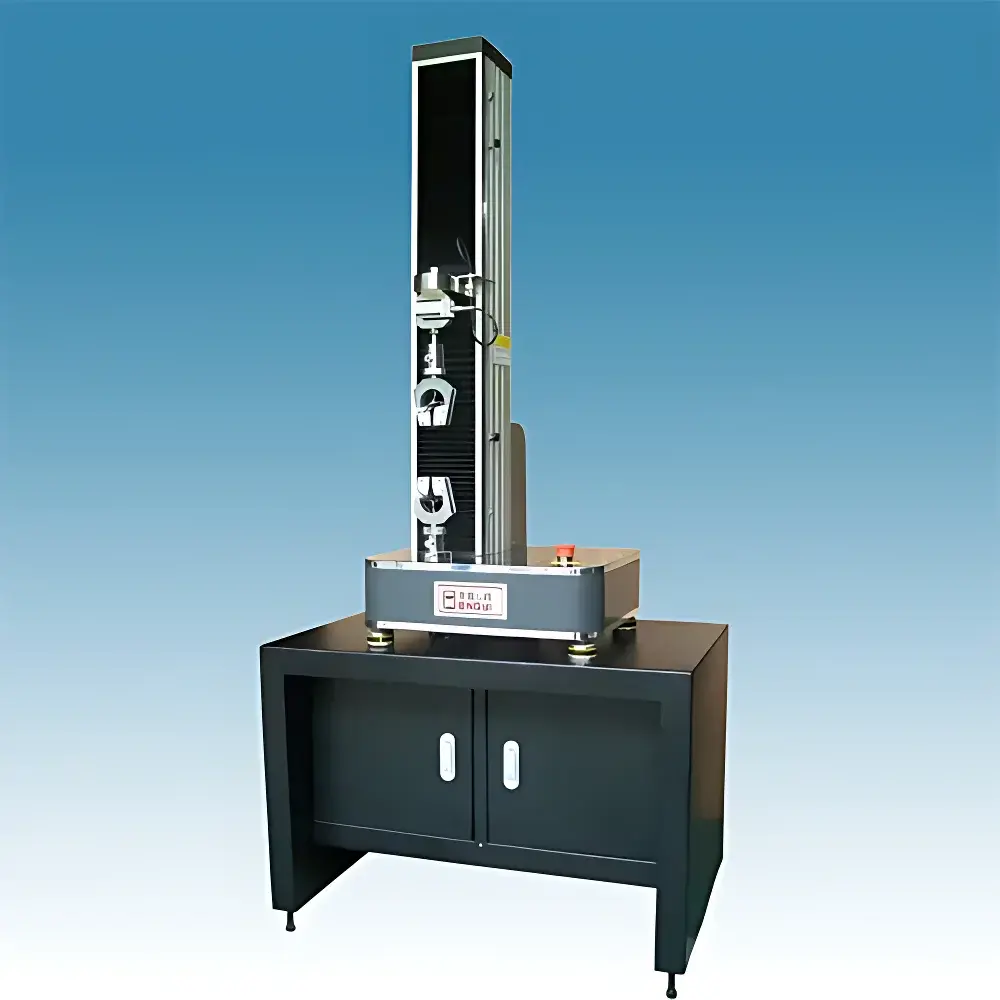
Hengyi HY-1080MJIFI Universal Testing Machine for Acrylic Bone Cement Compression Strength Testing
| Brand | Hengyi / Hengyitest |
|---|---|
| Origin | Shanghai, China |
| Manufacturer Type | Direct Manufacturer |
| Instrument Type | Electromechanical Universal Testing Machine |
| Load Capacity | 10 kN (adjustable down to 100 N) |
| Force Accuracy | ±0.01% of full scale |
| Measurement Accuracy | < ±0.5% |
| Test Speed Range | 0.001–500 mm/min |
| Speed Accuracy | ±0.5% |
| Displacement Accuracy | ±0.5% |
| Effective Test Width | ~380 mm |
| Stroke | ~800 mm |
| Power Supply | 220 V AC |
| Unit Weight | ~210 kg |
| Dimensions (W×D×H) | 700 × 420 × 1600 mm |
| Compliance | GB/T 1041, GB/T 1040, ISO 604, ISO 178, ASTM D695, ASTM D790, ASTM F451, ISO 5833 |
Overview
The Hengyi HY-1080MJIFI Universal Testing Machine is an electromechanical materials testing system engineered for high-precision mechanical characterization of orthopedic biomaterials—specifically acrylic bone cements used in joint arthroplasty and vertebroplasty procedures. Designed in accordance with international standards for implantable medical device evaluation, this system implements closed-loop servo-controlled loading to perform compression, flexural, and tensile tests under rigorously defined displacement or load control modes. Its core architecture integrates a 32-bit ARM9 microprocessor-based controller with a military-grade 24-bit analog-to-digital converter, enabling real-time acquisition of force, displacement, and strain signals at up to 1 kHz sampling rate. The machine supports static and quasi-static mechanical testing per ISO 5833 (Implants for surgery — Acrylic resin cements), ASTM F451 (Standard Specification for Acrylic Bone Cement), and GB/T 1041 (Plastics — Determination of compressive properties). It delivers traceable, reproducible results essential for regulatory submissions, quality assurance, and R&D validation in biomedical polymer laboratories.
Key Features
- 10 kN dual-range load cell with ±0.01% full-scale accuracy and automatic range switching for optimal resolution across low-force (e.g., cement paste deformation) and high-force (e.g., cured cement block compression) regimes
- High-stiffness aluminum alloy frame with anti-aging surface treatment, minimizing thermal drift and mechanical hysteresis during extended test cycles
- Precision ball-screw actuation system with backlash-free preloading, supporting test speeds from 0.001 to 500 mm/min at ±0.5% speed fidelity
- Integrated optical isolation USB 2.0 interface compliant with IEC 61000-4 electromagnetic compatibility standards; hot-pluggable without risk of controller damage
- Real-time dual-channel digital display showing synchronized force (N), displacement (mm), and calculated stress/strain values; auto-scaling time-force and stress-strain curves
- Programmable stop conditions including fracture detection (via slope threshold), preset load/displacement limits, and timed termination—critical for standardized cement compression testing per ISO 5833 Annex B
- Full compliance with GLP data integrity requirements: audit-trail enabled software logs all parameter changes, operator IDs, calibration events, and raw data exports with timestamped metadata
Sample Compatibility & Compliance
The HY-1080MJIFI accommodates standardized cylindrical (e.g., 6 mm × 12 mm) and prismatic (e.g., 10 mm × 10 mm × 50 mm) bone cement specimens as specified in ISO 5833 and ASTM F451. Optional fixtures include compression platens with self-aligning spherical seats, three-point bending jigs (span = 40 mm), and tensile grips with pneumatic clamping for brittle polymer specimens. All test methods are fully configurable to meet regulatory testing protocols required by FDA 21 CFR Part 820 (Quality System Regulation), EU MDR Annex I (General Safety and Performance Requirements), and ISO 13485-certified QA environments. Raw data export formats include CSV and XML, compatible with statistical process control (SPC) platforms and electronic lab notebooks (ELNs).
Software & Data Management
Built on a Windows-native platform, the proprietary test software provides method-driven workflow management—from specimen definition and environmental condition logging (temperature/humidity tags) to automated report generation per ISO/IEC 17025 reporting templates. The VB.NET + SQL Server backend ensures deterministic calculation of key parameters: compressive strength (MPa), elastic modulus (GPa), flexural modulus (GPa), yield offset (0.2% strain), and fracture energy (area under curve). All calculations adhere to ASTM E4 and ISO 7500-1 verification protocols. Software includes built-in uncertainty estimation per GUM (Guide to the Expression of Uncertainty in Measurement) and supports 21 CFR Part 11-compliant electronic signatures when deployed with validated domain authentication and role-based access controls.
Applications
- Quantitative evaluation of acrylic bone cement compressive strength (ISO 5833 Clause 6.2) and setting kinetics via time-dependent modulus tracking
- Mechanical screening of antibiotic-loaded cements, radiopaque additives (e.g., BaSO₄, ZrO₂), and bioactive glass composites
- Comparative analysis of polymerization shrinkage effects on interfacial stress development using custom compression creep protocols
- Validation of sterilization-induced property degradation (gamma vs. ethylene oxide) per ISO 11137
- Supporting ASTM F2118 (Standard Practice for Characterizing Mechanical Properties of Bone Cement) and ISO 14630 (Non-active surgical implants — General requirements)
- Materials qualification for ISO 14801 (Dental implants — Fatigue testing of implant-abutment connections) where composite substrates require mechanical benchmarking
FAQ
Does the HY-1080MJIFI comply with FDA-required validation documentation for medical device testing?
Yes—the system ships with IQ/OQ documentation packages aligned with ASTM E2500 and ISO/IEC 17025. Installation Qualification (IQ) verifies hardware configuration; Operational Qualification (OQ) confirms performance against stated specifications under controlled environmental conditions.
Can the software generate reports compliant with ISO 17025 accreditation requirements?
Yes—reports include instrument identification, calibration status, environmental monitoring data, raw measurement traces, uncertainty budgets, and digitally signed analyst verification fields.
Is third-party calibration certification available for the load cell and displacement transducer?
Yes—certified calibration services traceable to NIM (China National Institute of Metrology) or UKAS-accredited labs are offered with optional on-site verification.
What is the minimum resolvable force for bone cement compression testing at early curing stages?
With the 100 N sub-range activated, the system achieves ≤0.01 N resolution—sufficient to capture initial gelation forces in acrylic monomer-polymer transitions.
How does the system handle specimen slippage during high-speed compression tests?
The controller employs adaptive gain scheduling: proportional-integral-derivative (PID) parameters automatically adjust during loading ramp phases to maintain positional fidelity within ±0.5 µm tolerance, preventing premature failure misclassification.



