
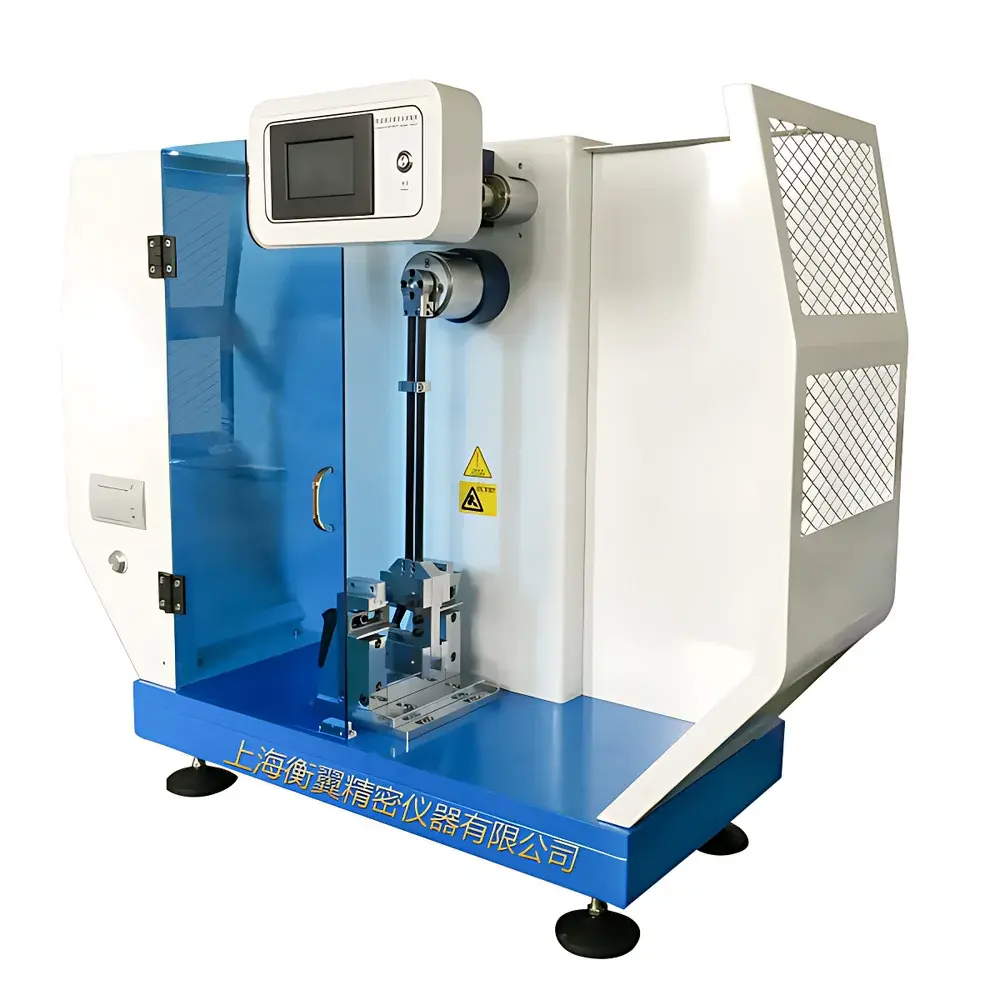
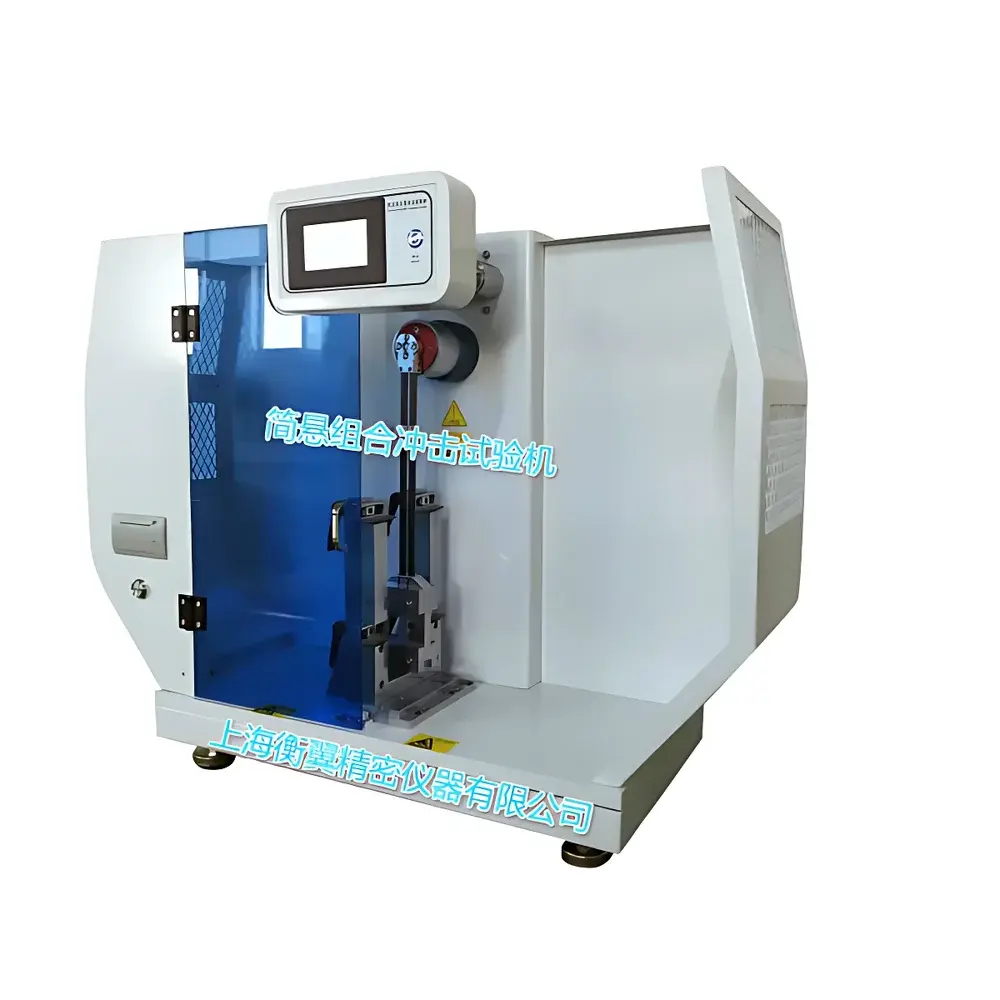
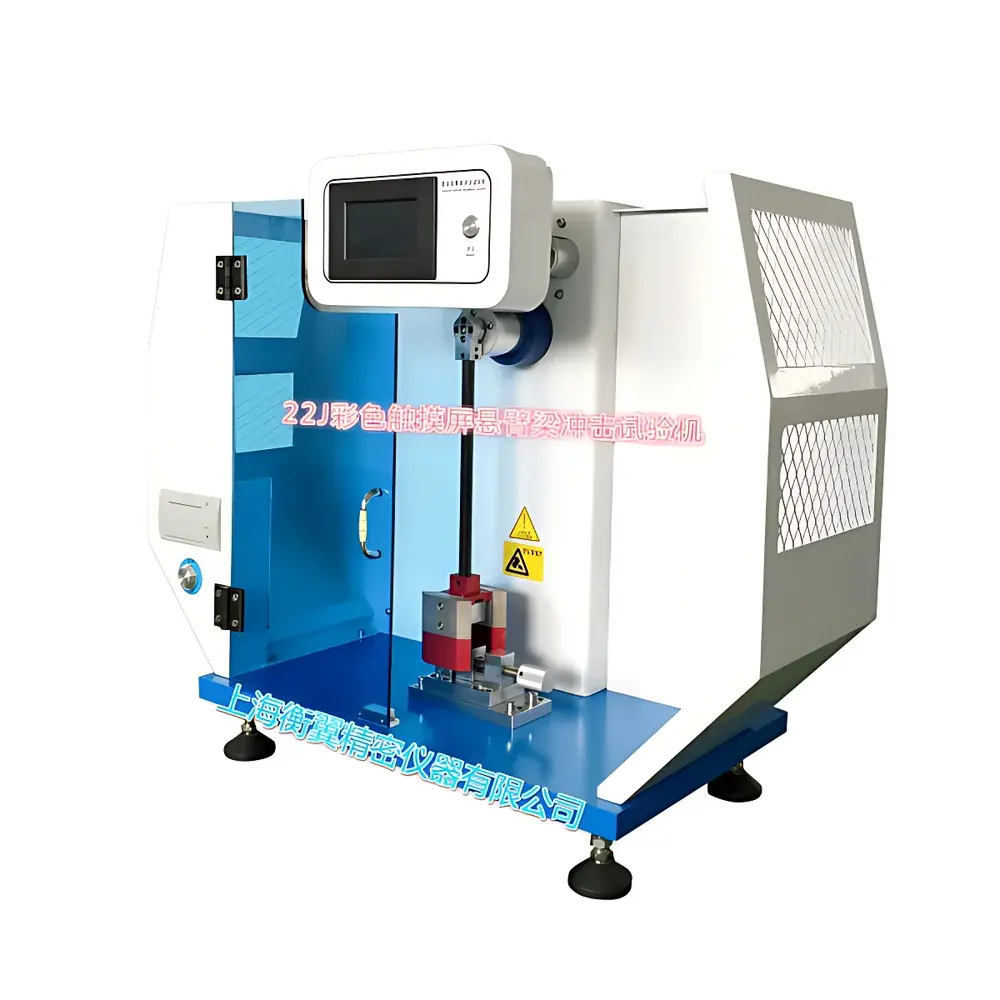
Hengyi HY(BC)-5.5J Digital Cantilever Beam Impact Tester
| Brand | Hengyi |
|---|---|
| Origin | Shanghai, China |
| Manufacturer Type | Direct Manufacturer |
| Product Category | Domestic |
| Model | HY(BC)-5.5J |
| Instrument Type | Pendulum Impact Tester |
| Nominal Impact Energy | 5.5 J |
| Impact Velocity | 3.5 m/s |
| Pendulum Torque (Impact Constant) | 0.53590 N·m |
| Load Cell Range | 5.5 J |
| Maximum Pendulum Lift Height | 395 mm |
| Temperature Range | 15–35 °C |
| Power Supply | AC 220 V, 50 Hz |
| Display Resolution | 0.001 J (≤5.5 J) |
| Energy Loss | ≤1% (at 2.75 J & 5.5 J), ≤2% (at 1 J) |
| Specimen Notch Types | ISO A-type (45° ±1°, R = 0.25 ±0.05 mm), B-type (45° ±1°, R = 1.0 ±0.05 mm) |
| Blade Radius | R = 0.8 ±0.2 mm |
| Distance from Blade Tip to Clamp Surface | 22 ±0.2 mm |
| Blade Angle | 75° |
| Pendulum Center of Strike Distance | 335 mm |
| Pre-lift Angle | 150° |
| Dimensions (W×D×H) | 550 × 350 × 850 mm |
| Net Weight | 160 kg |
Overview
The Hengyi HY(BC)-5.5J Digital Cantilever Beam Impact Tester is a precision-engineered pendulum-type impact testing instrument designed for the quantitative determination of notched and unnotched impact strength in rigid non-metallic materials. It operates on the fundamental principle of gravitational potential energy conversion: a calibrated pendulum is raised to a defined angular position, released, and allowed to strike a standardized specimen clamped in cantilever configuration. The energy absorbed during fracture—calculated as the difference between initial potential energy and residual kinetic energy—is measured with high reproducibility using an integrated load cell and real-time microprocessor compensation. Unlike conventional analog impact testers, this model eliminates reliance on empirical correction charts by performing dynamic friction and air resistance loss compensation *during* the impact event itself—ensuring traceable, first-principle-based energy quantification per ISO 180 and ASTM D256 requirements.
Key Features
- Microprocessor-controlled digital measurement system with automatic real-time compensation for bearing friction and aerodynamic drag losses—no manual chart-based corrections required.
- LCD display interface providing direct readout of absorbed impact energy (in joules) with 0.001 J resolution across the full 1 J–5.5 J range.
- Angle self-identification algorithm ensures accurate energy calculation independent of minor mechanical alignment deviations.
- Dual-notch compatibility: supports both ISO A-type (R = 0.25 mm) and B-type (R = 1.0 mm) specimen geometries per ISO 180 Annex A and ASTM D256 Method A.
- High-stiffness cast-iron base and precision-machined pendulum shaft ensure mechanical stability and long-term repeatability under laboratory conditions.
- Compliant pendulum geometry: nominal impact velocity of 3.5 m/s, strike center distance of 335 mm, and pre-lift angle of 150°—all aligned with international standard kinematic constraints.
Sample Compatibility & Compliance
This tester is validated for use with standardized rectangular bars (typically 80 × 10 × 4 mm) fabricated from thermoplastics (e.g., ABS, PC, PP), reinforced composites (glass-fiber or carbon-fiber filled nylon), ceramic matrix composites, electrical insulating laminates (e.g., FR-4), and cast stone materials. Specimens must be machined to strict dimensional tolerances and feature either A- or B-type notches prepared via precision milling or EDM. The instrument meets the mechanical and metrological requirements of ISO 180:2019 (Plastics — Determination of Izod impact strength), ASTM D256-23 (Standard Test Methods for Determining the Izod Pendulum Impact Resistance of Plastics), GB/T 1843–2008 (Chinese national standard equivalent to ISO 180), GB/T 2611–2007 (General requirements for testing machines), and JB/T 8761–2007 (Mechanical vibration and shock — Pendulum impact testers). Calibration verification follows ISO/IEC 17025 traceable procedures using certified reference specimens.
Software & Data Management
While the HY(BC)-5.5J operates as a standalone benchtop instrument with embedded firmware, its digital output supports RS-232 serial communication for optional integration into centralized laboratory data acquisition systems. Raw energy values, test timestamps, and operator IDs (via manual entry) are logged internally and exportable in CSV format. The firmware implements audit-trail functionality compliant with GLP principles: all parameter changes, calibration events, and test result modifications are time-stamped and non-erasable. For regulated environments (e.g., ISO 9001-certified QC labs), optional PC-based software packages provide enhanced reporting, statistical process control (SPC) charting, and 21 CFR Part 11-compliant electronic signatures when deployed with appropriate validation protocols.
Applications
- Quality control of injection-molded plastic components in automotive and consumer electronics supply chains.
- R&D evaluation of polymer toughening agents (e.g., elastomer blends, nano-fillers) under standardized impact loading.
- Comparative assessment of aging effects (thermal, UV, hydrolytic) on composite material ductility.
- Validation of manufacturing process consistency for fiber-reinforced thermosets used in aerospace secondary structures.
- Teaching laboratories for undergraduate mechanical engineering courses covering fracture mechanics and polymer physics.
FAQ
What standards does the HY(BC)-5.5J fully comply with?
It satisfies the mechanical design, calibration, and operational requirements of ISO 180:2019, ASTM D256-23, GB/T 1843–2008, GB/T 2611–2007, and JB/T 8761–2007.
Can it test specimens with both A-type and B-type notches?
Yes—the machine accommodates both ISO-defined notch geometries; users select the appropriate pendulum hammer and notch gauge during setup.
Is external calibration certification included with purchase?
A factory calibration certificate traceable to CNAS-accredited standards is provided; annual recalibration using certified reference specimens is recommended per ISO/IEC 17025 guidelines.
What environmental conditions are required for valid testing?
Testing must be conducted in a temperature-controlled environment (15–35 °C) with relative humidity <80% RH and minimal air turbulence near the pendulum path.
How is energy loss due to friction compensated?
The embedded microcontroller measures residual pendulum swing angle post-impact and computes instantaneous energy dissipation using pre-characterized friction coefficients—correction occurs autonomously within 200 ms of impact.



