
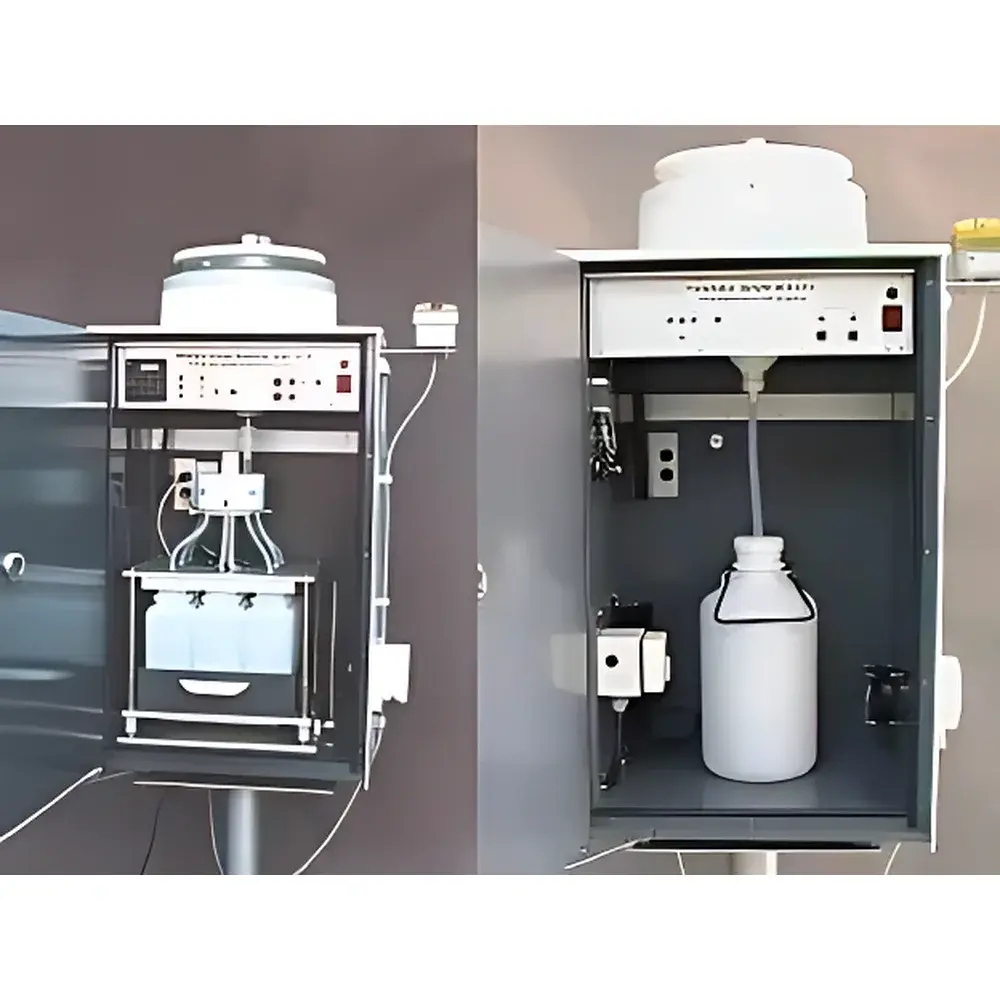
Eigenbrodt NSA181 Precipitation Collector for Mercury-Specific and Multi-Phase Atmospheric Deposition Monitoring
| Brand | Eigenbrodt |
|---|---|
| Origin | Germany |
| Model | NSA181 |
| Application | Mercury (Hg) speciation sampling, wet/dry deposition monitoring, dual- or tri-weekly fractionated collection |
| Cooling | Continuous refrigerated sample chamber (4 °C) |
| Sample Allocation | Motorized multi-bottle distributor (3-position standard) |
| Material Compatibility | Borosilicate glass (DURAN®) and PTFE-wetted surfaces |
| Environmental Certification | Compliant with EN 14211, ISO 10473, and EU Directive 2004/107/EC for heavy metal deposition monitoring |
| Data Interface | RS-485, analog outputs, GSM-enabled telemetry (optional) |
| Power Options | 230 V AC / 12 V DC auto-switching |
| Optional Accessories | IRSS 88 infrared precipitation sensor, snow cover kit, magnetic isolation valve, GLP-compliant audit trail logging (via optional software module) |
Overview
The Eigenbrodt NSA181 Precipitation Collector is a field-deployable, refrigerated atmospheric deposition sampler engineered for high-fidelity collection of mercury (Hg)-containing precipitation and particulate matter under ambient outdoor conditions. Designed in accordance with the metrological requirements of European air quality monitoring networks, it implements a controlled, time-resolved sampling strategy—supporting dual-week (NSA181/KD–MERCURY, NSA181/KD–VMM) and tri-weekly (NSA181/KHT) collection cycles—to enable temporal resolution of Hg deposition fluxes across seasonal gradients. Its core measurement principle relies on gravimetric and chemical-speciation-compatible capture: precipitation is directed via a calibrated funnel into a temperature-stabilized sample chamber (maintained at 4 °C ±1 °C), where sequential allocation to chemically inert receptacles prevents analyte volatilization, oxidation, or adsorption loss—critical for total gaseous mercury (TGM), reactive gaseous mercury (RGM), and particulate-bound mercury (PBM) analysis. The system operates autonomously for up to 6 weeks unattended, integrating meteorological triggering, real-time diagnostics, and remote data telemetry.
Key Features
- Continuous refrigeration: Integrated Peltier-cooled chamber maintains 4 °C sample storage throughout collection cycle—validated per ISO 10473 Annex B for trace-metal preservation.
- Chemically inert fluid path: All wetted components fabricated from DURAN® borosilicate glass and virgin PTFE, minimizing surface adsorption and leaching for ultra-trace Hg analysis (detection limits <0.1 ng/L achievable post-ICP-MS).
- Intelligent sample allocation: Motor-driven 3-position distributor with magnetic isolation valve ensures zero cross-contamination between fractions; valve remains closed during dry periods to prevent airborne contamination ingress.
- Multi-signal diagnostic interface: Real-time monitoring of bottle position, chamber temperature deviation (>±2 °C), actuator status, and enclosure door integrity—each mapped to discrete digital outputs for SCADA integration.
- Flexible power architecture: Auto-switching between 230 V AC mains and 12 V DC battery supply; optional IRSS 88 infrared rain sensor enables event-triggered activation independent of tipping-bucket reliability.
- Modular expansion: Snow cover kit (IP65-rated polycarbonate dome) enables year-round operation in alpine or boreal environments; GSM telemetry module supports encrypted SMS-based status reporting and firmware-over-the-air (FOTA) updates.
Sample Compatibility & Compliance
The NSA181 is validated for collection of wet deposition (rain, snow, fog drip) and coarse dry deposition (settled dust, aerosol particles >10 µm) in accordance with EN 14211:2012 (ambient air—standard method for determination of mercury in precipitation) and ISO 10473:2002 (air quality—sampling of deposited dust). Its material selection meets US EPA Method 1631E requirements for mercury-free sample contact surfaces. When configured with the KD–MERCURY variant, the system satisfies the QA/QC criteria outlined in the European Monitoring and Evaluation Programme (EMEP) Mercury Speciation Protocol, including blank control limits (92% for spiked methylmercury standards). All variants support GLP-compliant metadata tagging—including GPS coordinates, local barometric pressure, and UTC-synchronized timestamps—for regulatory submission to national air quality databases (e.g., EEA AirBase, US EPA AQS).
Software & Data Management
Data acquisition is handled by the embedded Eigenbrodt EDA-200 controller, which logs 24-bit sensor readings at 10 Hz and stores full-cycle diagnostic histories in non-volatile memory (16 MB internal, expandable via microSD). Optional EIGENBRODT DataLink software provides USB/RS-485 connectivity for configuration, calibration verification, and export to CSV or NetCDF formats compliant with FAIR data principles. For regulated environments, the FDA 21 CFR Part 11–compliant Audit Trail Module (sold separately) enables electronic signature enforcement, user role-based access control, and immutable event logging—including all parameter changes, sample transitions, and alarm acknowledgments. Raw telemetry supports MQTT protocol integration with cloud platforms (e.g., AWS IoT Core, Azure IoT Hub) for centralized fleet monitoring.
Applications
- Long-term mercury deposition monitoring at EMEP, GAW, and NADP stations.
- Source apportionment studies near coal-fired power plants, chlor-alkali facilities, and artisanal gold mining zones.
- Validation of atmospheric chemistry transport models (e.g., GEOS-Chem, CMAQ) requiring speciated Hg wet/dry flux inputs.
- Co-location with passive air samplers (e.g., Tekran 2537) to correlate gaseous and depositional mercury pathways.
- Climate–chemistry interaction research: snowpack mercury loading assessment in cryospheric regions.
- Regulatory compliance reporting for national implementation of the Minamata Convention on Mercury.
FAQ
What is the minimum detectable mercury concentration achievable with NSA181-collected samples?
Analytical detection limits depend on downstream instrumentation (e.g., cold vapor atomic fluorescence spectrometry or ICP-MS), but the NSA181’s low-blank design enables routine quantification down to 0.03 ng/L in 500 mL rainwater aliquots when paired with EPA Method 1631E lab protocols.
Can the NSA181 operate without GSM connectivity?
Yes—the base unit functions fully autonomously with local SD card logging and analog/digital I/O; GSM is an optional telemetry layer for remote status alerts and data push.
Is the IRSS 88 precipitation sensor compatible with all NSA181 variants?
Yes—IRSS 88 integrates natively with all NSA181 submodels via dedicated 4–20 mA input and replaces mechanical tipping-bucket reliance for improved accuracy in drizzle, freezing rain, and snowmelt events.
How is temperature stability maintained during extended power outages?
The 12 V DC battery option (with 20 Ah capacity) sustains refrigeration and control logic for ≥72 h at ambient temperatures ≤25 °C; thermal mass of the DURAN® chamber further extends hold time for sample integrity.
Does Eigenbrodt provide calibration certificates traceable to NIST or PTB?
Factory calibration includes traceable verification of temperature sensor (PTB-certified RTD), funnel geometry (laser-scanned dimensional validation), and valve timing (high-speed photogate measurement); full calibration reports are issued per ISO/IEC 17025 upon request.







