
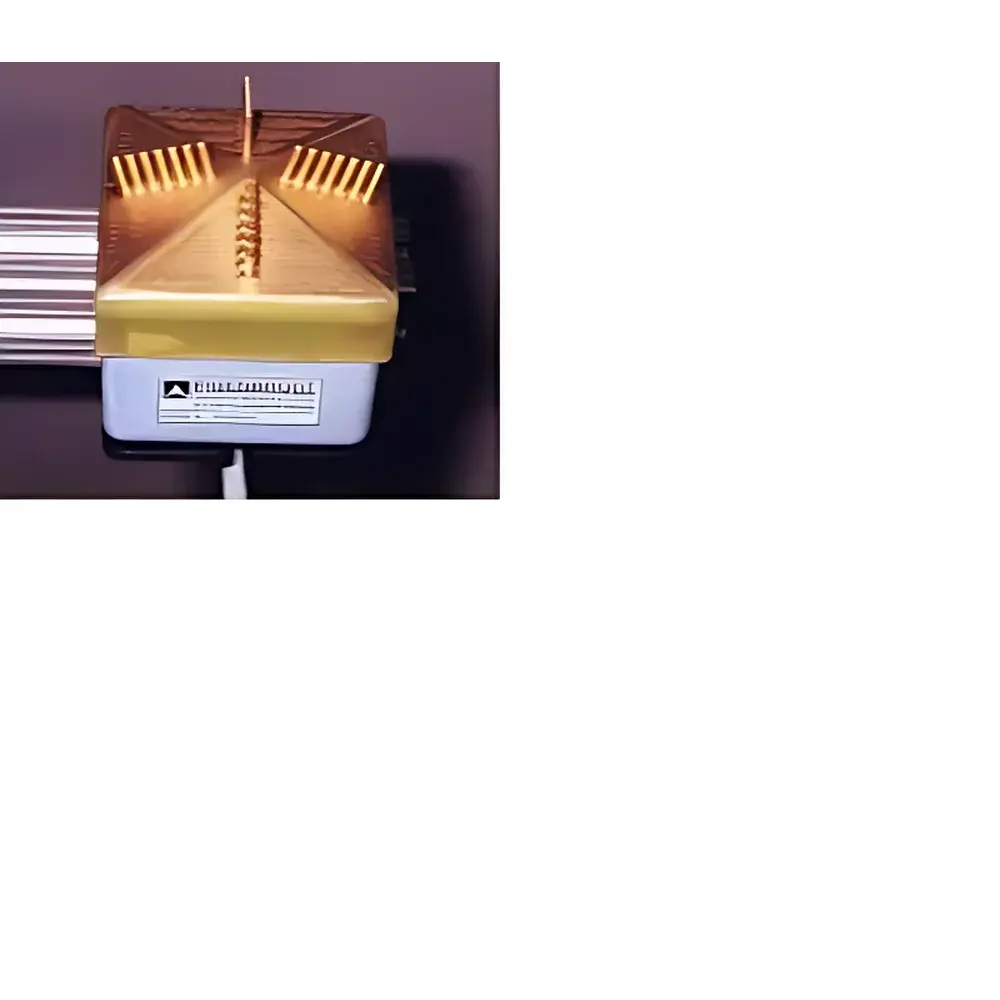
Eigenbrodt RS85/RS85OP/NRS80 Precipitation Sensors
| Brand | Eigenbrodt |
|---|---|
| Origin | Germany |
| Model | RS85 / RS85OP / NRS80 |
| Power Supply | 24 V DC/AC (RS85/RS85OP: max. 20 W |
| NRS80 | max. 700 mA, half-wave rectified) |
| Output | Dry-contact relay (NO/NC), 100 V DC / 250 V AC, 5 A, 1250 VA |
| Sensing Area | RS85/RS85OP ≈ 60 cm² |
| Activation | Instant on-rain detection |
| Deactivation Delay | 0–270 s adjustable in 30 s increments |
| Heating | Dual-stage proportional electronic heating (24 V DC) |
| Enclosure Rating | IP65 |
| Dimensions | RS85/RS85OP 83 × 83 × 85 mm, 700 g |
| Compliance | Designed for continuous outdoor deployment in meteorological and environmental monitoring networks |
Overview
The Eigenbrodt RS85, RS85OP, and NRS80 precipitation sensors are industrial-grade, climate-resilient devices engineered for reliable rain/snow onset and cessation detection in automated environmental monitoring systems. Each model operates on the principle of conductive surface wetting: rainfall or melted snow bridges micro-electrodes on a precisely angled, gold-plated sensing surface, completing an electrical circuit and triggering a dry-contact relay output. This binary (YES/NO) detection method provides deterministic, low-latency activation—critical for controlling roof hoods, sample collectors, valve actuators, and real-time data logging systems in compliance with ISO 13370, WMO No. 8 guidelines, and national hydrometeorological network protocols. Unlike optical or acoustic methods, these sensors deliver robust performance under high-humidity, freezing, dusty, or saline coastal conditions without drift or false positives from dew or condensation. Their solid-state architecture—featuring no moving parts, sealed electronics, and corrosion-inhibiting gold plating—ensures long-term stability across temperature ranges from −30 °C to +70 °C.
Key Features
- Gold-plated sensing surface (RS85/RS85OP: ~60 cm²; NRS80: ~40 cm²) for corrosion resistance and stable conductivity over decades of exposure
- Pyramid-shaped (RS85/RS85OP) or adjustable 30° tilt (NRS80) geometry to ensure rapid runoff and minimize standing water retention
- Dual-stage proportional heating (24 V DC): low-power standby mode maintains surface readiness; high-power mode activates instantly upon wetting to accelerate evaporation and reduce deactivation delay
- Configurable deactivation delay (0–270 s, in 30 s steps) allows system-level tuning to match local evaporation dynamics and avoid chattering during intermittent drizzle
- IP65-rated polyester housing (RS85/RS85OP) or compact polycarbonate enclosure (NRS80) with screw-removable lid for field maintenance and calibration verification
- Electromechanical relay output (5 A, 1250 VA) compatible with PLCs, SCADA I/O modules, and legacy control panels without signal conditioning
Sample Compatibility & Compliance
These sensors are designed for integration into regulated environmental sampling workflows—including EPA Method 1694-compliant atmospheric deposition studies, ISO 5667-10-based wet-only precipitation collection, and GLP-aligned air quality monitoring stations. The RS85 variant includes four vertical gold-plated probes to detect snowmelt initiation—enabling differentiation between frozen and liquid-phase precipitation events per WMO Guide to Instruments and Methods of Observation (CIMO Guide, Chapter 12). All models meet CE marking requirements for electromagnetic compatibility (EN 61326-1) and environmental protection (EN 60529, IP65). Their relay outputs support fail-safe interlocking with rain-sampling systems certified under DIN EN 12341 and VDI 2119 standards. No software-based validation is required for binary event detection; however, audit trails of relay state changes may be logged in accordance with FDA 21 CFR Part 11 when integrated with compliant data acquisition hardware.
Software & Data Management
The RS85, RS85OP, and NRS80 operate as autonomous, analog-free digital transducers—requiring no firmware updates, driver installation, or proprietary software. Relay status (open/closed) is directly wired to external DAQ systems (e.g., Campbell Scientific CR1000X, Siemens Desigo CC, or custom PLC logic). For traceable environmental monitoring, users commonly log timestamps of relay closure and opening alongside concurrent measurements of temperature, RH, wind speed, and barometric pressure. When deployed in networks, these sensors feed discrete event flags into time-series databases (e.g., InfluxDB or TimescaleDB) where precipitation start/end times are used to trigger metadata tagging, QA/QC flagging, or automated report generation. Optional accessories—including aluminum-enclosed 220–230 V AC / 24 V DC power supplies and galvanized mounting masts—facilitate plug-and-play integration into existing infrastructure without voltage conversion or grounding complications.
Applications
- Automated wet-only precipitation samplers in national atmospheric deposition networks (e.g., NADP/NTN, EMEP)
- Real-time roof hood actuation in rooftop air intake systems for HVAC and cleanroom facilities
- Triggering of bypass valves in stormwater quality monitoring stations (ISO 5667-14)
- Event-synchronized particulate matter (PM2.5/PM10) filter exchange in ambient air monitoring shelters
- Validation reference for optical precipitation gauges (e.g., IRSS 88) in dual-sensor redundancy configurations
- Climate station automation for frost-thaw cycle detection and freeze-thaw index derivation
FAQ
How does the RS85 differentiate between rain and snow?
The RS85 uses four vertically oriented gold-plated probes integrated into its pyramidal surface. When snow accumulates and begins melting, capillary action draws moisture downward to contact multiple probes simultaneously—generating a distinct, sustained conductivity signature distinguishable from transient raindrop impacts.
Can the deactivation delay be disabled entirely?
Yes—the delay is fully configurable from 0 seconds (instant deactivation upon drying) up to 270 seconds. Zero-delay mode is recommended for applications requiring immediate response to precipitation cessation, such as emergency roof closure in sensitive laboratory environments.
Is heater power consumption included in the stated 20 W rating for RS85?
Yes—the 20 W maximum accounts for combined electronics and full-power heating operation. Typical standby power draw is <1.2 W; peak heating load occurs only during active wetting events and lasts ≤90 seconds per event.
What maintenance is required for long-term reliability?
Annual visual inspection of the gold-plated surface for debris accumulation and verification of mechanical tilt angle (for NRS80) is sufficient. No recalibration is needed; sensor drift is negligible due to passive conductive measurement physics and absence of optical components.
Are these sensors suitable for marine coastal installations?
Yes—gold plating, IP65 sealing, and non-ferrous construction provide inherent resistance to salt-laden aerosols. Users in offshore or harbor environments should mount units ≥2 m above splash zone and orient the sensing surface away from prevailing winds to minimize salt deposition.
Related Products







