
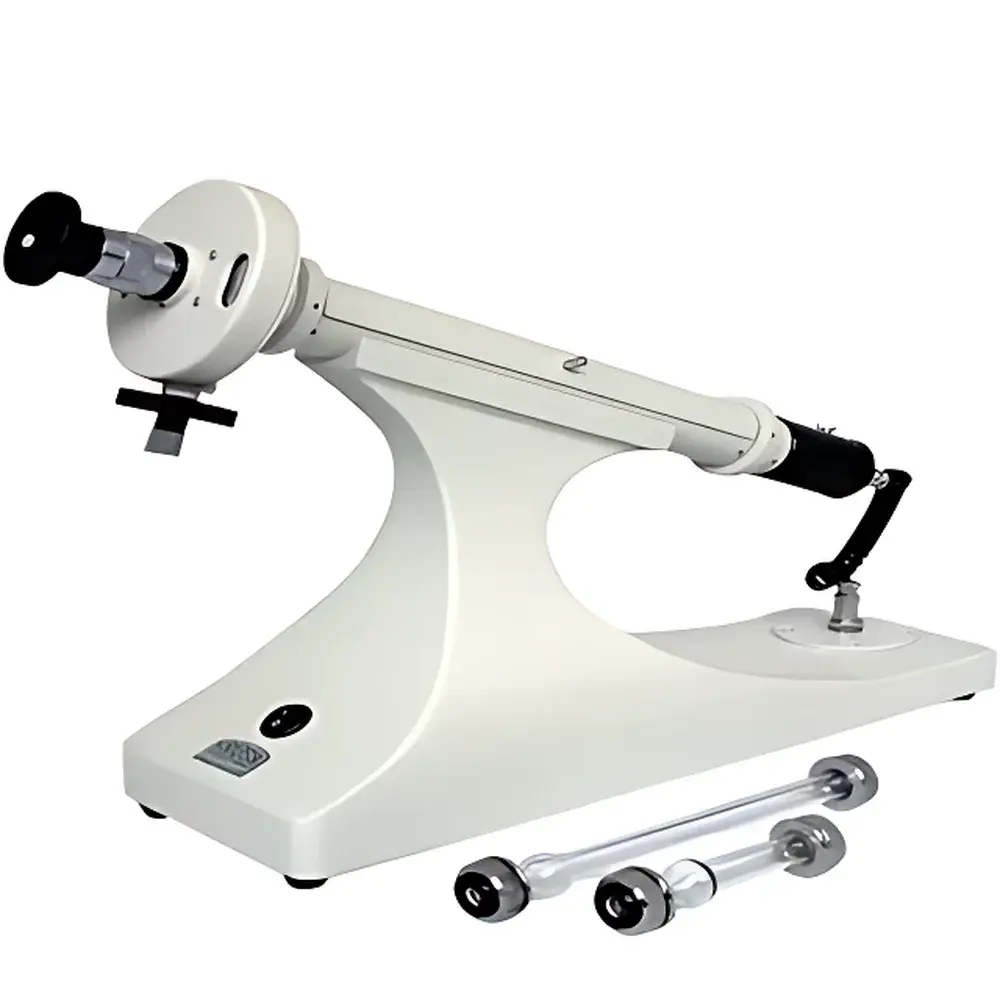
KRUESS P1000-LED Manual Polarimeter
| Brand | KRUESS |
|---|---|
| Origin | Germany |
| Model | P1000-LED |
| Instrument Type | Circular Polarimeter |
| Light Source | LED |
| Measurement Range | ±180° (2 half-circles) |
| Angular Scale Division | 1° |
| Reading Accuracy | ±0.05° (vernier scale) |
| Sample Tube Length | 100–200 mm (standard 220 mm cell chamber) |
| Dimensions (W×D×H) | 14.0 × 33.0 × 50.0 cm |
| Weight | 4.3 kg |
| Temperature Control | None |
| Display | Analog (optical vernier, no digital readout) |
| Compliance | Designed per ISO 13871 and ASTM E1254 for manual polarimetric measurement |
Overview
The KRUESS P1000-LED Manual Polarimeter is a precision optical instrument engineered for fundamental chiral analysis in academic laboratories, quality control environments, and training applications. It operates on the classical half-shade field principle—a robust, interference-free method relying on visual alignment of two adjacent brightness fields within the eyepiece. This mechanical design eliminates electronic dependencies, ensuring long-term stability and metrological traceability without software calibration drift. The instrument measures the angular rotation of plane-polarized light induced by optically active substances—such as sugars, amino acids, pharmaceuticals, and essential oils—providing direct quantitative determination of specific rotation [α] under defined wavelength (589 nm, sodium D-line equivalent), path length, and concentration conditions. Its all-metal base and rigid optical housing deliver mechanical stability critical for reproducible manual alignment, while the integrated 220 mm sample chamber accommodates standard-length glass tubes (100 mm and 200 mm included), supporting both routine verification and comparative analysis across multiple sample formats.
Key Features
- High-stability mechanical architecture with cast-aluminum base and precision-ground optical mounts
- Long-life LED light source emitting at 589 nm (D-line equivalent), rated for >50,000 hours—eliminating sodium lamp replacement cycles and spectral drift
- Vernier scale with 1° main divisions and 0.05° interpolation resolution, enabling manual reading with certified repeatability per ISO 13871 Annex B
- Dual-element optical train: fixed polarizer and rotatable analyzer with calibrated angular encoder ring and locking mechanism
- Integrated rotating cover for ambient light suppression and consistent viewing geometry
- Compliance-ready mechanical design—no firmware or software components, facilitating straightforward validation in GLP-regulated teaching labs and QC workflows
Sample Compatibility & Compliance
The P1000-LED accepts standard cylindrical glass sample cells (100 mm and 200 mm lengths supplied; 220 mm maximum chamber capacity). Tubes are secured via spring-loaded end caps to minimize axial displacement during rotation. The instrument conforms to the geometric and photometric requirements specified in ISO 13871:2019 (Polarimeters — Performance requirements and tests) and ASTM E1254-22 (Standard Guide for Validation of Analytical Methods for Optical Rotation). While it does not incorporate active temperature regulation, its thermal mass and low-power LED minimize thermal gradients during short-duration measurements—making it suitable for ambient-condition protocols aligned with USP and Ph. Eur. 2.2.7. All optical surfaces are coated for minimal reflectance loss, and the LED spectral bandwidth (<5 nm FWHM) meets the monochromaticity criteria for pharmacopoeial polarimetry.
Software & Data Management
The P1000-LED is a fully analog, software-free instrument. No embedded microcontroller, data logging, or digital interface is present—ensuring zero cybersecurity surface and eliminating requirements for 21 CFR Part 11 compliance documentation. Measurement values are recorded manually into laboratory notebooks or LIMS-compatible spreadsheets. This architecture supports audit-ready documentation practices: each reading includes operator ID, sample ID, tube length, ambient temperature (recorded separately), and raw vernier value—enabling full traceability per ISO/IEC 17025 clause 7.7. Calibration verification is performed using certified quartz control plates (optional accessory), with results logged alongside instrument identification and date.
Applications
- Determination of sucrose concentration in food and beverage extracts (e.g., ICUMSA methods)
- Enantiomeric purity assessment of synthetic intermediates in fine chemical synthesis
- Educational demonstration of optical activity, Fresnel’s theory, and Malus’ law
- Pharmaceutical raw material identity testing per USP monographs (e.g., glucose, levodopa, epinephrine)
- Quality assurance of chiral solvents and natural product isolates (e.g., limonene, camphor)
- Method transfer validation between automated and manual polarimetric platforms
FAQ
Does the P1000-LED support temperature-controlled measurements?
No. It is a manually operated, ambient-temperature instrument without Peltier or fluid-circulation temperature regulation.
Can it be used for regulatory submissions under FDA or EMA guidelines?
Yes—as a primary reference method where pharmacopoeial monographs permit manual polarimetry (e.g., USP , Ph. Eur. 2.2.7); validation documentation must include operator qualification, calibration plate traceability, and environmental monitoring records.
What is the expected lifetime of the LED light source?
Rated minimum operational life is 50,000 hours at nominal drive current—approximately 500× longer than conventional sodium vapor lamps.
Is the instrument supplied with calibration standards?
A set of certified quartz control plates (±5°, ±10°, ±30°) is available as optional accessory; the base configuration includes only sample tubes and alignment tools.
How is measurement uncertainty determined for this instrument?
Per ISO 13871, combined standard uncertainty is dominated by vernier reading error (±0.05°), tube centering deviation (±0.1°), and wavelength tolerance (±0.5 nm), yielding an expanded uncertainty (k=2) of ±0.2° under controlled lab conditions.







