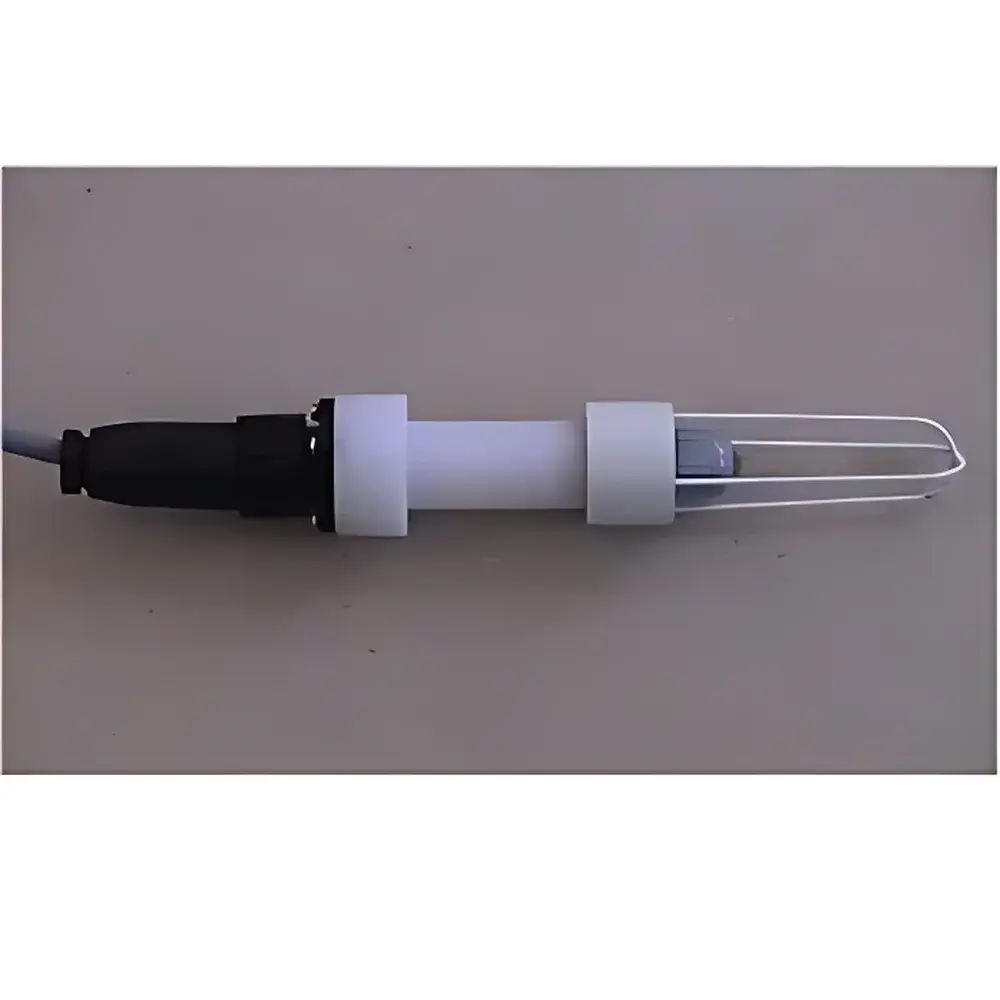
Eigenbrodt LTS 2000 Atmospheric Temperature Sensor
| Brand | Eigenbrodt |
|---|---|
| Origin | Germany |
| Model | LTS 2000 |
| Sensor Type | Pt-100 (DIN EN 60751 / IEC 60751) |
| Measurement Range | −40 °C to +50 °C |
| Operating Temperature | −30 °C to +40 °C |
| Accuracy | ±0.2 K at 0 °C |
| Total Error | ±(0.3 °C + 0.005 × t °C), where t = absolute temperature in °C |
| Response Time (at 1 m/s airflow) | ≈25 s |
| Resistance Output | ≈80–120 Ω |
| Time Constant | <1 min |
| Resolution | <0.1 K |
| Tolerance Class | 1/3 Class B |
| Mounting Height | 5 cm above ground level |
| Compatible Enclosure | LAM 630 radiation shield |
Overview
The Eigenbrodt LTS 2000 is a high-stability, precision-grade atmospheric temperature sensor engineered for long-term, unattended operation in meteorological and environmental monitoring networks. Designed and manufactured in Germany, it conforms to the stringent calibration and installation requirements defined by the German Meteorological Service (Deutscher Wetterdienst, DWD) for official climate observation. The sensor employs a hermetically sealed Pt-100 platinum resistance thermometer (PRT) element compliant with DIN EN 60751 and IEC 60751 standards—ensuring traceable accuracy, low drift, and robust thermal stability across extended exposure cycles. Its measurement principle relies on the well-characterized linear resistance–temperature relationship of platinum, enabling direct, analog resistance output (80–120 Ω) that can be interfaced with standard data loggers supporting 2-, 3-, or 4-wire Pt-100 configurations. The LTS 2000 is not a standalone weather station but a core sensing module intended for integration into certified radiation shielding systems—most commonly the LAM 630 passive ventilated radiation shield—to eliminate solar loading and convective bias during ambient air temperature measurement.
Key Features
- Pt-100 sensing element with 1/3 Class B tolerance per DIN EN 60751—exceeding standard Class B performance for enhanced field accuracy
- Hermetic glass-encapsulated construction ensuring long-term stability and resistance to humidity-induced drift
- Optimized thermal mass and geometry for rapid response: <25 s time constant at 1 m/s wind speed (per DWD test protocol)
- Low self-heating design with excitation current compatibility ≤1 mA—minimizing measurement error due to Joule heating
- Robust stainless-steel housing rated IP65 for outdoor deployment; compatible with standardized mounting brackets (SHE 850 series)
- Fixed 5 cm elevation above ground plane—aligned with WMO and DWD reference height for near-surface air temperature
- No internal electronics or signal conditioning: delivers raw, linear resistance output for maximum system-level calibration control
Sample Compatibility & Compliance
The LTS 2000 is explicitly designed for use within internationally recognized passive radiation shielding systems, primarily the LAM 630 ventilated screen—a DWD-certified enclosure meeting ISO 8500-1:2021 requirements for solar radiation attenuation and natural ventilation. It is installed at precisely 5 cm above ground level using either the SHE 850 or SHE 850/B mounting bracket, both conforming to DWD technical specifications for spatial repeatability and mechanical stability. The sensor complies with the European Standard EN 13039:2001 (Meteorological instruments — Requirements for temperature sensors) and supports adherence to WMO Guide to Instruments and Methods of Observation (CIMO Guide, Chapter 4). Its metrological traceability is maintained through factory calibration against national standards (PTB-accredited), with optional UKAS or DAkkS-certified calibration certificates available upon request.
Software & Data Management
As a passive analog sensor, the LTS 2000 does not incorporate embedded firmware, digital communication protocols, or onboard memory. It interfaces exclusively via analog resistance measurement—requiring external data acquisition hardware capable of precision 4-wire ohmmetry (e.g., Campbell Scientific CR1000X, Delta-T DL2e, or HOBO U30-NRC). When integrated into regulated environments (e.g., GLP-compliant environmental monitoring or EU ETS reporting sites), the sensor’s raw resistance values are converted to temperature using the Callendar–Van Dusen equation per IEC 60751, with full audit trail support in compliant logging software. Systems employing the LTS 2000 may meet FDA 21 CFR Part 11 requirements when paired with validated data loggers featuring electronic signatures, change history, and secure user access controls.
Applications
- National and regional meteorological networks requiring DWD-compliant temperature measurements
- Climate reference stations participating in GCOS (Global Climate Observing System) or ECA&D (European Climate Assessment & Dataset)
- Environmental impact assessments and long-term ecological monitoring (LTER sites)
- Calibration transfer and intercomparison studies between reference and operational sensors
- Air quality monitoring networks where temperature-corrected gas concentration calculations depend on high-fidelity ambient readings
- Validation of numerical weather prediction (NWP) model surface layer outputs
FAQ
Is the LTS 2000 suitable for direct outdoor mounting without a radiation shield?
No. Direct exposure to solar radiation will introduce significant positive bias (>2–5 °C). It must be used exclusively within a certified passive radiation shield such as the LAM 630.
What is the recommended excitation current for optimal accuracy?
A maximum of 1 mA is advised to limit self-heating error; higher currents require correction per IEC 60751 Annex D.
Can the LTS 2000 be used in automated weather stations (AWS)?
Yes—provided the AWS data logger supports precision Pt-100 resistance measurement and implements the full Callendar–Van Dusen algorithm.
Does Eigenbrodt provide calibration certificates with NIST or PTB traceability?
Factory calibration is traceable to PTB standards; accredited calibration certificates (DAkkS or UKAS) are available as optional add-ons.
What is the expected service life under continuous outdoor operation?
With proper installation in a LAM 630 shield and periodic verification (recommended every 2 years), the LTS 2000 demonstrates operational stability exceeding 10 years.