
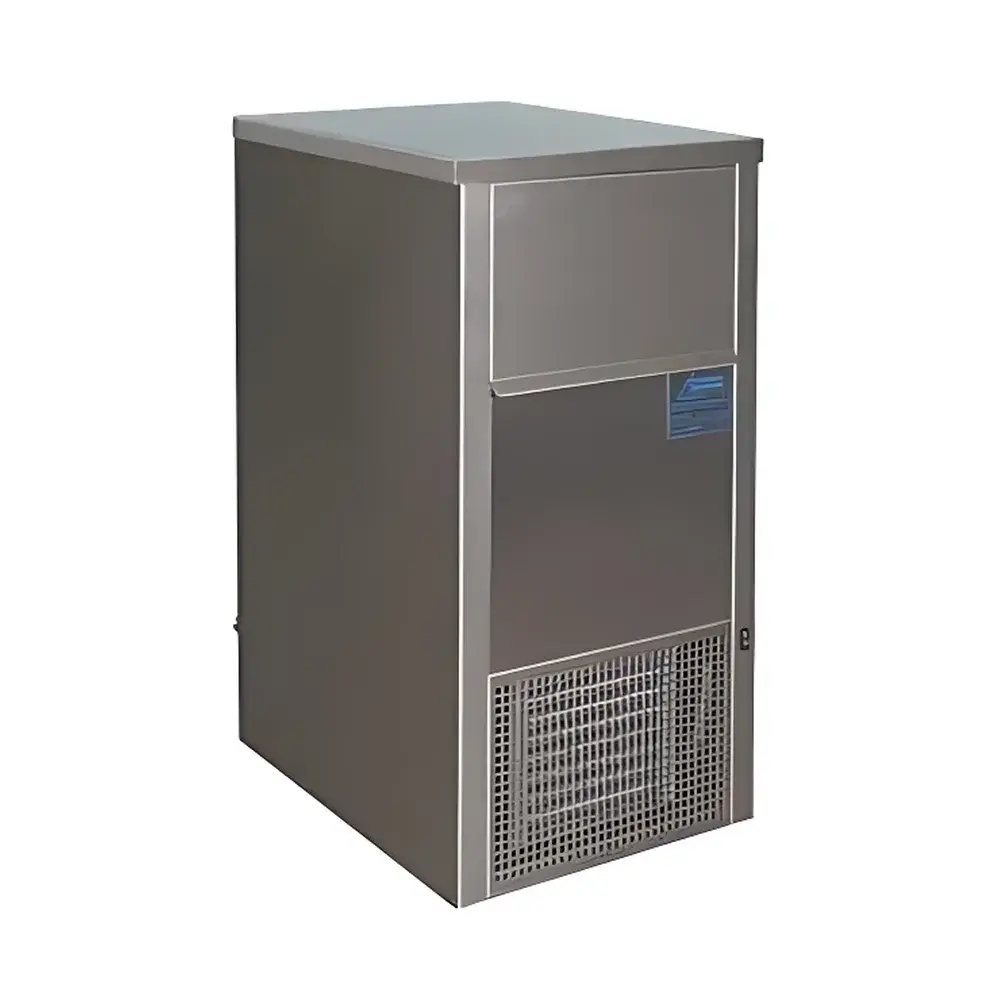
ZIEGRA ZBE 70-35 Flake Ice Machine
| Brand | ZIEGRA |
|---|---|
| Origin | Germany |
| Model | ZBE 70-35 |
| Ice Production Capacity | 70 kg/24 h |
| Ice Storage Capacity | 35 kg |
| Water Consumption | ~1 L/kg |
| Cooling Method | Hermetic Compressor |
| Ice Type | Flake Ice |
| Ice Temperature | –0.5 °C |
| Power Supply | 230 V, 50 Hz, 0.4 kW |
| Ambient Operating Temperature | 7–42 °C |
| Refrigerant | R404A (optional R290) |
| Sound Pressure Level | 45 dBA |
| Dimensions (W×D×H) | 460 × 600 × 910 mm |
| Net Weight | 70 kg |
| Construction | Full Stainless Steel (AISI 304) |
| Insulation | Polyurethane Foam, 40 mm Thickness |
| Compliance | EU Drinking Water Directive 98/83/EC, EN 60335-1, EN 60335-2-74 |
Overview
The ZIEGRA ZBE 70-35 is a laboratory-grade flake ice machine engineered for continuous, high-reliability ice production in demanding scientific and clinical environments. Designed and manufactured in Germany, it employs a dual-screw extrusion principle to produce dry, thin, irregularly shaped flake ice with a consistent surface temperature of –0.5 °C—optimized for rapid thermal transfer without clumping or excessive fusion during storage. Unlike cube or nugget ice systems, flake ice offers superior surface-area-to-volume ratio and conformability, making it ideal for sample cooling, biological specimen preservation, chromatography column temperature control, and cold-chain integrity maintenance during transport or benchtop assays. The unit operates autonomously under microprocessor-based logic, dynamically adjusting compression cycle timing, water feed intervals, and evaporator dwell time based on ambient load and reservoir fill level—ensuring stable output across fluctuating environmental conditions (7–42 °C ambient) and inlet water temperatures (5–30 °C).
Key Features
- Full AISI 304 stainless steel construction—internally and externally—resistant to corrosion, compliant with ISO 8573-1 for compressed air purity and EU hygiene standards for food-contact surfaces.
- Hermetically sealed refrigeration circuit using R404A (with R290 option available), optimized for low-GWP operation and long-term compressor stability under continuous 24/7 duty cycles.
- 40 mm polyurethane insulation layer in the storage bin minimizes thermal bridging and maintains ice integrity for up to 72 hours without manual intervention.
- Intelligent defrost management: adaptive hot-gas defrost triggered only when evaporator frost accumulation exceeds threshold—reducing energy waste and extending component life.
- Integrated safety architecture including overtemperature cut-off, phase-loss protection, water-level monitoring, and automatic shutdown upon drain line obstruction or low-flow detection.
- Low acoustic signature (45 dBA at 1 m) enables installation in shared lab spaces, cleanrooms (ISO Class 7–8 compatible), or near sensitive instrumentation such as mass spectrometers or NMR consoles.
Sample Compatibility & Compliance
The ZBE 70-35 is validated for use with biological samples (e.g., blood bags, tissue biopsies, PCR reagents), pharmaceutical intermediates, and calibration standards requiring non-aggressive, uniform thermal contact. Its ice meets EN 13486:2002 requirements for ice intended for direct contact with consumables and diagnostic materials. All wetted components comply with EU Directive 98/83/EC for drinking water quality, and the system supports GLP-compliant documentation via optional RS485 Modbus RTU interface. It satisfies mechanical safety requirements per EN 60335-1 and EN 60335-2-74 (Household and Similar Electrical Appliances — Safety — Part 2-74: Particular Requirements for Ice Makers), and may be integrated into ISO 17025-accredited laboratories with traceable calibration of water inlet pressure (1–5 bar) and supply temperature sensors.
Software & Data Management
While the ZBE 70-35 operates as a standalone appliance, its embedded controller logs operational parameters—including cumulative runtime, number of defrost cycles, average ice yield per cycle, and fault history—for local review via front-panel LCD. For networked deployment, an optional communication module enables integration into LabVantage, STARLIMS, or custom SCADA platforms via Modbus RTU. Audit trails meet FDA 21 CFR Part 11 requirements when paired with third-party electronic logbook software supporting digital signatures and immutable timestamping. No cloud connectivity is built-in; all data remains on-premise unless explicitly configured by the end user.
Applications
- Cooling of enzymatic reaction mixtures during kinetic assays and ELISA plate incubation.
- Temperature stabilization of HPLC autosampler trays and column ovens during method development.
- Pre-chilling of centrifuge rotors and cryogenic sample tubes prior to ultra-low temperature processing.
- On-demand ice supply for histopathology tissue embedding stations and frozen section microtomes.
- Backup cold source for refrigerator/freezer validation studies (IQ/OQ/PQ) where redundant thermal mass is required.
- Support of ASTM D445 (kinematic viscosity) and ISO 3104 testing protocols requiring precisely controlled bath temperatures.
FAQ
What is the expected service life under continuous laboratory operation?
Rated for ≥15 years of uninterrupted use when maintained per ZIEGRA’s scheduled servicing protocol (biannual refrigerant pressure verification, annual evaporator cleaning, and quarterly water filter replacement).
Can the unit operate reliably in tropical climates with high humidity and ambient temperatures up to 42 °C?
Yes—the condenser coil and fan assembly are oversized for Class 4 tropical rating per IEC 60068-2-14; performance derating is limited to ≤8% at 42 °C/80% RH.
Is potable water supply mandatory, or can deionized water be used?
Potable water meeting EU Directive 98/83/EC is required; DI water is not recommended due to increased risk of scale formation on stainless steel heat exchangers and potential electrolytic corrosion.
Does the ZBE 70-35 support remote monitoring or alarm notification?
Standard configuration includes dry-contact alarm outputs (ice full, water low, compressor fault); Ethernet or Wi-Fi telemetry requires external IoT gateway integration.
How does the –0.5 °C ice temperature impact sample integrity compared to conventional –5 °C or –10 °C ice?
It eliminates thermal shock to temperature-sensitive biomolecules and prevents localized freezing within aqueous suspensions—critical for maintaining viability in cell culture work and preserving antigenicity in immunoassays.



