
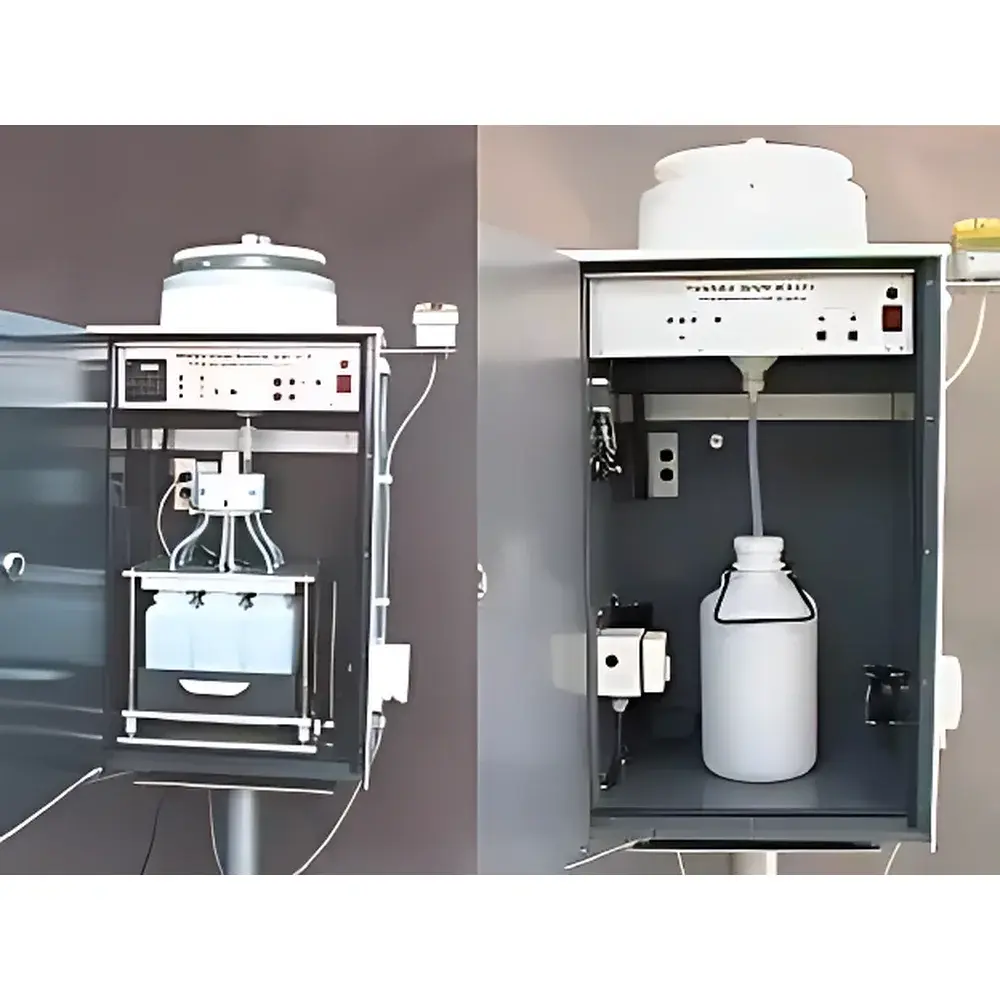
Eigenbrodt NSA 181 Automatic Precipitation Sampler
| Brand | Eigenbrodt |
|---|---|
| Country of Origin | Germany |
| Model | NSA 181 |
| Sampling Configurations | E-type (single 5–10 L HD-PE bottle), D-type (dual-week, two 5 L HD-PE bottles), S-type (8-day sequential, eight 1 L HD-PE bottles) |
| Heating | Bottom-heated sample bottles (D/S types) or heated collection chamber (E-type) |
| Control System | Siemens LOGO! programmable logic controller |
| Power Backup | Integrated rechargeable battery supporting ≥24 h operation during mains failure |
| Enclosure | Double-insulated PVC housing with automatic ventilation |
| Collection Area | 500 cm² polyethylene funnel compliant with VDI 3870 |
| Sensor Interface | RS 485-compatible precipitation sensor (e.g., RS 85, NRS 80, IRSS 88) |
| Materials | Chemically inert HD-PE, DURAN® borosilicate glass, or PTFE components |
| Data Logging | Integrated LCD timer + digital data recording system |
| Structural Base | Galvanized steel mounting frame |
| Compliance | Designed per VDI 3870 |
Overview
The Eigenbrodt NSA 181 Automatic Precipitation Sampler is a field-deployable, programmable environmental sampling instrument engineered for high-reliability, long-term atmospheric deposition monitoring. It operates on a gravimetric collection principle: precipitation—rain, snowmelt, or mixed-phase events—is detected via an external optical or capacitive sensor (e.g., RS 85, IRSS 88, or NRS 80), triggering actuation of the polyethylene collection funnel. Upon signal confirmation, the motor-driven lid retracts laterally—minimizing aerodynamic disturbance—and exposes the 500 cm² VDI 3870-compliant funnel surface. Collected precipitation flows via gravity-fed tubing into either a single large-volume container (E-type configuration) or is sequentially distributed across multiple chemically inert sample vessels using a precision rotary distributor head (D- or S-type configurations). The system’s architecture prioritizes sample integrity: all wetted surfaces—including funnels, tubing, and bottle interiors—are constructed from HD-PE, DURAN® glass, or PTFE to prevent leaching, adsorption, or catalytic interference during storage. Its double-insulated PVC enclosure incorporates passive thermal regulation to mitigate solar heating effects, while integrated bottom-heating elements (for D/S configurations) or chamber heating (E-type) prevent freezing in sub-zero ambient conditions—critical for preserving analyte stability in cold-climate deployments.
Key Features
- Three modular sampling modes: E-type (single 5 L or 10 L HD-PE bottle), D-type (dual-week collection using two 5 L bottles on a rotating tray), and S-type (8-day time-resolved sampling across eight 1 L HD-PE bottles)
- Siemens LOGO! PLC-based control system enabling configurable start/stop logic, interval timing, and event-triggered sampling based on real-time sensor input
- Fail-safe power management: integrated rechargeable battery sustains timer, rotary head positioning, and sensor interface for ≥24 hours during AC mains interruption
- VDI 3870-compliant 500 cm² polyethylene funnel with motorized lateral-lid actuation—designed to minimize wind-induced turbulence and splash loss
- Chemically inert fluid path: HD-PE, DURAN® glass, or PTFE components ensure compatibility with trace-metal, anion, cation, organic, and isotopic analyses
- Passively ventilated, double-walled PVC enclosure with galvanized steel base—engineered for outdoor installation under variable UV, humidity, and temperature exposure
Sample Compatibility & Compliance
The NSA 181 accommodates standard HD-PE, DURAN® glass, or quartz sample containers—enabling direct compatibility with EPA Method 1694, ISO 6107-12, and EN 14780 for atmospheric deposition chemistry. Its material selection meets ASTM D4295 requirements for polymer resistance to hydrolysis and UV degradation. The system supports GLP-aligned audit trails when paired with external data loggers (via RS 485 interface), and its deterministic sampling logic aligns with ISO/IEC 17025 method validation prerequisites. Optional IRSS 88 optical sensors provide snowfall discrimination, while the “H” snow cover accessory prevents accumulation-induced mechanical obstruction. All heating zones are thermostatically regulated to ±2 °C tolerance, ensuring consistent freeze-thaw mitigation without evaporative bias.
Software & Data Management
While the NSA 181 operates autonomously via its embedded Siemens LOGO! controller, it integrates natively with third-party SCADA platforms and environmental data management systems through its RS 485 serial interface. The onboard LCD timer logs timestamped sampling events—including start/stop times, bottle index positions, and sensor activation counts—with non-volatile memory retention. When interfaced with a PC or industrial RTU, raw event logs can be exported in CSV format for traceability in QA/QC documentation. The system supports custom programmable thresholds (e.g., minimum precipitation intensity or duration) to suppress false triggers—essential for reducing matrix contamination in low-event-frequency environments. Firmware updates are performed via standard LOGO! programming software, ensuring long-term maintainability and regulatory adaptability.
Applications
- Long-term atmospheric deposition monitoring for acid rain studies (SO₄²⁻, NO₃⁻, NH₄⁺)
- Wet deposition flux quantification of heavy metals (Pb, Cd, Hg), persistent organic pollutants (POPs), and radionuclides
- Isotopic hydrology (δ¹⁸O, δ²H) requiring temporally resolved, contamination-free rainwater archives
- Validation of satellite-based precipitation estimates and regional climate models
- Compliance monitoring for national air quality networks operating under EU Directive 2004/107/EC or U.S. NADP protocols
- Remote-site deployment in alpine, boreal, or island ecosystems where manual sampling is logistically constrained
FAQ
Does the NSA 181 support unattended operation during extended power outages?
Yes—the integrated rechargeable battery maintains core functions (timer, rotary head positioning, sensor polling) for a minimum of 24 hours after AC failure.
Can the system distinguish between rain and snow?
When equipped with the optional IRSS 88 optical precipitation sensor or NRS 80 snow-specific detector, the NSA 181 enables precipitation phase discrimination and adaptive sampling logic.
What materials are available for sample containers to avoid metal contamination in trace-element analysis?
DURAN® borosilicate glass and quartz funnels—paired with HD-PE or PTFE sample bottles—are certified for ultra-trace metal work per ISO 15587-2.
Is the funnel geometry compliant with international standard methods?
Yes—the 500 cm² polyethylene funnel conforms precisely to VDI 3870 guidelines for geometric aperture, edge curvature, and vertical alignment tolerances.
How is data integrity ensured during multi-day sequential sampling?
Each bottle position is logged with absolute UTC timestamps and sensor-confirmed precipitation onset/offset; the rotary head uses stepper-motor indexing with mechanical end-stop verification to guarantee positional repeatability.
Related Products







