
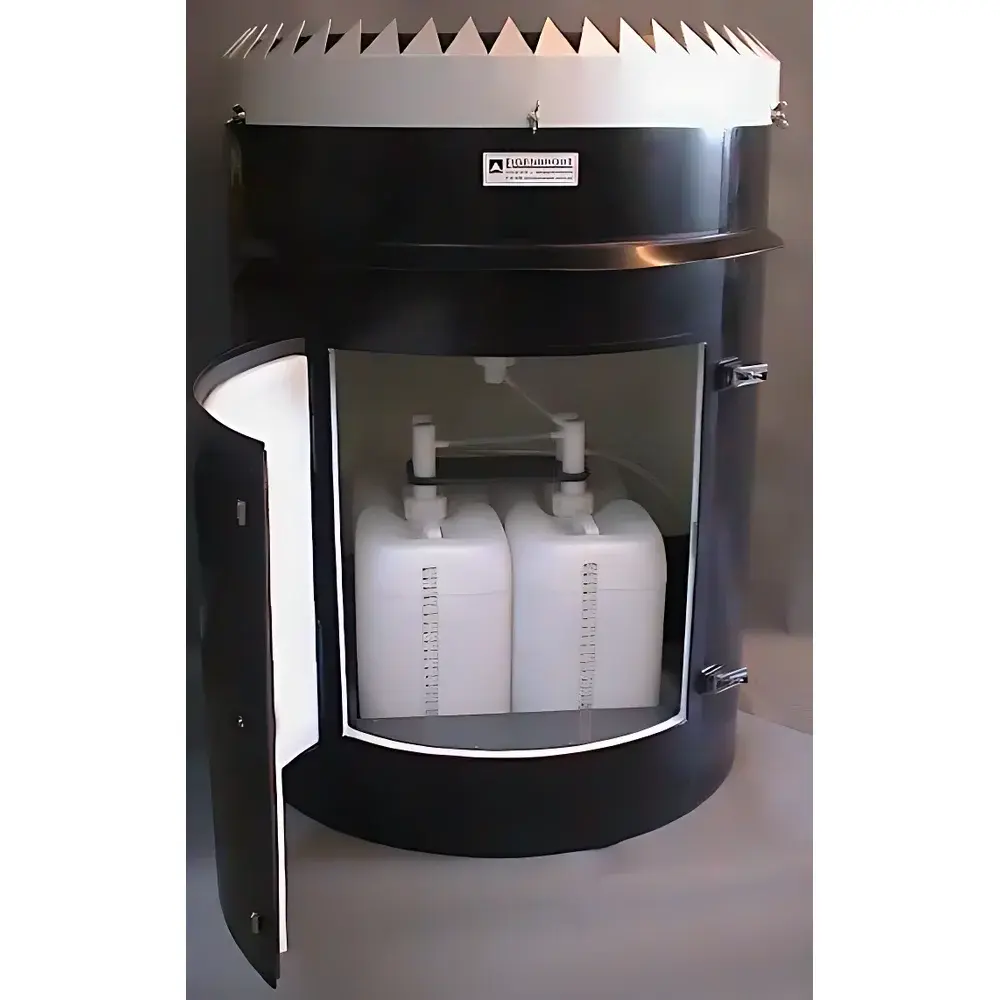
Eigenbrodt NSA 161/R T-N Precipitation Sampler
| Brand | Eigenbrodt |
|---|---|
| Origin | Germany |
| Model | NSA 161/R T-N |
| Collection Area | 5000 cm² |
| Power Supply | 230 VAC / 50 Hz, max. 400 VA |
| Heating System | 2 × 200 W convection heaters, thermostatically controlled |
| Operating Height | 1500 mm (requires base) |
| Enclosure Dimensions | H 1250 mm × Ø 900 mm |
| Weight | Sampler 68 kg, Base 14 kg |
| Construction | Double-walled cylindrical polyethylene housing with mineral wool insulation |
| Funnel | Open-top PE funnel with integrated sharp-edged rim for total deposition sampling |
| Sample Containers | 4 × 20 L HD-PE bottles |
| Temperature Control | Maintains internal chamber above 0 °C during winter to prevent freezing and melt snow |
| Overflow System | Integrated bypass for excess precipitation after all bottles are filled |
| Volume Indication | Calibrated scale per bottle |
Overview
The Eigenbrodt NSA 161/R T-N Precipitation Sampler is a rigorously engineered environmental monitoring instrument designed for the autonomous, long-term collection of bulk atmospheric precipitation—including rain, snow, and dry deposition—for subsequent radiometric analysis. Developed in Germany to meet stringent nuclear safety and environmental surveillance requirements, it operates on a gravity-fed, sequential volumetric sampling principle: precipitation captured by the 5000 cm² open funnel flows via calibrated downspout into a rotating distribution manifold, directing flow sequentially into four 20 L HD-PE sample containers. Once all four vessels are filled, surplus liquid is diverted through an integrated overflow channel—ensuring precise volume accountability without loss or cross-contamination. Its thermostatically regulated dual-heater system (2 × 200 W) maintains the internal chamber above freezing under subzero ambient conditions, enabling reliable snowmelt and preventing ice formation in both the funnel and sample bottles—a critical capability for year-round operation in temperate and boreal climates.
Key Features
- Double-walled cylindrical polyethylene enclosure (Ø 900 mm × H 1250 mm) with mineral wool thermal insulation, providing robust environmental shielding and thermal stability.
- Open-top polyethylene funnel with precision-engineered sharp-edged rim to capture total deposition—including wet scavenging and dry particle fallout—without aerodynamic bias.
- Thermostatically controlled convection heating system (2 × 200 W, 230 VAC) coupled with axial ventilation ensures uniform temperature distribution and prevents condensation-induced sample dilution.
- Front-access hinged door for rapid, tool-free replacement of 20 L HD-PE sample containers—designed for compatibility with gamma spectrometry vial geometry and low-background radiochemical handling protocols.
- Calibrated volume indicators on each container enable field verification of collected volume prior to transport; supports traceable volumetric reporting per ISO 6141 and IAEA Technical Reports Series No. 438.
- Removable protective ring and modular funnel design facilitate thorough decontamination between sampling campaigns—essential for radiological monitoring in regulated nuclear facilities.
Sample Compatibility & Compliance
The NSA 161/R T-N is explicitly validated for collection of precipitation intended for gamma-spectrometric determination of radionuclide activity concentration (Bq/L), particularly 137Cs, 134Cs, and natural 40K. Its materials—food-grade HD-PE and UV-stabilized polyethylene—are leach-resistant and exhibit negligible background radioactivity. The system complies with IAEA Safety Standards Series RS-G-1.8 (Environmental Monitoring for Regulatory Purposes) and supports implementation of national regulatory frameworks aligned with EURATOM Directive 2013/59. It is routinely deployed in paired configurations—one oriented along dominant wind trajectories near nuclear power plant exhaust plumes, the other at a control site—to support source attribution and dispersion modeling per IAEA TECDOC-1894.
Software & Data Management
The NSA 161/R T-N operates as a standalone, microprocessor-free mechanical system—eliminating firmware dependencies, cybersecurity vulnerabilities, or calibration drift associated with embedded electronics. All operational parameters (collection area, container volume, heating setpoint, overflow threshold) are fixed by physical design and certified during factory acceptance testing. Volume data are manually recorded using the engraved scale; for digital integration, users may pair the sampler with external environmental data loggers (e.g., Campbell Scientific CR1000X) via dry-contact closure signals triggered by bottle-fill detection (optional accessory). Audit trails, sample chain-of-custody logs, and analytical result linkage are maintained externally in LIMS platforms compliant with ISO/IEC 17025 and FDA 21 CFR Part 11 when used in GLP/GMP-regulated radiological laboratories.
Applications
- Continuous environmental surveillance around nuclear facilities, research reactors, and radioactive waste repositories.
- Long-term trend analysis of atmospheric radionuclide deposition in national monitoring networks (e.g., Germany’s IMIS, France’s Téléray).
- Validation of atmospheric dispersion models (e.g., RIMPUFF, CALPUFF) through empirical wet and dry deposition flux quantification.
- Baseline studies for radiological impact assessments preceding new nuclear infrastructure projects.
- Inter-laboratory comparison programs organized by the IAEA and NIST for gamma-spectrometry proficiency testing.
FAQ
Does the NSA 161/R T-N require external software or network connectivity to operate?
No—it is a fully mechanical, non-electronic sampling system. All functions are actuated by gravity, thermal regulation, and calibrated fluid dynamics.
Can the sampler be used for chemical analysis (e.g., pH, ion chromatography) in addition to radiometry?
Yes, provided appropriate container pre-treatment (e.g., acid-washing) and cold-chain logistics are implemented; however, its primary validation is for gamma-emitting radionuclides.
Is the 5000 cm² collection area traceably certified?
Yes—the effective aperture is verified via dimensional metrology per DIN EN ISO 17025-accredited procedures and documented in the Certificate of Conformance supplied with each unit.
What maintenance intervals are recommended for field deployment?
Biannual inspection of heater elements, door gasket integrity, funnel alignment, and overflow channel clearance is advised; full decontamination required after each sampling cycle in radiological applications.
Is the base included in the standard configuration?
The 14 kg reinforced concrete-compatible mounting base is supplied separately and must be installed on a level, vibration-damped foundation to ensure funnel planarity and volumetric accuracy.







