
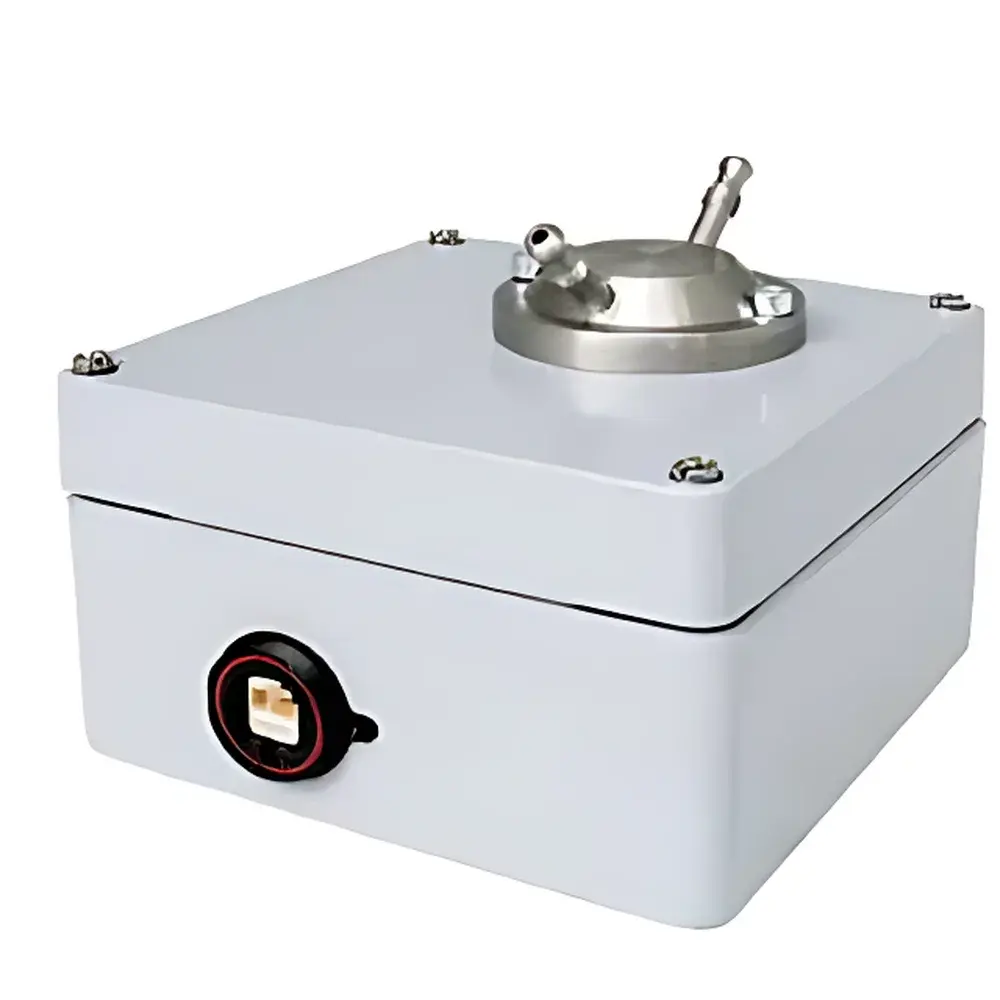
KRUESS PRB21 In-Line Refractometer
| Brand | KRUESS |
|---|---|
| Origin | Germany |
| Model | PRB21 |
| Product Type | In-line refractometer |
| Temperature Control | Yes |
| Digital Display | No (LCD 120×32 px, touch-enabled) |
| Measurement Range | 1.3300–1.5600 nD / 0–95 %Brix |
| Accuracy | PRB-H: ±0.00002 nD / ±0.02 %Brix |
| PRB-S | ±0.0002 nD / ±0.2 %Brix |
| Resolution | PRB-H: 0.00001 nD / 0.01 %Brix |
| PRB-S | 0.0001 nD / 0.1 %Brix |
| Measurement Time | 3–60 s |
| Temperature Range | −10 to 99.9 °C |
| Temp. Resolution | 0.1 °C |
| Temp. Accuracy | ±0.2 °C |
| Temp. Compensation | ICUMSA-compliant |
| Temperature Sensor | PT100 |
| Prism Material | Sapphire |
| Light Source | LED |
| Output Interfaces | RS-232, 0/4–20 mA analog, 1 relay, PROFIBUS (optional) |
| Enclosure Rating | IP65 |
| Supply Voltage | 24 V DC |
| Sample Cell | Stainless steel (316L) |
| Cleaning | Manual access for prism cleaning |
| Compliance | CE, RoHS, ATEX optional |
Overview
The KRUESS PRB21 In-Line Refractometer is an industrial-grade process analytical instrument engineered for continuous, real-time measurement of refractive index (nD) and derived concentration units—including %Brix, %glucose, %fructose, and %invert sugar—in flowing liquid streams. Operating on the principle of total internal reflection at a solid–liquid interface, the PRB21 directs a collimated LED beam onto a sapphire prism in direct contact with the process medium. The critical angle of refraction is detected by a high-stability photodiode array and converted into a precise refractive index value. Unlike benchtop or handheld refractometers, the PRB21 is designed for permanent installation in bypass or main-line configurations, delivering robust performance under dynamic flow conditions without interference from sample color, turbidity, or suspended solids. Its stainless-steel (AISI 316L) flow cell and sapphire prism ensure chemical resistance, mechanical durability, and long-term optical stability—critical for hygienic and abrasive process environments.
Key Features
- High-precision optical sensing with sapphire prism (Vickers hardness >2000 HV), resistant to scratching, corrosion, and thermal shock
- Two accuracy grades available: PRB21-H (high-resolution) and PRB21-S (standard), supporting application-specific validation requirements
- Configurable measurement interval from 3 seconds to 60 seconds, enabling optimization for rapid control loops or slow-changing batch processes
- Integrated PT100 temperature sensor with automatic ICUMSA-compliant temperature compensation—ensuring traceable, thermally corrected nD values per ISO 21542 and AOAC 932.12
- IP65-rated housing with 24 V DC power supply, suitable for mounting in demanding industrial zones (ATEX Zone 2/22 optional)
- Direct PLC integration via analog 0/4–20 mA output, digital RS-232 serial interface, and fieldbus-ready PROFIBUS-DP (custom-configurable)
- Touch-enabled monochrome LCD (120 × 32 pixels) for local status monitoring, parameter adjustment, and password-protected configuration access
- Minimal sample volume requirement (<5 mL dead volume) and tool-free prism access for routine cleaning—reducing downtime and supporting GMP-aligned maintenance protocols
Sample Compatibility & Compliance
The PRB21 accommodates aqueous solutions, syrups, juices, caustic washes, acid baths, glycol mixtures, and hydrocarbon-based process streams—provided they remain optically homogeneous during transit through the measurement zone. Its sapphire prism and 316L stainless-steel wetted parts comply with FDA 21 CFR 178.3570 (indirect food additives) and EHEDG Doc. 8 (hygienic equipment design). While not intrinsically certified for explosive atmospheres as standard, ATEX-compliant variants are available upon request. The instrument supports audit-ready operation under GLP and GMP frameworks: all calibration events, temperature logs, and output signal timestamps are internally recorded and exportable via RS-232. It meets electromagnetic compatibility requirements per EN 61326-1 and carries CE marking under the EU Measuring Instruments Directive (MID) Annex MI-005 for continuous-concentration measuring systems.
Software & Data Management
The PRB21 operates autonomously without external software but supports full integration into distributed control systems (DCS) and SCADA platforms via its native analog and serial outputs. Configuration—including measurement unit selection (nD, %Brix, %glucose), alarm thresholds, temperature compensation mode (ICUMSA default or user-defined polynomial), and relay activation logic—is performed locally via the touch interface or remotely via Modbus RTU over RS-232. All operational parameters are stored in non-volatile memory with battery-backed retention. For centralized data aggregation, the device outputs linearized 4–20 mA signals traceable to NIST-traceable refractometer standards (e.g., KRUESS SRM-100 series). Optional firmware upgrades—delivered via USB-to-serial adapter—introduce enhanced diagnostics, extended temperature logging, and dual-range Brix mapping for multi-sugar matrices.
Applications
The PRB21 delivers validated concentration data across regulated and high-throughput industries. In beverage production, it monitors sugar dosing consistency in soft drink blending tanks and verifies pasteurization efficacy via refractive index drift. In pulp and paper mills, it controls white water recirculation ratios and chemical additive concentrations (e.g., starch, sizing agents). Within food processing, it ensures batch-to-batch repeatability in jam, honey, and tomato paste production while meeting USP particulate matter expectations due to immunity to turbidity. In chemical manufacturing, it tracks solvent recovery efficiency in distillation side-streams and verifies acid concentration in pickling baths for metal surface treatment. Municipal and industrial wastewater plants deploy the PRB21 to quantify polymer coagulant dosing and monitor anaerobic digester feedstock strength (VS/TSS correlation).
FAQ
Does the PRB21 require periodic recalibration?
Yes—calibration is recommended before commissioning, after maintenance, and at intervals defined by process criticality (typically quarterly for GMP applications). Calibration uses certified refractive index standards traceable to NIST or BAM.
Can the PRB21 measure opaque or highly viscous samples?
It measures refractive index independently of color or turbidity, but requires laminar, bubble-free flow and sufficient optical path clarity. Viscosities up to 10,000 mPa·s are supported with appropriate flow conditioning.
Is temperature compensation mandatory?
Yes—refractive index is inherently temperature-dependent. The integrated PT100 and ICUMSA algorithm eliminate manual correction, ensuring compliance with ISO 21542 and industry-specific sugar analysis standards.
What certifications does the PRB21 hold for food-contact use?
Wetted parts conform to 3-A Sanitary Standards 3-A 03-05 and EHEDG Guideline Doc. 8. Full material declarations (EN 10204 3.1) and FDA-compliant elastomer options (EPDM, FKM) are available.
How is validation support provided for regulated environments?
KRUESS supplies IQ/OQ documentation templates, as-found/as-left calibration reports, and traceable uncertainty budgets aligned with EURACHEM/CITAC Guide CG4. On-site SAT and CSV support is available globally.



