
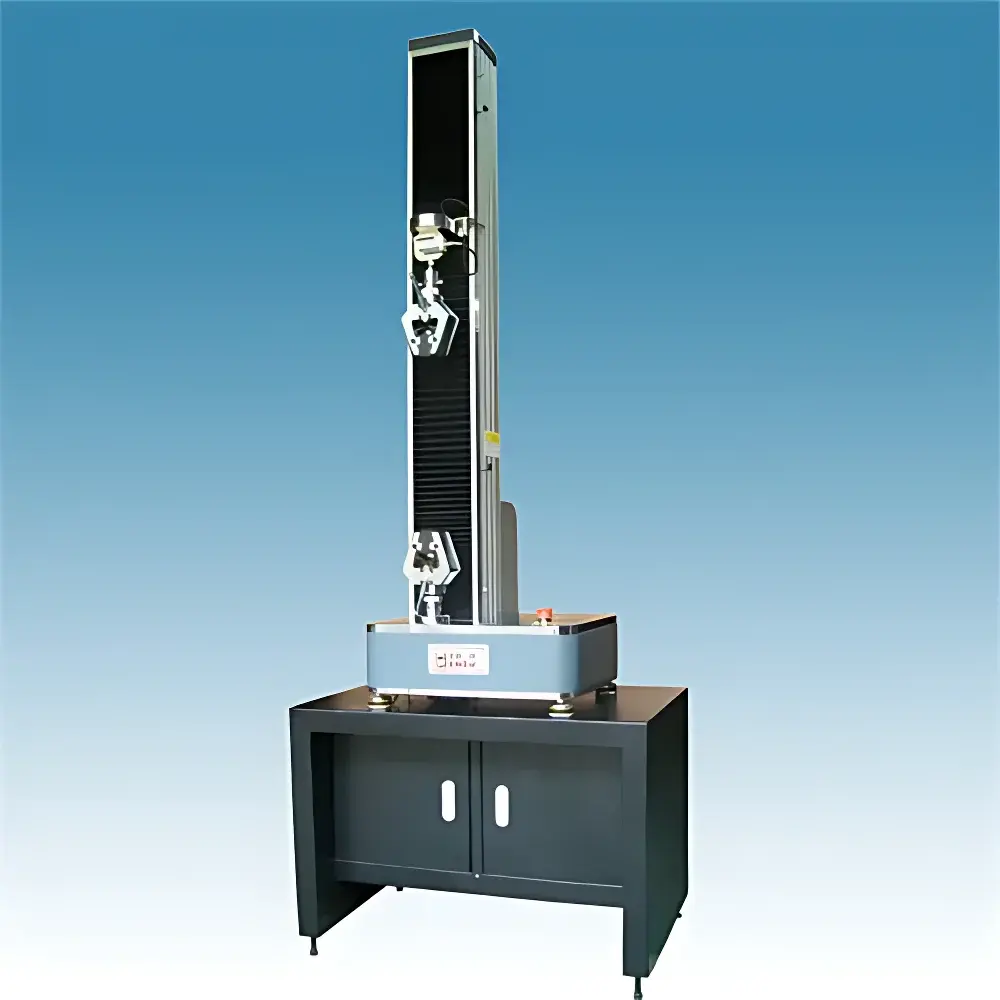
Hengyi HY-0580 Nano-Materials Mechanical Testing System
| Brand | Hengyi |
|---|---|
| Origin | Shanghai, China |
| Manufacturer Type | Direct Manufacturer |
| Product Category | Domestic |
| Model | HY-0580TYUUUU |
| Instrument Type | Electromechanical Universal Testing Machine |
| Load Capacity Options | 1 N to 5000 N (multi-range selectable) |
| Force Accuracy | ≤0.5% of reading |
| Effective Test Width | 120 mm |
| Effective Vertical Travel | 800 mm |
| Speed Range | 0.001–500 mm/min (adjustable) |
| Speed Accuracy | ±0.5% of set value |
| Displacement Accuracy | ±0.5% of reading |
| Strain Control Range | 0.002–6% FS/s |
| Stress Control Range | 0.005–6% FS/s |
| Force Resolution | ±500,000 counts (full-scale, no range switching) |
| Power Supply | 220 V AC, 750 W |
| Dimensions (W×D×H) | 470 × 400 × 1510 mm |
| Weight | 120 kg |
Overview
The Hengyi HY-0580 Nano-Materials Mechanical Testing System is an electromechanical universal testing machine engineered for high-precision static mechanical characterization of nanoscale and microscale specimens—including nanofibers, thin films, nanocomposites, electrospun membranes, and 2D materials such as graphene oxide monolayers or MXene flakes. Unlike conventional macro-scale tensile testers, the HY-0580 integrates ultra-low-force load cells (down to 1 N full scale), sub-micrometer displacement resolution, and adaptive control algorithms optimized for specimens with cross-sectional areas below 100 µm². Its single-column, space-saving architecture supports both uniaxial tension and compression modes, with real-time force–displacement–strain data acquisition synchronized at up to 1 kHz sampling rate. The system operates on fundamental principles of quasi-static mechanical testing per ISO 6892-1, ASTM E8/E21, and ISO 527-1, adapted for miniaturized geometries through calibrated micro-gripping fixtures and environmental shielding against thermal drift and vibration.
Key Features
- Multi-range force measurement capability: Interchangeable load cells from 1 N to 5000 N, all traceable to national metrological standards (CNAS-accredited calibration certificates available).
- High-fidelity motion control: Servo-driven crosshead with closed-loop position feedback, enabling speed stability of ±0.5% across the full 0.001–500 mm/min range—critical for creep, stress-relaxation, and low-strain-rate nanoindentation-coupled tests.
- Full-spectrum control modes: Independent stress-, strain-, and displacement-controlled loading profiles; programmable ramp-hold-step sequences compliant with ISO 6892-2 Annex B for cyclic loading of nanomaterials.
- Integrated safety architecture: Dual-stage electronic limit protection, overload cutoff at 110% of selected capacity, automatic return-to-home post-test, and real-time diagnostic self-checks for drive current, encoder signal integrity, and amplifier saturation.
- Modular fixture interface: Standard M4 threaded mounting platform compatible with custom micro-clamps, pneumatic micro-grips, liquid cell stages, and in-situ SEM/TEM-compatible load frames (optional).
Sample Compatibility & Compliance
The HY-0580 accommodates specimens ranging from freestanding nanowires (diameter ≥50 nm) to polymer nanocomposite films (thickness 10 nm–5 µm), fiber bundles (1–50 µm diameter), and brittle ceramic nanocoatings. It meets structural and metrological requirements of GB/T 2611–2007 (General Technical Requirements for Testing Machines), GB/T 16491–2008 (Electronic Universal Testing Machines), and ISO 7500-1:2018 (Calibration of Force-Proving Instruments). When configured with optional environmental enclosures (temperature: −40°C to +150°C; humidity: 10–95% RH non-condensing), it supports testing under conditions aligned with ASTM D882 (thin plastic films) and ISO 527-3 (plastics—films and sheets). All firmware and control logic are designed to support audit-ready operation under GLP and GMP frameworks, including user access levels, electronic signatures, and 21 CFR Part 11-compliant data archiving when paired with Hengyi’s optional LabManager Pro software suite.
Software & Data Management
Bundled with Hengyi TestSuite v4.2, the system delivers ISO/IEC 17025-aligned test method definition, real-time curve overlay, multi-channel synchronization (force, displacement, extensometer, temperature), and automated report generation in PDF/A-1b and CSV formats. Raw data streams are stored in HDF5 format with embedded metadata (operator ID, calibration timestamp, environmental logs, fixture ID). The software supports ASTM E1823-defined fracture toughness calculations for notched nanocomposites and implements ISO 10360-compliant uncertainty propagation models for derived parameters (Young’s modulus, yield strength, elongation at break). Optional API integration enables bidirectional communication with LIMS platforms (e.g., Thermo Fisher SampleManager, LabVantage) and MATLAB/Simulink for custom algorithm deployment.
Applications
- Mechanical property mapping of solution-processed perovskite thin films for flexible photovoltaics.
- Tensile fatigue behavior of carbon nanotube yarns under variable humidity and temperature gradients.
- Interfacial shear strength quantification in polymer-nanocellulose composites using micro-droplet debonding protocols.
- Creep compliance analysis of metal–organic framework (MOF) aerogels under sub-gram loads.
- Standardized evaluation of biomedical nanofibrous scaffolds per ISO 13779-2 and ASTM F2450.
FAQ
What is the minimum measurable force resolution for the 1 N load cell?
The 1 N load cell achieves a force resolution of 0.002 N (0.2 mN) with ±0.5% linearity over its full scale, verified per ISO 376:2011 Annex C.
Can the HY-0580 be used with video extensometry for non-contact strain measurement?
Yes—the system provides TTL-synchronized strobe output and Ethernet-based trigger interface compatible with commercial digital image correlation (DIC) systems (e.g., Correlated Solutions VIC-2D, LaVision StrainMaster) for surface strain field mapping.
Is third-party calibration certification included with delivery?
Each unit ships with a factory calibration report traceable to NIM (National Institute of Metrology, China); CNAS-accredited external calibration (ISO/IEC 17025) is available as an add-on service.
Does the controller support real-time PID tuning during active testing?
Yes—advanced users may adjust proportional, integral, and derivative gains via the TestSuite engineering console to optimize response for highly viscoelastic nanomaterials or rate-dependent hydrogels.
Are software updates provided for the lifetime of the instrument?
Hengyi offers free minor version updates and paid major-version upgrades (v4.x → v5.x) with documented backward compatibility for legacy test methods and data archives.



