
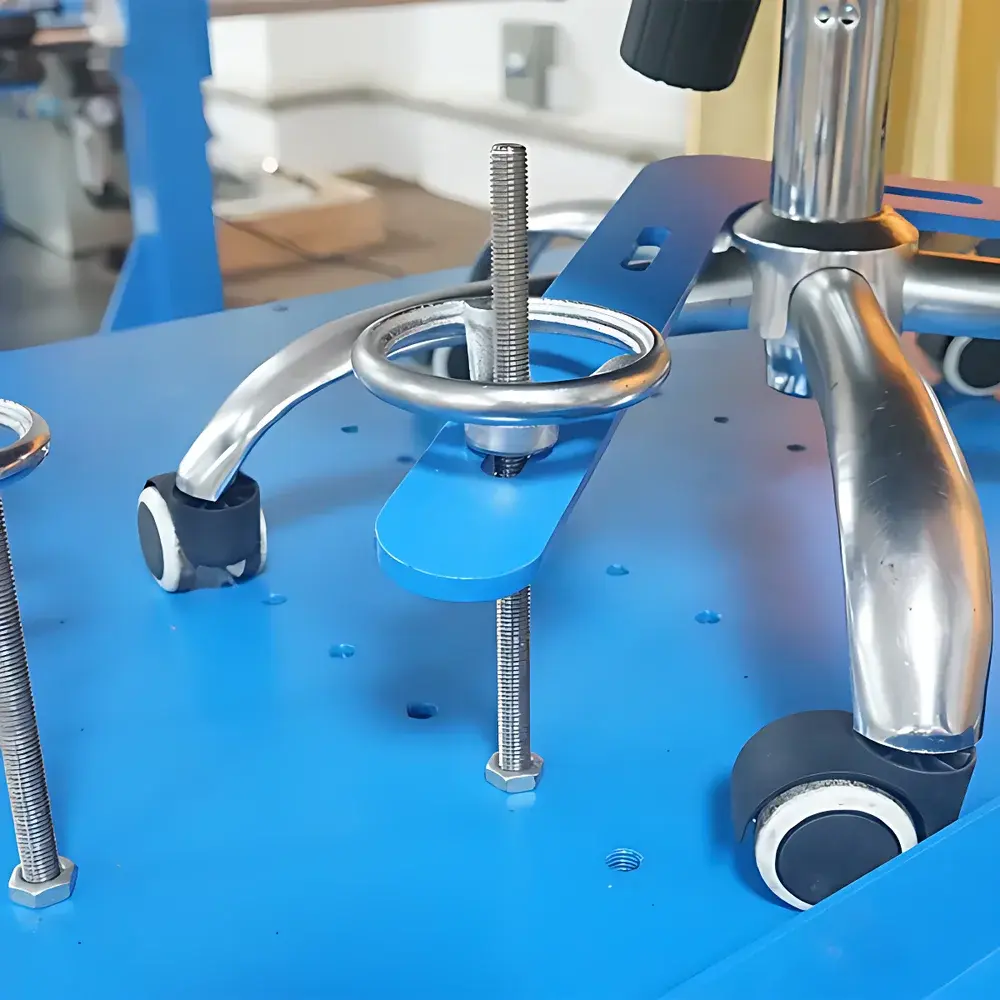
HAIDA HD-F743 Chair Structural Strength Tester
| Brand | HAIDA INTERNATIONAL |
|---|---|
| Origin | Guangdong, China |
| Manufacturer Type | OEM/ODM Manufacturer |
| Country of Origin | China |
| Model | HAIDA HD-F743 Chair Structural Strength Tester |
| Load Capacity | 2 kN (durability), 5 kN (strength) |
| Force Range | 445 N–1.9 kN |
| Test Speed | 5–20 cycles/min (fatigue), 450 mm/min (static strength) |
| Load Application | Pneumatic cylinder (fatigue), servo motor (static strength) |
| Compliance Standards | QB/T 2280–2016, ANSI/BIFMA X5.1–2017 |
| Fixture Set | Seat base clamp, vertical armrest clamp, backrest pull clamp, foot block, webbing block |
| Weight | ~250 kg |
| Dimensions (L×W×H) | 2450 × 1000 × 2250 mm |
| Power Supply | 1∮ AC 220 V, ~200 W |
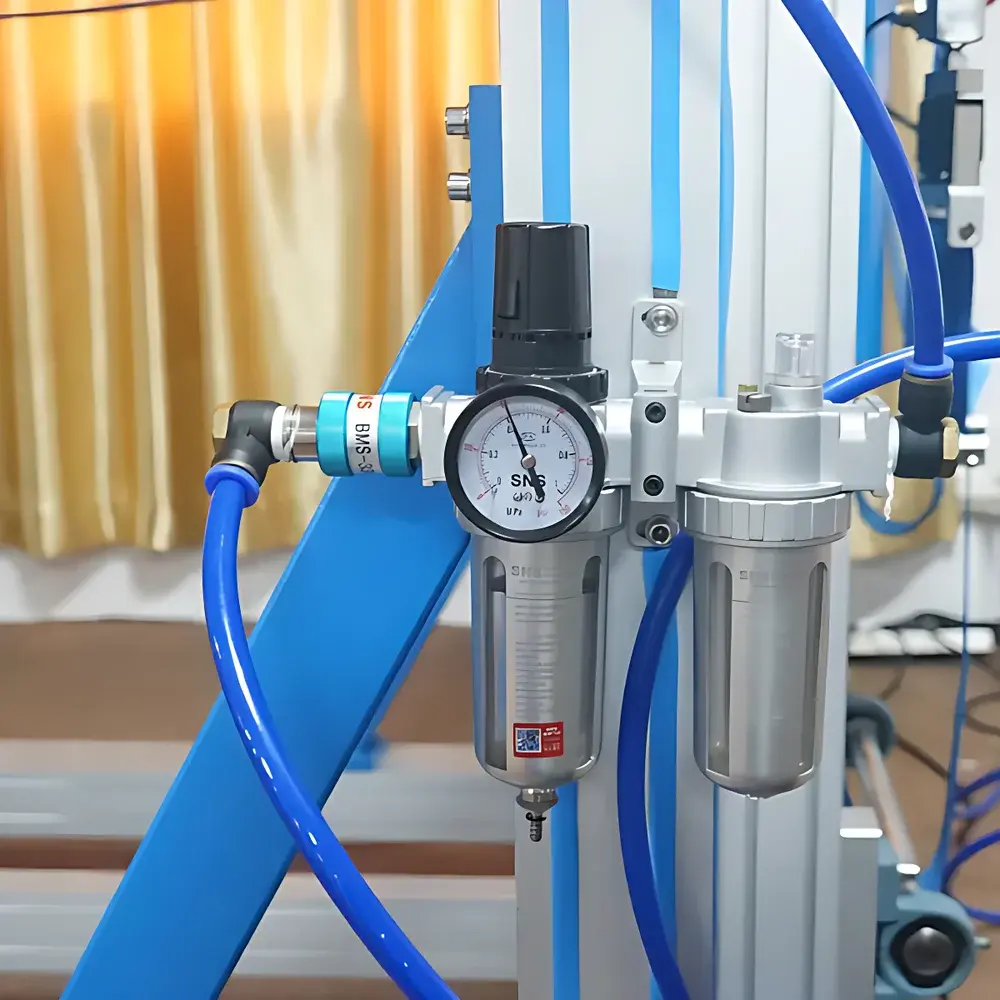
| Air Supply | ≥0.6 MPa |
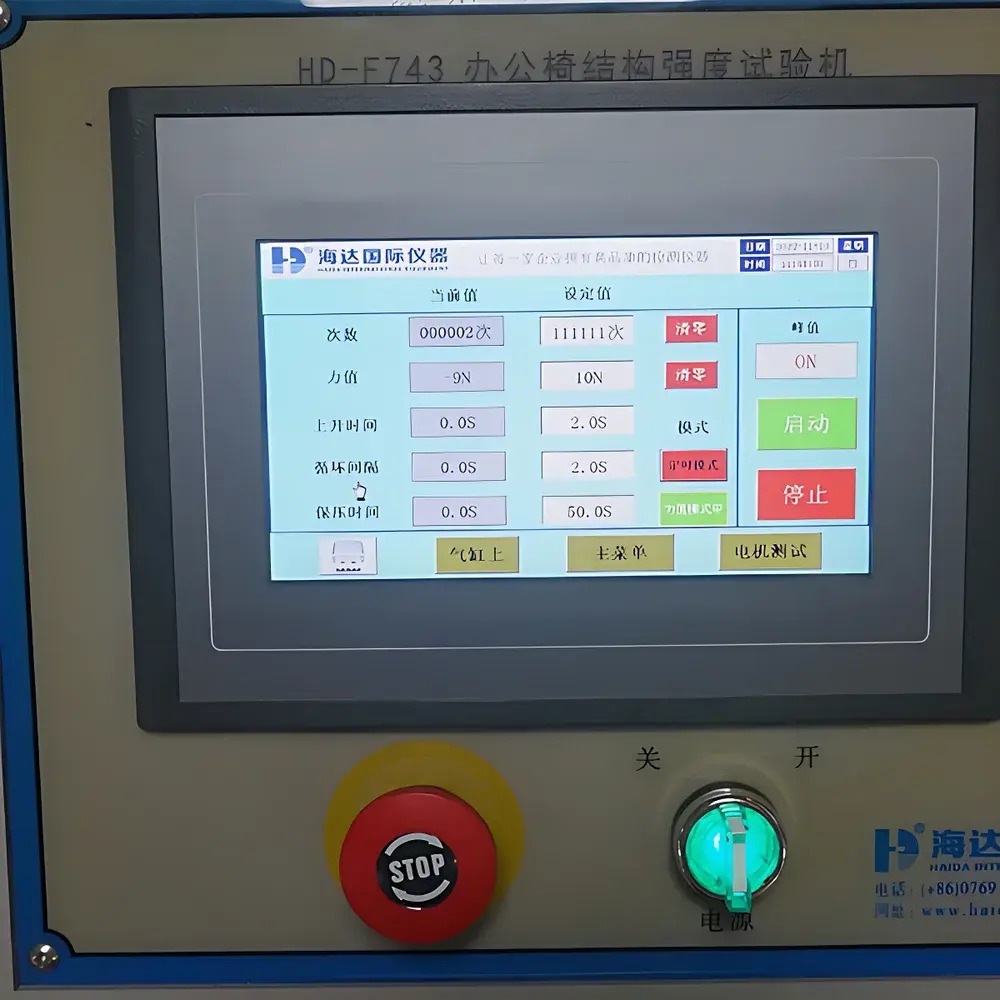
| Control System | PLC + 7-inch HMI touchscreen |
| Data Retention | Power-loss memory with auto-resume |
| Safety Features | Mechanical stroke limiters, electrical leakage protection, emergency stop, overload cutoff |
Overview
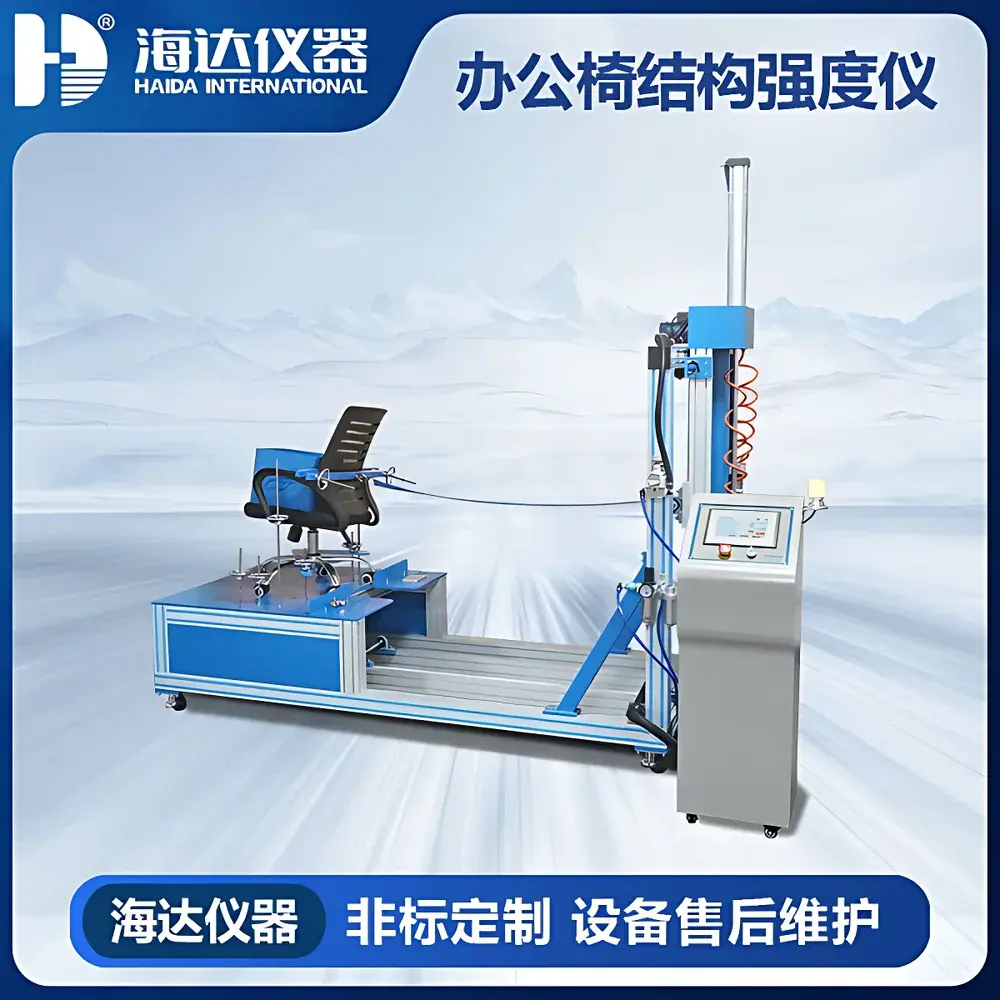
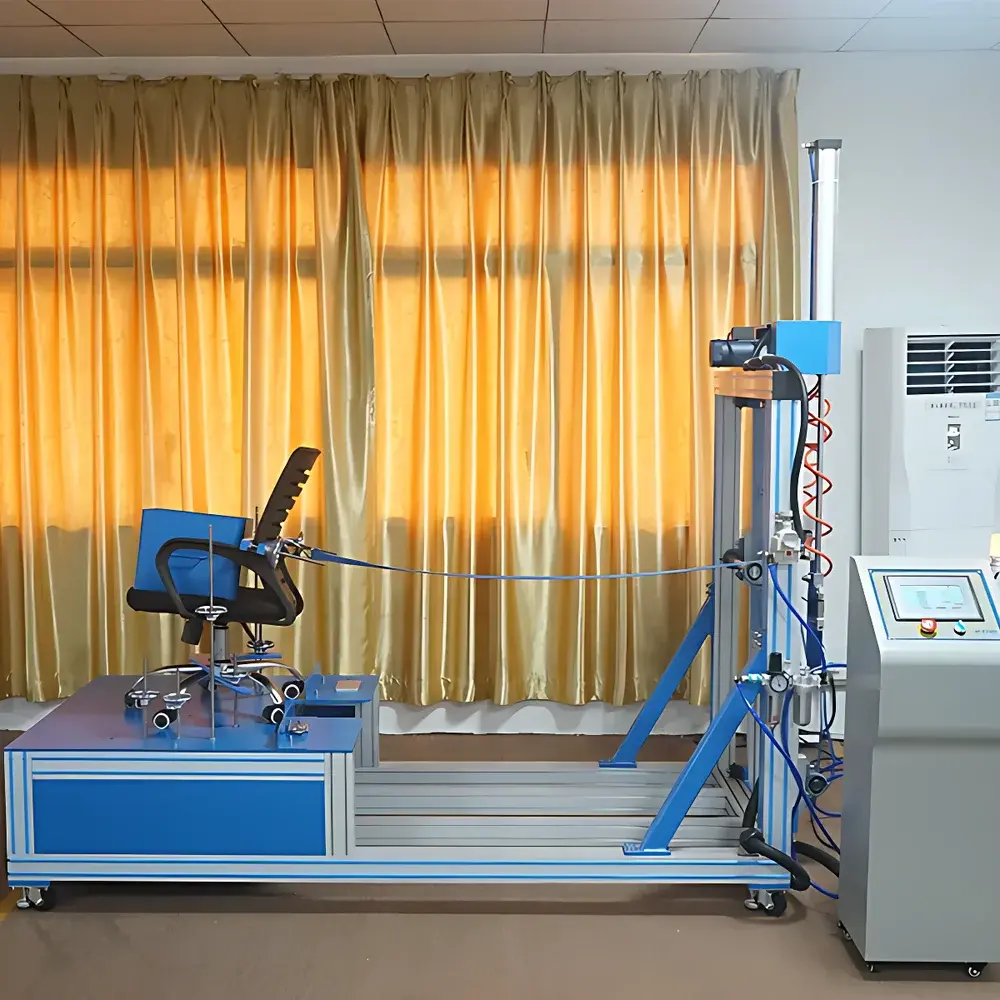
The HAIDA HD-F743 Chair Structural Strength Tester is an engineered mechanical test system designed for standardized structural validation of office chairs in accordance with international ergonomic and safety requirements. It implements dual-actuation methodology—pneumatic drive for high-cycle fatigue simulation and servo-motor-driven linear actuation for controlled static strength evaluation—to replicate real-world usage patterns across critical load-bearing components: backrests, armrests, and seat frames. The system adheres to the fundamental principles of structural mechanics testing, where applied force, displacement, dwell time, and cycle count are precisely regulated to assess functional integrity, deformation resistance, and failure thresholds. Its architecture supports both destructive and non-destructive evaluation modes, enabling laboratories and quality assurance departments to verify compliance with performance envelopes defined by regulatory frameworks such as ANSI/BIFMA X5.1–2017 and QB/T 2280–2016.
Key Features
- Modular dual-sensor configuration: 2 kN precision load cell for durability cycling and 5 kN high-range sensor for ultimate strength assessment—both sourced from certified international suppliers to ensure long-term metrological stability.
- Reinforced aluminum extrusion frame structure providing rigidity >1.2 × 10⁶ N·mm² stiffness, minimizing frame deflection during high-force vertical loading and ensuring repeatability within ±0.5% of full scale.
- Intelligent force-limiting control logic prevents over-travel or hydraulic shock during pneumatic actuation, eliminating sensor drift and mechanical wear associated with unregulated cylinder motion.
- Programmable test sequencing via 7-inch industrial HMI: users define force profiles (pre-load, hold duration, peak load, ramp rate), cycle counts (1–999,999), and pass/fail criteria per test phase.
- Integrated power-loss memory: all active parameters—including elapsed cycles, current load value, and timestamp—are retained in non-volatile memory upon unexpected shutdown; resumption occurs at the exact point of interruption.
- Comprehensive safety architecture including mechanical end-stop limit switches, Class II ground-fault circuit interrupters (GFCI), emergency stop button with hardware interlock, and automatic overload cutoff at 110% of setpoint.
Sample Compatibility & Compliance
The HD-F743 accommodates a wide range of commercial and institutional seating types—including Class I (light-duty), Class II (medium-duty), and Class III (heavy-duty) office chairs—as defined in BIFMA X5.1. Standardized fixture sets enable repeatable positioning of seat bases, armrests (horizontal and vertical axes), and backrests per test protocol requirements. The system fully supports mandatory test sequences outlined in:
- QB/T 2280–2016 (Chinese National Standard): Sections 6.6.4 (armrest vertical strength), 6.6.5 (armrest horizontal strength), and 6.6.9 (backrest durability).
- ANSI/BIFMA X5.1–2017: Test Methods 5 & 6 (backrest strength), 9 (backrest fatigue), 12 & 13 (armrest vertical/horizontal strength), and 14 & 15 (backrest durability under cyclic loading).
All test protocols are executed under traceable conditions compliant with ISO/IEC 17025 general requirements for testing laboratories. Calibration certificates for force sensors are provided with NIST-traceable documentation, and system validation reports include uncertainty budgets per GUM (Guide to the Expression of Uncertainty in Measurement).
Software & Data Management
Control and data acquisition are managed through a deterministic PLC-based platform interfaced with a ruggedized touchscreen HMI. No external PC is required for routine operation. All test parameters—including force setpoints, dwell times, cycle limits, and pass/fail thresholds—are stored in encrypted internal memory. Real-time force vs. time plots are displayed during execution, with on-screen digital readouts showing instantaneous load, displacement, and cycle count. Post-test data export is supported via USB 2.0 to CSV format for integration into LIMS or statistical process control (SPC) platforms. Audit trails record operator ID, test start/stop timestamps, parameter modifications, and calibration events—fully aligned with GLP and FDA 21 CFR Part 11 electronic record requirements when used in regulated environments.
Applications
- Backrest fatigue testing: cyclic application of 445 N (Class I) or 334 N (Classes II/III) at specified frequency and duration to evaluate hinge integrity, weld fatigue, and foam retention.
- Armrest structural validation: simultaneous verification of horizontal (445 N pre-load + 667 N hold) and vertical (750 N pre-load + 1125 N hold) load resistance per BIFMA X5.1 Clause 12–13.
- Ultimate strength determination: motor-driven quasi-static loading up to 1.9 kN to identify yield points, plastic deformation onset, and catastrophic failure modes.
- Pre-production design verification: iterative testing of prototype frames to optimize material selection, joint geometry, and mounting configurations before tooling release.
- Supplier qualification: third-party certification labs use the HD-F743 to issue formal test reports supporting ISO 9001:2015 clause 8.5.1 (control of production and service provision) and ISO 14001:2015 environmental compliance documentation.
FAQ
Does the HD-F743 support automated reporting in PDF or Excel format?
No—the system exports raw test data in CSV only. Custom report generation requires post-processing in external software such as Microsoft Excel or Minitab.
Is compressed air supply included with the base configuration?
No—an external air compressor rated ≥3 HP (2.2 kW) with dryer and filter is required and must be purchased separately.
Can the HD-F743 perform tests according to EN 1335 or ISO 5970?
The mechanical architecture supports custom test routines, but pre-configured EN/ISO test methods are not embedded in firmware; users must manually configure force profiles and timing per standard clauses.
What is the recalibration interval recommendation for the load cells?
Annual recalibration is recommended per ISO/IEC 17025 Annex A.3.2, with interim verification using certified deadweight standards every 90 days.
Are replacement fixtures available for specialized chair geometries (e.g., ergonomic mesh backs or cantilever designs)?
Yes—HAIDA offers custom fixture engineering services with lead times of 4–6 weeks; drawings and dimensional specifications must be submitted prior to quotation.



