
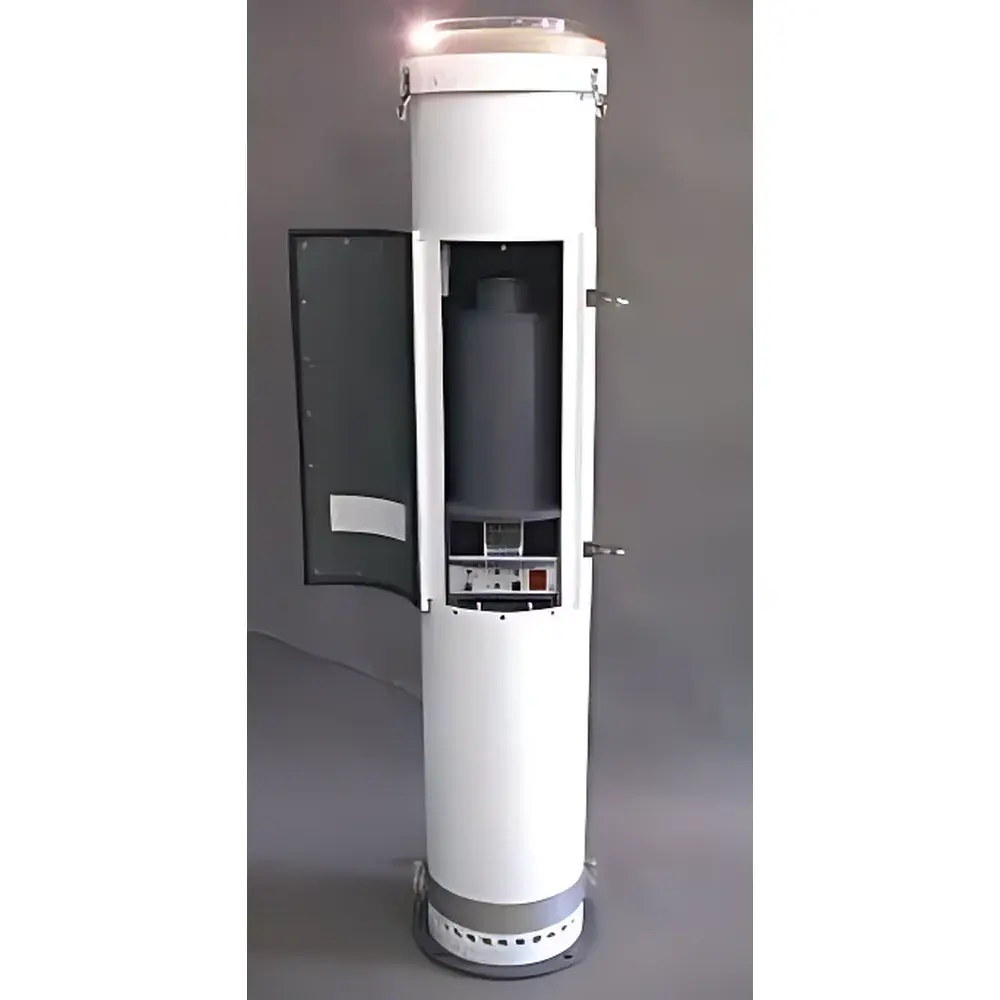
Eigenbrodt BUS125/KE Wet and Dry Deposition Sampler
| Brand | Eigenbrodt |
|---|---|
| Origin | Germany |
| Model | BUS125/KE |
| Collection Area | 500 cm² |
| Power Supply | 230 VAC, 50 Hz, max. 100 VA |
| Funnel Heating | 12 VDC, 50 W |
| Sample Heating | 12 VDC, 40 W |
| Sample Cooling | 12 VDC, 40 W |
| Operating Height | 1500 mm |
| Dimensions | H 1500 mm × Ø 315 mm |
| Weight | 35 kg |
| Funnel Material | DURAN® borosilicate glass |
| Temperature Control | Peltier-based heating/cooling, sample maintained at ~5 °C |
| Enclosure | Thick-walled PVC housing with lockable door |
| Compliance | VDI 3870, LAWA guidelines |
Overview
The Eigenbrodt BUS125/KE is a precision-engineered wet and dry deposition sampler designed for long-term, unattended operation in ambient air quality monitoring networks. It functions as a total precipitation collector—capable of capturing both rainwater (wet deposition) and particulate-bound compounds that settle via gravitational or turbulent mechanisms (dry deposition)—within a single, integrated sampling train. The instrument operates on the principle of passive, gravity-driven collection into a thermally regulated sample reservoir, ensuring representative integration of atmospheric chemical fluxes over defined time intervals. Its design conforms rigorously to VDI 3870 (Guideline for Sampling and Analysis of Atmospheric Deposition), the technical standard issued by the Association of German Engineers, and aligns with LAWA (Working Group of German Federal States on Environmental Affairs) requirements for trace organic compound analysis. The system is particularly optimized for preserving sample integrity during storage—critical when quantifying labile organic micropollutants such as PAHs, PCBs, pesticides, or emerging contaminants where evaporation, photolysis, or microbial degradation must be minimized.
Key Features
- Modular, field-serviceable architecture: Separable components—including tubular housing, DURAN® borosilicate glass funnel, and removable aluminum sample insert—facilitate routine maintenance and contamination-free cleaning.
- Dual-mode thermal management: Integrated Peltier elements provide independent, electronically controlled heating (for snowmelt and frost prevention) and active cooling (to stabilize samples at ~5 °C), reducing analyte loss via volatilization or biological activity.
- Chemically inert collection surface: The 500 cm² DURAN® funnel exhibits neutral pH, high thermal shock resistance, and minimal surface adhesion—ensuring quantitative transfer of low-volume or viscous precipitation without retention artifacts.
- Low-power electronics: Total system power draw ≤100 VA at 230 VAC/50 Hz; DC-powered heating/cooling circuits (12 V) enable compatibility with solar-battery hybrid stations in remote deployments.
- Robust environmental enclosure: Thick-walled PVC housing with lockable access door provides IP54-rated protection against dust and water ingress, while grounding rods and tensioning hardware ensure mechanical stability at 1.5 m mounting height.
Sample Compatibility & Compliance
The BUS125/KE is validated for collection of aqueous-phase precipitation (rain, snowmelt) and resuspended particulates co-deposited within the same catchment area. Its geometry, material selection, and thermal control strategy meet the dimensional and surface-property specifications outlined in VDI 3870 Section 4.2 and LAWA’s “Quality Assurance Guidelines for Deposition Monitoring.” The system supports subsequent laboratory analysis under ISO/IEC 17025-accredited protocols for organic trace analysis—including GC-MS, LC-MS/MS, and TOC determination—without introducing bias from adsorption, leaching, or temperature-induced degradation. All wetted materials (DURAN® glass, food-grade HD-PE optional variants, anodized aluminum) are certified non-reactive toward polar and non-polar organics per DIN EN ISO 11348 and US EPA Method 1694.
Software & Data Management
While the BUS125/KE operates autonomously without embedded firmware, it is fully compatible with third-party environmental data loggers (e.g., Campbell Scientific CR1000X, Delta-T DL2e) via analog voltage outputs or digital I²C interfaces. Optional miniature data loggers—integrated into the base module—record time-stamped ambient temperature, funnel surface temperature, and sample chamber temperature at user-defined intervals (1–60 min resolution). Logged data export formats include CSV and XML, supporting ingestion into LIMS platforms compliant with FDA 21 CFR Part 11 and EU Annex 11 requirements for audit-trail integrity and electronic signature validation. Calibration certificates for Peltier modules and NIST-traceable temperature sensors are supplied with each unit.
Applications
- Long-term trend analysis of atmospheric organic pollutant deposition across national monitoring networks (e.g., EMEP, GAW, UBA networks).
- Source apportionment studies linking urban, agricultural, or industrial emission signatures to receptor-site deposition chemistry.
- Validation of atmospheric chemistry transport models (e.g., CMAQ, EMEP MSC-W) through direct measurement of bulk deposition fluxes.
- Compliance monitoring under EU Directive 2008/50/EC (Ambient Air Quality Directive) and national transposition laws requiring deposition-based exposure assessment.
- Research on climate-chemistry interactions, including effects of temperature variability on deposition efficiency and analyte stability.
FAQ
Does the BUS125/KE require external power for year-round operation?
Yes—it requires a continuous 230 VAC supply for main control electronics and 12 VDC for thermal regulation. For off-grid sites, it can be integrated with solar-charged battery banks rated for ≥120 Ah capacity.
Can the DURAN® funnel be replaced with alternative materials?
No—only certified DURAN® Type I borosilicate glass funnels are supplied, as deviations compromise compliance with VDI 3870’s optical clarity, thermal expansion, and pH neutrality requirements.
Is the system suitable for coastal or high-salinity environments?
Yes—the PVC housing and stainless steel fasteners are corrosion-resistant; however, optional marine-grade anodizing for aluminum components is recommended for extended service life in saline aerosol conditions.
How frequently must the sample bottle be exchanged?
Exchange frequency depends on local precipitation intensity and analytical objectives; typical deployment cycles range from 1 to 4 weeks. The 5 °C cooling function extends holding time without preservatives per ISO 5667-3 guidelines.
Does Eigenbrodt provide calibration services for the thermal modules?
Yes—annual recalibration of Peltier temperature control loops and sensor verification against PT100 reference standards is available through authorized service centers in Europe and North America.







