
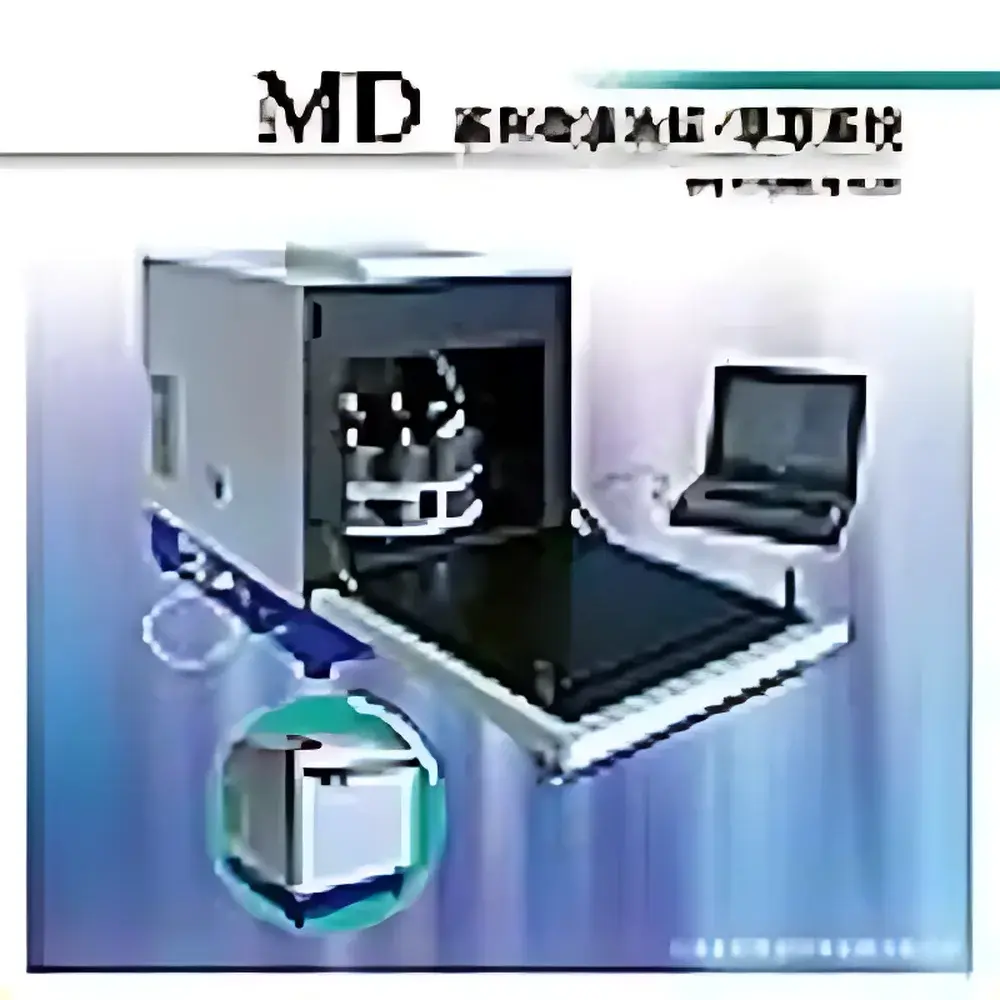
MICHEM MP6T Industrial-Grade Microwave Digestion and Extraction System
| Brand | MICHEM |
|---|---|
| Origin | Beijing, China |
| Model | MP6T |
| Chamber Rating | Industrial-Grade |
| Sample Capacity | 10 vessels |
| Microwave Source | Single Magnetron |
| Max Temperature | 260 °C |
| Max Pressure | 1500 psi |
| Cavity Coating | PFA (DuPont) |
| Outer Vessel Material | PEEK (10 MPa rating) |
| Inner Vessel Material | TFM |
| Temperature Control Range | 0–300 °C |
| Temp Accuracy | ±0.5 °C |
| Pressure Control Range | 0–9 MPa (1305 psi) |
| Pressure Resolution | 0.01 MPa |
| Microwave Leakage | ≤0.3 mW/cm² |
| Cooling Airflow | 3 m³/min |
| Rotational Stirring | 0–5000 rpm (bidirectional, electromagnetic + mechanical) |
| Control Options | Laptop-based A-type software or C-type microcontroller (15 pre-programmed methods, 8-step ramping) |
Overview
The MICHEM MP6T Industrial-Grade Microwave Digestion and Extraction System is a CE-compliant, high-reliability sample preparation platform engineered for trace-element analysis and organic matrix decomposition in regulated laboratory environments. It operates on the principle of microwave-assisted closed-vessel digestion—where controlled electromagnetic energy (2450 MHz ±13 MHz) induces rapid, volumetric heating within chemically resistant reaction vessels under elevated temperature and pressure. This accelerates acid-mediated oxidative decomposition of complex matrices (e.g., soils, biological tissues, polymers, catalysts), achieving complete mineralization while minimizing volatile element loss (e.g., As, Hg, Se, Pb). Unlike open-vessel hotplate digestion, the MP6T’s sealed architecture maintains stoichiometric reagent ratios, reduces blank contributions, and eliminates ambient acid vapor exposure—supporting ISO 17025-compliant workflows and GLP/GMP documentation requirements.
Key Features
- Industrial-rated 45-L cavity with DuPont PFA coating—resistant to aqua regia, HF, and mixed oxidants at sustained temperatures up to 300 °C
- Single magnetron source delivering stable 1200 W output, continuously adjustable via PID-controlled power modulation (0–100%)
- Real-time dual-parameter monitoring: Pt100 platinum resistance thermometry (±0.5 °C accuracy) and direct-contact pressure transduction (0–9 MPa, 0.01 MPa resolution)
- Patented lateral-release safety door with dual-stage mechanical interlock and rupture-disk overpressure protection (rated at 200 psi / 400 psi thresholds)
- 360° bidirectional rotating turntable driven by optically controlled reversible motor—ensuring uniform field distribution across all 10 sample positions
- Integrated dual-mode stirring: electromagnetic coupling for low-viscosity solutions and mechanical agitation for heterogeneous slurries or viscous organics (0–5000 rpm, continuous adjustment)
- Compliance-certified microwave leakage ≤0.3 mW/cm²—well below IEC 61000-4-3 and national safety limits (≤5 mW/cm²)
Sample Compatibility & Compliance
The MP6T accommodates standard 10–1500 mL reaction vessels. High-pressure configurations utilize PEEK outer vessels (10 MPa burst rating) and TFM inner liners—chemically inert against concentrated HNO₃, HCl, HF, H₂O₂, and organic solvents. The system supports ASTM D5511 (anaerobic biodegradation), EPA Method 3050B/3051A/3052 (soil/sediment digestion), and ISO 11885 (water metal analysis). All vessel assemblies conform to ASME BPVC Section VIII Division 1 pressure containment standards. Cavity design and control firmware meet FDA 21 CFR Part 11 requirements for electronic records and signatures when configured with A-type laptop control—enabling audit-trail generation, user access levels, and method versioning.
Software & Data Management
The A-type control interface runs on Windows-based application software that logs time-stamped temperature/pressure profiles with ≥1 Hz sampling frequency. Users define multi-step ramp-hold-cool protocols (up to 8 segments per method), assign calibration offsets, and export raw data in CSV or XML formats compatible with LIMS integration. Unlimited method storage supports laboratory-wide SOP harmonization. The C-type microcontroller variant provides local operation with 15 programmable methods, numeric LED display, and non-volatile memory retention during power interruption. Both versions enforce hardware-enforced safety locks: automatic microwave cutoff upon door opening, pressure deviation >±5%, or thermal runaway detection.
Applications
The MP6T serves as a primary sample preparation tool for elemental quantification via ICP-OES, ICP-MS, AAS, and AFS—particularly where recovery of semi-volatile metals (e.g., Cd, Sb, Te) or halogens is critical. Its extraction capability extends to accelerated solvent extraction (ASE) of PAHs, PCBs, pesticides, and mycotoxins from food, environmental, and pharmaceutical samples per AOAC 2007.01 and USP . In synthetic chemistry labs, it enables reproducible microwave-assisted esterification, amidation, and Suzuki coupling reactions under inert atmosphere—reducing side-product formation versus conventional reflux. Routine QC/QA laboratories leverage its batch reproducibility (RSD <3% for triplicate digests) to meet ISO/IEC 17025 precision criteria.
FAQ
What safety certifications does the MP6T hold?
The system complies with IEC 61010-1 (electrical safety), IEC 61000-4-3 (EMC immunity), and GB 4706.21 (Chinese microwave appliance standard). Pressure vessels are ASME-certified; PFA and TFM components meet USP Class VI biocompatibility requirements.
Can the MP6T be integrated into an automated lab workflow?
Yes—via RS-232 or USB communication ports, the A-type controller supports SCPI command sets for integration with robotic sample handlers and LIMS platforms. Audit trails include operator ID, timestamp, method name, and final T/P values.
Is HF-compatible digestion supported?
Yes—TFM liners and PEEK vessels resist hydrofluoric acid up to 20% concentration at 220 °C. Optional HF-safe venting kits and post-digestion neutralization modules are available.
How is method validation performed on this system?
Users may run CRM-based spike recovery tests (e.g., NIST SRM 1643e, 2783) and monitor blank levels per ISO 17025 clause 5.4.5. The software exports raw curves for statistical evaluation of linearity, LOD/LOQ, and intermediate precision.
What maintenance is required for long-term reliability?
Annual calibration of Pt100 sensors and pressure transducers is recommended. Cavity cleaning with dilute NaOH followed by DI water rinse preserves PFA integrity. Magnetron output verification is performed using calorimetric load testing per IEC 62209-1.



