
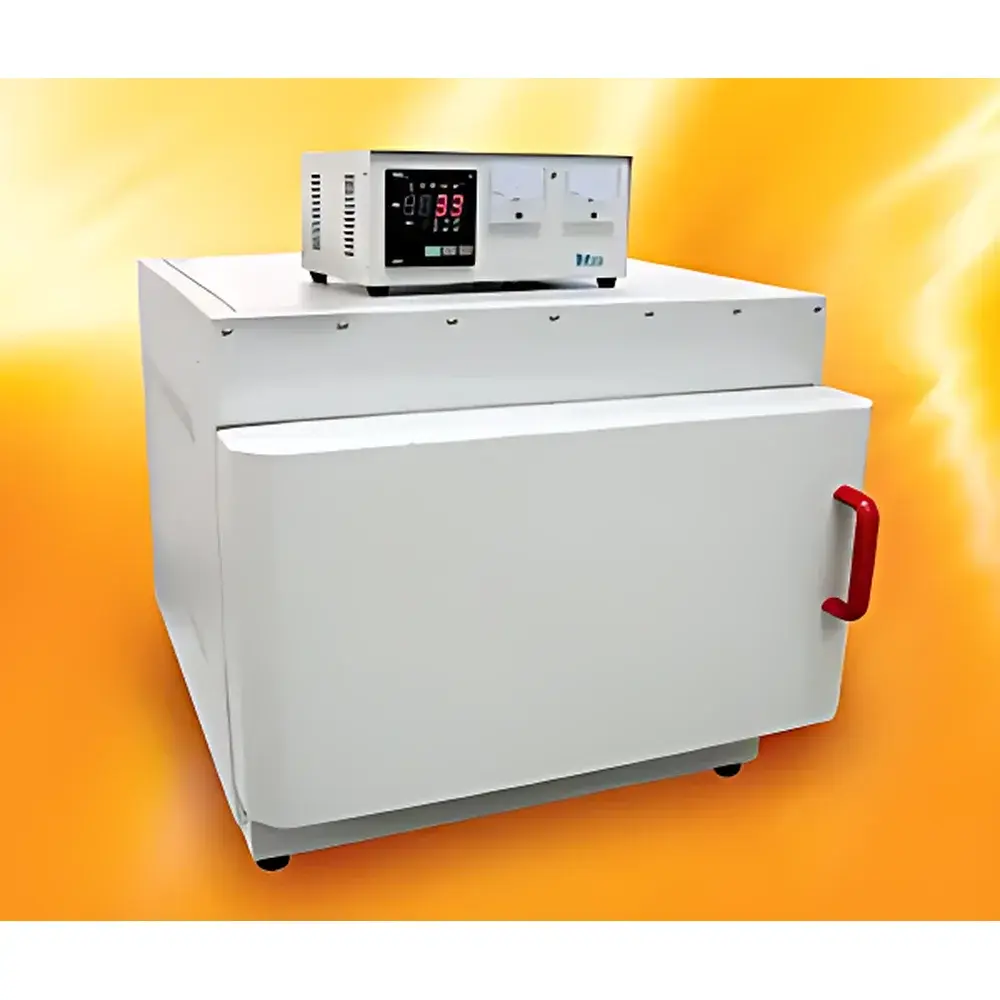
MICHEM TM09 Series High-Temperature Box Furnace
| Brand | MICHEM |
|---|---|
| Origin | Beijing, China |
| Model | TM09 Series |
| Type | Box-Type Muffle Furnace |
| Max Temperature | 1000 °C / 1200 °C / 1400 °C / 1700 °C |
| Temperature Control Accuracy | ±1 °C |
| Max Power | 3 kW (for ≤1400 °C models) / 7.5 kW (for 1700 °C model) |
| Heating Rate to Max Temp | 30 min (1000 °C) / 40 min (1200 °C) / 50 min (1400 °C) / 90 min (1700 °C) |
| Heating Element | HRE high-temp alloy (≤1400 °C) / Silicon Molybdenum (MoSi₂) rod (1700 °C) |
| Internal Chamber Dimensions | 200 × 300 × 150 mm (W × D × H) |
| Chamber Volume | 9 L |
| Net Weight | 65 kg |
| Power Supply | 220 V AC, 16 A (single-phase) or 380 V AC, 16 A (three-phase, for larger models) |
Overview
The MICHEM TM09 Series High-Temperature Box Furnace is a precision-engineered laboratory muffle furnace designed for applications requiring stable, uniform, and repeatable thermal environments up to 1700 °C. Based on the principle of resistive heating within an insulated ceramic fiber chamber, this furnace delivers rapid thermal response, exceptional energy efficiency, and long-term operational stability—critical for materials synthesis, ashing, sintering, calcination, annealing, and high-temperature calibration. Unlike conventional brick-lined furnaces, the TM09 series employs low-density, high-purity alumina-silica ceramic fiber insulation (≥95% Al₂O₃ + SiO₂), achieving surface temperatures below 60 °C during prolonged 1000 °C operation—minimizing ambient heat load and improving lab safety. Its modular design supports four maximum temperature variants (1000, 1200, 1400, and 1700 °C), each optimized with thermally matched heating elements and calibrated sensor placement to ensure axial and radial temperature uniformity within ±3 °C across the working zone per ASTM E220 and ISO 8573-1.
Key Features
- Rapid thermal ramping: Achieves 1000 °C in ≤30 minutes, 1700 °C in ≤90 minutes from ambient—among the fastest in its class for ceramic fiber box furnaces.
- Ultra-lightweight construction: 9 L chamber model weighs only 65 kg—facilitating repositioning and integration into constrained lab spaces without structural reinforcement.
- Energy-efficient architecture: Patented heating element mounting and optimized thermal zoning reduce standby losses; power consumption at 1700 °C is 4–5 kW (typical), ~40–60% lower than legacy refractory-based equivalents.
- High-stability temperature control: PID-regulated digital controller (PP3 series) with 30 programmable segments, ±1 °C setpoint accuracy, and <0.2% full-scale stability under load.
- Enhanced safety protocols: Automatic power cutoff upon door opening, over-temperature cutout (OTC) at 50 °C above setpoint, and grounded double-wall chassis compliant with IEC 61010-1.
- Modular sensor compatibility: Standard K-type (up to 1200 °C) and S-type (up to 1600 °C) thermocouples; optional B-type (up to 1800 °C) available for 1700 °C configurations.
Sample Compatibility & Compliance
The TM09 series accommodates crucibles and sample holders made from alumina, silicon carbide, quartz (below 1100 °C), and molybdenum disilicide (MoSi₂)—enabling inert, oxidizing, and mildly reducing atmospheres. It is routinely employed in ASTM C1171 (ash content of coal), ASTM E1157 (thermal decomposition kinetics), and ISO 5660-1 (fire reaction testing). The furnace meets CE marking requirements (EMC Directive 2014/30/EU and LVD Directive 2014/35/EU), conforms to GLP-compliant operation when paired with audit-trail-capable controllers, and supports traceable calibration per ISO/IEC 17025 when used with NIST-traceable reference thermocouples. For regulatory workflows, optional data-logging modules provide timestamped temperature profiles compliant with FDA 21 CFR Part 11 requirements.
Software & Data Management
While the standard PP3 controller operates via front-panel interface, optional RS485/Modbus RTU or USB-C connectivity enables integration with LabVIEW™, MATLAB®, or custom SCADA systems. Firmware supports real-time temperature logging at user-defined intervals (1–60 s), export of CSV-formatted thermal profiles, and alarm event tagging (e.g., door open, OTC trigger, power loss). When configured with the optional data acquisition module, the system maintains an immutable audit trail—including operator ID, parameter changes, and calibration events—satisfying GMP documentation standards for QC laboratories performing thermal validation per USP .
Applications
- Materials science: Sintering of advanced ceramics (ZrO₂, Si₃N₄), densification of metal powders, and phase transformation studies.
- Geochemical & environmental analysis: Gravimetric determination of loss-on-ignition (LOI), total organic carbon (TOC) oxidation, and heavy metal residue ashing per EPA Method 3050B.
- Metallurgy: Homogenization annealing of superalloys, decarburization studies, and flux-assisted fusion for XRF sample preparation.
- Standards metrology: Serving as a stable, high-temperature blackbody source for radiometric calibration of infrared pyrometers and thermographic cameras—validated per NIST SP 250-93.
- Quality assurance: Thermal aging tests per IPC-TM-650 2.6.26 and solderability pre-conditioning per J-STD-002.
FAQ
What atmosphere options are supported?
The TM09 series operates in ambient air by default. Optional quartz tube inserts or flanged ports allow purging with N₂, Ar, or forming gas (5% H₂/95% N₂); vacuum operation requires external pump integration and is not factory-rated.
Is the furnace suitable for continuous 1700 °C operation?
Yes—when equipped with MoSi₂ heating elements and B-type thermocouples, the 1700 °C models are rated for continuous duty cycles up to 1000 hours between element inspection, per manufacturer’s maintenance schedule.
How is temperature uniformity verified?
Uniformity is characterized using a 5-point thermocouple mapping procedure per ASTM E220 Annex A2: sensors placed at center, corners, and mid-walls of the chamber while holding at 1000 °C, 1400 °C, and 1700 °C; certified reports available upon request.
Can the controller be upgraded for remote monitoring?
Yes—firmware version 2.4+ supports Modbus TCP over Ethernet; OEM integration kits include API documentation and Python SDK for automated script-driven thermal cycling.
What maintenance is required for long-term reliability?
Quarterly visual inspection of heating elements and ceramic fiber integrity; annual recalibration of thermocouple input circuitry; biannual cleaning of air vents and cooling fans—no lubrication or consumable replacement needed under normal use.



