
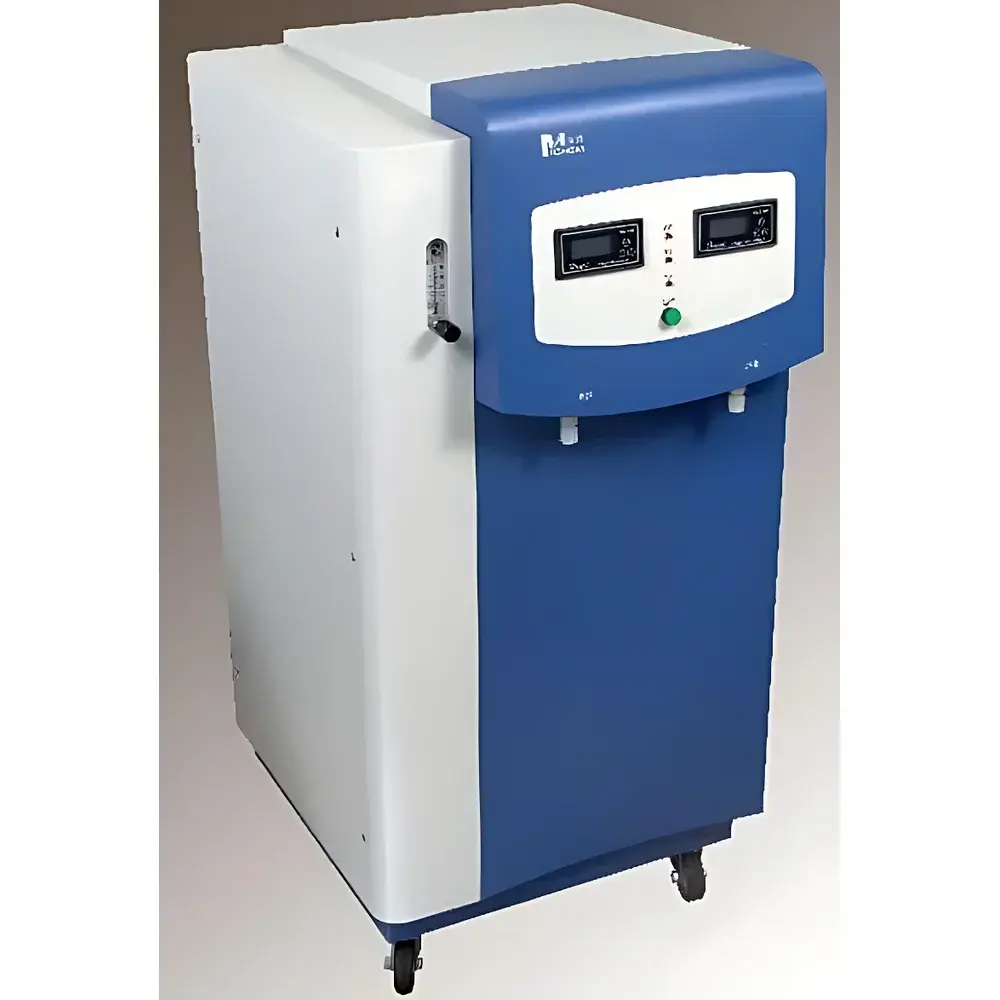
MICHEM MW-D20 Ultra Pure Water System
| Brand | MICHEM |
|---|---|
| Origin | Beijing, China |
| Model | MW-D20 |
| Output Rate | 20 L/h |
| Feed Water | Municipal tap water (TDS < 360 ppm, pressure > 0.2 MPa) |
| Pure Water Resistivity | 1–5 µS/cm |
| Ultra-Pure Water Resistivity | 10–18.25 MΩ·cm @ 25 °C |
| TOC | ≤10 ppb |
| Endotoxin | < 0.001 EU/mL |
| Microbial Count | ≤1 CFU/mL |
| Particles (>0.1 µm) | < 1 particles/mL |
| Heavy Metals & Soluble Silica | < 0.1 ppb |
| Conductivity Sensor | 0.01 cm⁻¹ stainless steel electrode, ±0.1 °C temperature compensation |
| Optional Terminal Filtration | Sartorius 0.22 µm filter |
| Power | AC 220 V / 50 Hz / 5 A |
| Dimensions (W×D×H) | 440 × 555 × 700 mm |
| Resin Capacity | 8,000 L per cycle |
| Noise Level | < 20 dB(A) |
Overview
The MICHEM MW-D20 Ultra Pure Water System is a laboratory-grade dual-loop water purification platform engineered for precision analytical and life science applications requiring consistent Type I ultrapure water (ASTM D1193-20, ISO 3696:1987, CLSI EP21-A, and GB/T 6682-2008 Class I). It employs a six-stage integrated purification architecture—comprising pre-filtration, activated carbon adsorption, reverse osmosis (RO), mixed-bed ion exchange, UV photooxidation (185/254 nm), and optional 0.22 µm terminal filtration—to remove ions, organic compounds, colloids, microorganisms, endotoxins, and sub-micron particulates from municipal tap feed water. The system delivers stable resistivity up to 18.25 MΩ·cm at 25 °C, with real-time monitoring of conductivity/resistivity, TOC, temperature, and flow status via an integrated LCD interface. Its closed-loop, stainless-steel spray-coated housing minimizes ambient contamination risk and supports flexible benchtop deployment without dedicated plumbing or ventilation.
Key Features
- Simultaneous dual-output design: independent pure water (1–5 µS/cm) and ultrapure water (≥10–18.25 MΩ·cm) streams, each with dedicated monitoring and dispensing control.
- High-fidelity resistivity measurement using a temperature-compensated 0.01 cm⁻¹ stainless steel electrode (±0.1 °C accuracy), enabling trace-level ionic impurity detection.
- UV oxidation module (dual-wavelength 185/254 nm) reduces TOC to ≤10 ppb and suppresses microbial regrowth in the distribution loop.
- Low-noise (<20 dB[A]) high-efficiency booster pump ensures stable RO operation under variable municipal pressure (≥0.2 MPa), with automatic shutdown on low-inlet or full-tank conditions.
- Smart maintenance management: programmable resin exhaustion alerts, filter replacement reminders, and event-logged operational history compliant with GLP audit trails.
- NSF-certified components—including Dow Filmtec RO membranes and DuPont/Koch ion-exchange resins—ensure long service life and regulatory alignment with USP , FDA 21 CFR Part 11 (when paired with validated software), and ISO 9001 manufacturing controls.
Sample Compatibility & Compliance
The MW-D20 is validated for use with sensitive analytical instrumentation requiring stringent water purity, including but not limited to ICP-MS, HPLC-MS, LC-MS/MS, atomic absorption spectroscopy (AAS), and cell culture media preparation. Its output meets or exceeds key international specifications: ASTM Type I water (D1193-20), CLSI-recommended water for clinical laboratories (EP21-A), ISO Grade 1 (3696:1987), and Chinese National Standard GB/T 6682-2008 Class I. Endotoxin levels (<0.001 EU/mL) and microbial counts (≤1 CFU/mL) satisfy requirements for pyrogen-sensitive applications such as monoclonal antibody formulation and sterile buffer preparation. All wetted materials comply with USP Class VI biocompatibility testing, and the system supports optional IQ/OQ documentation packages for GMP-regulated environments.
Software & Data Management
The MW-D20 features embedded firmware with non-volatile memory for storing up to 30 days of time-stamped water quality logs—including resistivity, TOC, temperature, cumulative volume, and alarm events. While the base unit operates standalone via tactile keypad and LCD display, optional RS232/USB connectivity enables integration with laboratory information management systems (LIMS) or centralized facility monitoring platforms. When deployed with validated third-party data acquisition software, the system supports electronic signatures, audit trail generation, and 21 CFR Part 11-compliant data integrity controls—including user access levels, change history, and immutable record retention. Calibration certificates for the resistivity sensor are traceable to NIST standards and include uncertainty budgets per ISO/IEC 17025.
Applications
- HPLC, UHPLC, and GC mobile phase preparation and column rinsing
- ICP-OES and ICP-MS sample dilution and standard solution preparation
- Cell culture media, reagent buffers, and molecular biology applications (e.g., PCR, electrophoresis, sequencing)
- Atomic spectroscopy techniques including AAS, AES, and GF-AAS
- Calibration standard preparation for trace metal analysis (e.g., EPA Method 200.8, ISO 17294-2)
- Cleanroom humidification and optical lens cleaning where particle-free rinse water is critical
FAQ
What feed water quality is required for optimal MW-D20 performance?
Municipal tap water with TDS ≤ 360 ppm and inlet pressure ≥ 0.2 MPa is sufficient; no pretreatment is needed beyond standard sediment/carbon prefiltration if local water contains high chlorine or particulate load.
Does the system support continuous 24/7 operation?
Yes—the MW-D20 incorporates thermal overload protection, automatic reservoir level sensing, and fail-safe shutoff logic, enabling unattended operation in core facility environments.
Can the MW-D20 be upgraded to meet stricter TOC or endotoxin specifications?
Optional enhancements include a second UV lamp stage, ultra-low TOC polishing cartridge (≤5 ppb), and sterile 0.1 µm final filtration—configurable during initial commissioning or retrofitted in-field.
How often must consumables be replaced under typical lab usage?
At 20 L/h average demand and typical municipal feed water (TDS ~200 ppm), the RO membrane lasts 2–3 years, mixed-bed resin ~8,000 L (≈6–12 months), and UV lamp 12 months—alerts are triggered automatically based on runtime and conductivity drift.
Is validation documentation available for regulated laboratories?
Yes—MICHEM provides IQ/OQ protocols, calibration records, material compliance declarations (RoHS, REACH), and test reports from CNAS-accredited third-party labs upon request.



