
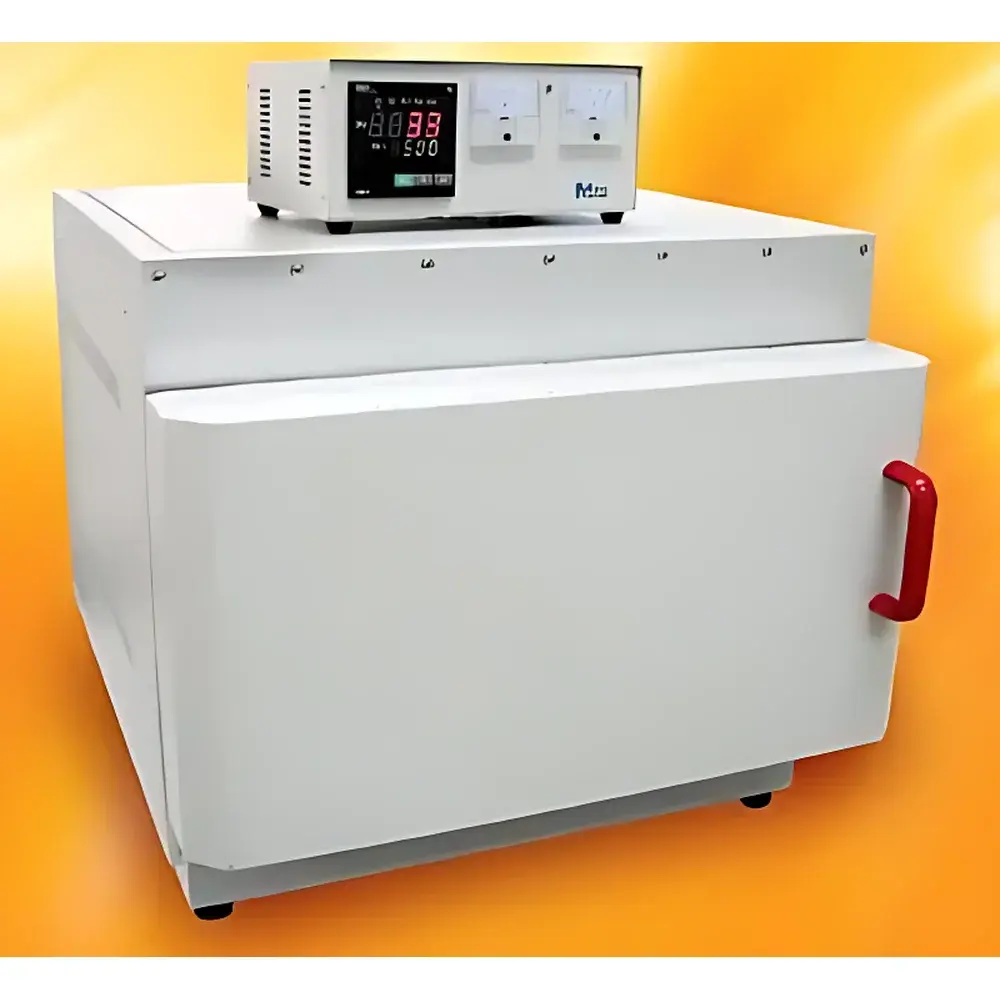
MICHEM TM Series Ceramic Fiber Muffle Furnace
| Brand | MICHEM |
|---|---|
| Origin | Beijing, China |
| Model | TM Series |
| Max Temperature | 1700 °C |
| Chamber Volume | 4–30 L |
| Heating Element | Kanthal resistance wire (≤1400 °C) / Silicon molybdenum (MoSi₂) rod (1700 °C) |
| Thermocouple Type | K (≤1200 °C), S (≤1400 °C), B (≤1700 °C) |
| Insulation Thickness | 80–140 mm |
| Power Supply | 220 V/16–25 A or 380 V/16 A (3-phase) |
| Power Rating | 2–7 kW |
| External Dimensions (W×D×H) | 550×530×430 to 710×760×640 mm |
| Net Weight | 52–110 kg |
| Temp. Stability | ±2 °C at setpoint |
| Ramp Rate | ≤90 min (100→1700 °C) |
| Compliance | Designed for GLP/GMP-aligned thermal processing |
Overview
The MICHEM TM Series Ceramic Fiber Muffle Furnace is a high-performance, laboratory-grade thermal processing system engineered for precision ashing, calcination, sintering, annealing, and fusion applications across analytical chemistry, metallurgy, materials science, and quality control laboratories. Unlike traditional brick-lined muffle furnaces, the TM Series employs low-density, high-purity ceramic fiber insulation—offering exceptional thermal efficiency, rapid thermal response, and minimized external heat dissipation. Its core architecture follows the principle of radiant heating within a sealed, oxidation-resistant chamber, with temperature uniformity maintained via optimized element placement and PID-controlled feedback loops. The furnace operates without direct flame or gas combustion, ensuring contaminant-free heating environments essential for trace-metal analysis (e.g., EPA Method 3050B, ISO 11885) and certified reference material preparation. The 1700 °C variant—developed under China’s National Key Technology R&D Program (“Tenth Five-Year Plan”)—represents a benchmark in domestic high-temperature furnace design, achieving full thermal soak at maximum temperature in under 90 minutes with ±2 °C stability over extended dwell periods.
Key Features
- Rapid Thermal Response: Achieves 100 °C to 1000 °C in <30 minutes; 100 °C to 1700 °C in <90 minutes—up to 2× faster than conventional refractory-lined units of comparable volume.
- Ultra-Lightweight Construction: Ceramic fiber insulation reduces structural mass significantly—6 L models weigh only 52 kg; 9 L models weigh 65 kg—enabling flexible benchtop or mobile cart deployment without structural reinforcement.
- High-Temperature Capability: Certified continuous operation up to 1700 °C using patented MoSi₂ heating elements and B-type thermocouples—validated per IEC 60584-2 and suitable for high-temperature calibration source applications (e.g., thermocouple wire certification, blackbody reference).
- Scalable Chamber Volumes: Four internal cavity configurations: 4 L (TM0417), 6 L (TM06xx), 9 L (TM09xx), 20 L (TM20xx), and 30 L (TM30xx)—with 20 L and 30 L variants supporting large-batch sample processing per ASTM C114 or ISO 6872 standards.
- Energy-Efficient Design: Input power ranges from 2 kW to 7 kW depending on model—up to 60% lower consumption versus legacy muffle furnaces—enabled by low thermal mass insulation and optimized element geometry (patent pending).
- Thermal Safety & Containment: Surface temperature remains ≤60 °C after 1-hour hold at 1000 °C; integrated door interlock cuts power upon opening—compliant with EN 61000-6-4 (EMC) and IEC 61000-3-2 (harmonic current limits).
Sample Compatibility & Compliance
The TM Series accommodates crucibles, boats, and trays fabricated from alumina, quartz, silicon carbide, and platinum—compatible with aggressive ashing matrices (e.g., biological tissues, polymers, coal, soil). Its inert, sealed chamber prevents cross-contamination during sequential runs and supports regulated workflows including USP heavy metal testing, AOAC 990.11 total ash determination, and ISO 1171 solid fuel analysis. All models are designed to meet general requirements for GLP-compliant thermal processing: full audit trail capability (when paired with optional data logger), configurable ramp/soak profiles, and traceable temperature validation per EURACHEM/CITAC Guide CG4. While not FDA 21 CFR Part 11–certified out-of-the-box, firmware supports electronic signature-ready logging when integrated with validated third-party software platforms.
Software & Data Management
The standard P-series and P3-series programmable controllers support up to 30-segment ramp-soak profiles, with resolution of 1 °C and timing precision of ±0.1% of set value. Each segment allows independent ramp rate (°C/min), dwell time (up to 9999 minutes), and overshoot suppression logic. Optional RS485 Modbus RTU interface enables integration with LabVIEW, SCADA, or LIMS systems for centralized monitoring and automated report generation. Data export (CSV) supports post-run thermal profile analysis, deviation reporting, and compliance documentation for ISO/IEC 17025 accreditation audits. Firmware updates are performed via USB port, preserving user-defined programs and calibration offsets.
Applications
- Analytical laboratories: Dry ashing of environmental samples (EPA 3050B), pharmaceutical excipients (USP ), and food matrices (AOAC 942.05).
- Metallurgical R&D: Oxidation studies, alloy homogenization, and flux-assisted fusion for XRF bead preparation (ISO 8289-1).
- Ceramics & advanced materials: Sintering of oxide ceramics, densification of battery cathode precursors, and thermal cycling stability tests.
- Quality assurance: Heat treatment validation per ASTM A956 (metallographic specimen preparation) and ISO 9001 thermal process control records.
- Standards laboratories: High-temperature reference source for thermocouple calibration (ASTM E230/E230M) and pyrometer verification.
FAQ
What thermocouple types are supported across the TM Series temperature range?
K-type (up to 1200 °C), S-type (up to 1400 °C), and B-type (up to 1700 °C) thermocouples are factory-configured per model—each calibrated against NIST-traceable references.
Can the furnace be used for inert-atmosphere processing?
No—standard TM models operate in ambient air. For controlled atmospheres (N₂, Ar, reducing gases), optional gas inlet/outlet ports and flanged door seals are available as field-installable accessories.
Is third-party temperature mapping validation supported?
Yes—uniformity testing per ASTM E2203 or IEC 60068-3-5 is facilitated by multiple thermocouple access ports (2–4 positions, depending on chamber size) and stable thermal equilibrium performance.
What maintenance is required for MoSi₂ heating elements?
Elements require no periodic replacement under normal use; however, avoid thermal shock (rapid cooling below 800 °C in air) to prevent oxidation-induced embrittlement—follow recommended cool-down protocols in the operator manual.
Are CE or UL certifications available?
CE marking is applied to all export-configured units meeting EN 61000-6-2/6-4 and EN 61000-3-2/3-3. UL 61010-1 listing is available upon request for North American distribution channels, subject to regional electrical configuration and safety interlock verification.



