
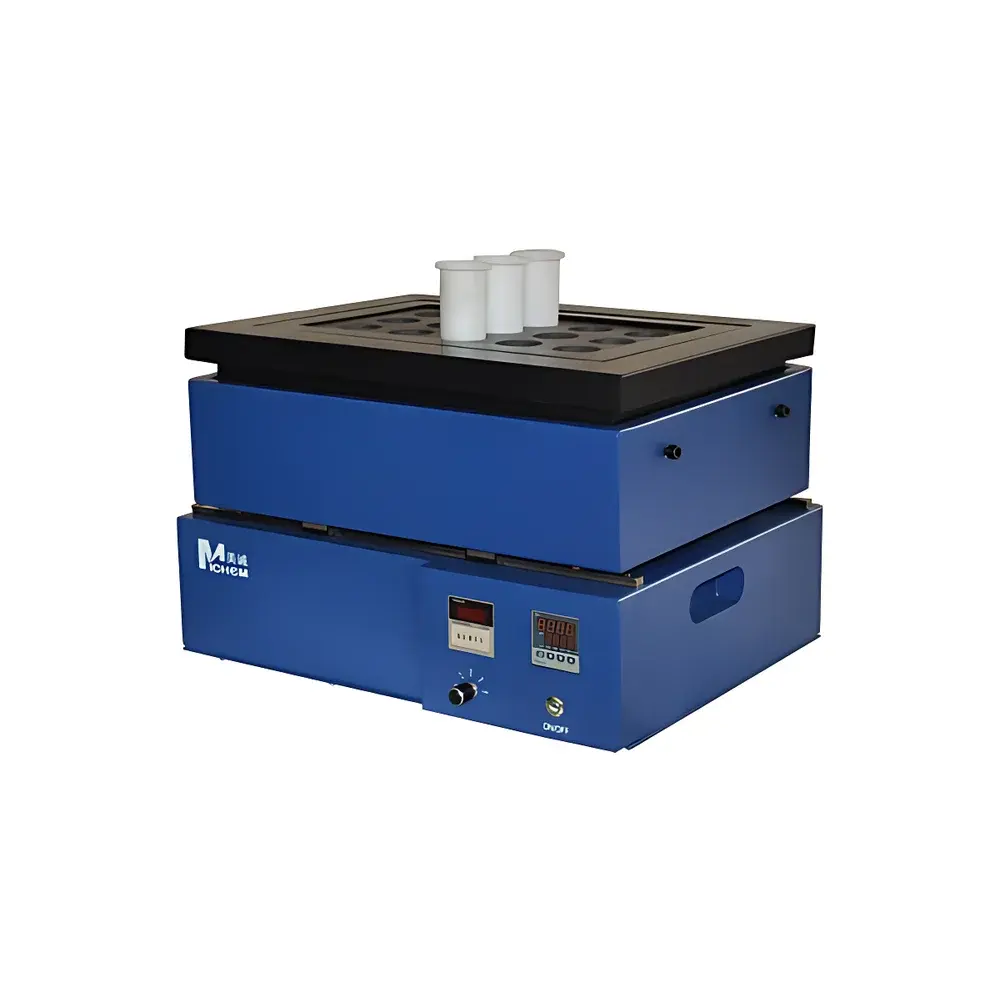
MICHEM ZDD Series Translation Oscillating Digestion System
| Brand | MICHEM |
|---|---|
| Model | ZDD-1 / ZDD-2 |
| Digestion Type | Graphite Block Digestion |
| Heating Method | Conventional (ZDD-1) / Infrared (ZDD-2) |
| Max. Temperature | 260 °C (ZDD-1) / 460 °C (ZDD-2) |
| Temp. Accuracy | ±1.0 °C |
| Oscillation Frequency | 0–300 cycles/min |
| Oscillation Amplitude | 10 mm (reciprocating) |
| Timer Range | 1–99 h |
| Power Supply | AC 220 V, 50 Hz, 16 A |
| Dimensions | 500 × 360 × 360 mm |
| Weight Capacity | 40 kg |
| Control System | PID with 30-step programmable ramp/soak |
| Heating Material | PTFE-coated graphite (ZDD-1) / High-temp PTFE-coated graphite (ZDD-2) |
| Motor Power | 45 W |
| Bearing Type | Imported linear bearing |
| Surface Finish | Brushed stainless steel |
Overview
The MICHEM ZDD Series Translation Oscillating Digestion System is an integrated laboratory instrument engineered for simultaneous or sequential thermal digestion and mechanical agitation of solid and liquid samples. Unlike conventional single-function digestion blocks or orbital shakers, the ZDD platform implements a precisely controlled reciprocating oscillation mechanism—mounted on high-precision imported linear bearings—combined with uniform graphite-block heating. Its core operational principle leverages conductive heat transfer via PTFE-coated graphite (standard in ZDD-1; high-temperature variant in ZDD-2) paired with forced convective mixing through horizontal translation motion. This dual-mode architecture enables reproducible sample homogenization under thermal stress, minimizing localized overheating, sedimentation, or incomplete acid contact—critical factors in trace metal analysis, environmental monitoring, and pharmaceutical QA/QC workflows. Designed as a benchtop unit with low center-of-gravity geometry, the system ensures mechanical stability during prolonged oscillation cycles while maintaining compliance with IEC 61010-1 safety standards for laboratory electrical equipment.
Key Features
- True dual-function operation: independent or concurrent use as a graphite digestion block and a precision reciprocating shaker—eliminating need for separate instruments and reducing cross-contamination risk.
- Two heating configurations: ZDD-1 employs resistive heating elements embedded in standard PTFE-coated graphite (max. 260 °C); ZDD-2 integrates infrared emitters with high-temperature PTFE-coated graphite (max. 460 °C), enabling rapid thermal response and enhanced energy efficiency.
- PID-controlled 30-segment programmable temperature profile with ramp/soak functionality, ±1.0 °C accuracy across full range (Rt to 460 °C), over-temperature and under-temperature alarms, and automatic thermal cutoff.
- Smooth, low-noise reciprocating oscillation (0–300 cycles/min, 10 mm amplitude) driven by a 45 W brushless motor and wave-switch speed control—ensuring long service life, minimal vibration transmission, and consistent kinetic energy delivery to all sample vessels.
- Robust construction: brushed stainless-steel housing resists corrosion from HNO₃, HCl, HF, and aqua regia vapors; load capacity of 40 kg supports up to 48 × 50 mL digestion tubes or custom vessel arrays.
- Integrated digital timer (1–99 hours) with auto-shutdown, facilitating unattended overnight digestion protocols compliant with EPA Method 3050B, ISO 11466, and ASTM D3682.
Sample Compatibility & Compliance
The ZDD system accommodates standard digestion vessels—including polytetrafluoroethylene (PTFE), perfluoroalkoxy (PFA), and quartz tubes—across volume ranges from 10 mL to 100 mL. It supports both open-vessel hotplate-style digestion and closed-vessel pre-digestion or post-microwave acid evaporation (e.g., “赶酸”/acid removal). Its uniform thermal field and mechanical agitation ensure statistically equivalent reaction kinetics across all positions—validated per ISO/IEC 17025 requirements for method validation. The instrument meets CE marking criteria (EMC Directive 2014/30/EU, LVD Directive 2014/35/EU) and is compatible with GLP-compliant documentation when paired with external data loggers supporting FDA 21 CFR Part 11 audit trails.
Software & Data Management
While the ZDD operates via front-panel digital interface, optional RS-485 or USB-to-serial adapters enable connection to third-party laboratory information management systems (LIMS) or custom SCADA platforms. Temperature and timer logs can be exported as CSV files for integration into electronic lab notebooks (ELN). All programmable parameters—including segment setpoints, dwell times, oscillation rates, and alarm thresholds—are retained after power cycling. No proprietary software is required; configuration adheres to Modbus RTU protocol for interoperability with industrial automation environments.
Applications
- Environmental testing: soil, sludge, and sediment digestion prior to ICP-MS or AAS analysis per EPA 3050B, 3051A, and 3052.
- Biological and clinical matrices: tissue, blood, and urine digestion for heavy metal quantification (Pb, Cd, As, Hg) under CLIA and CAP guidelines.
- Geochemical and mining assays: rock and ore sample preparation for multi-element geochemistry (XRF, ICP-OES).
- Pharmaceutical excipient testing: residual catalyst metal screening in APIs per USP and .
- Academic research: method development for novel digestion chemistries requiring kinetic control (e.g., sequential HNO₃–H₂O₂–HF addition under agitation).
FAQ
Can the ZDD be used with microwave digestion systems?
Yes—the ZDD serves as a primary digestion station for low-temperature pre-treatment or as a post-microwave acid removal (‘赶酸’) platform, eliminating the need for hotplates with inconsistent heating zones.
What safety protections are built into the heating system?
Independent dual thermal cutoffs (mechanical and electronic), real-time temperature deviation alerts, and automatic power disengagement at ±5 °C beyond setpoint prevent thermal runaway and vessel rupture.
Is calibration traceable to national standards?
The integrated Pt100 sensor is factory-calibrated against NIST-traceable references; users may perform field verification using certified thermocouple calibrators per ISO/IEC 17025 Clause 6.5.
Does oscillation affect temperature uniformity across the block?
No—finite element modeling confirms <±0.8 °C inter-position variation at 200 °C under 200 cycles/min, due to optimized graphite thermal mass and symmetrical drive coupling.
What maintenance is required for long-term reliability?
Annual inspection of linear bearing preload and PTFE coating integrity; no lubrication required; graphite block replacement recommended every 2 years under continuous 400 °C operation.



