
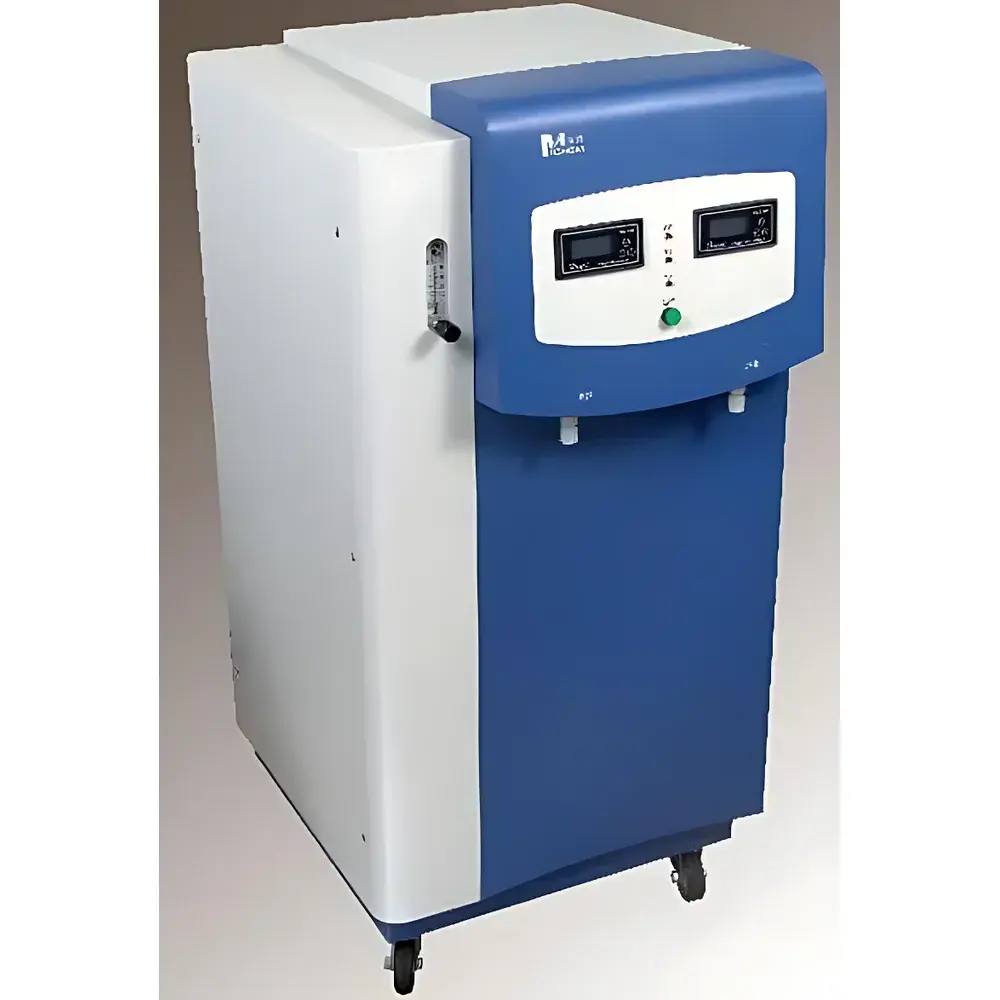
MICHEM MW-150D / MW-1T / MW-1.5T / MW-2T Industrial-Grade Ultra-Pure Water System
| Brand | MICHEM |
|---|---|
| Origin | Beijing, China |
| Model Series | MW-150D, MW-1T, MW-1.5T, MW-2T |
| Resistivity | 18.25 MΩ·cm @ 25 °C |
| Heavy Metals & Soluble Silica | < 0.1 ppb |
| Total Organic Carbon (TOC) | ≤ 10 ppb |
| Microbial Count | < 1 CFU/mL |
| Endotoxin Level | < 0.001 EU/mL |
| Particles (>0.1 µm) | < 1 particle/mL |
| Output Flow Rate | 150 L/h to 2000 L/h (model-dependent) |
| Feed Water | Municipal tap water (TDS < 360 ppm, pressure > 0.2 MPa) |
| Compliance | GB/T 6682–2008 Grade I, ASTM D1193–20, NCCLS EP21-A, CAP Laboratory Standards |
Overview
The MICHEM MW-Series Industrial-Grade Ultra-Pure Water System is a modular, dual-loop purification platform engineered for continuous, high-reliability production of Type I ultrapure water in demanding analytical and manufacturing environments. Based on a multi-stage purification architecture—integrating pre-filtration, activated carbon adsorption, reverse osmosis (RO), electrodeionization (EDI), dual-wavelength UV photooxidation (185/254 nm), and final 0.22 µm membrane filtration—the system delivers water meeting or exceeding the strictest international specifications for critical applications. Its core measurement principle relies on real-time resistivity monitoring via temperature-compensated stainless-steel electrodes (±0.1 °C sensitivity), enabling precise quantification of ionic purity. The MW-Series is not a point-of-use benchtop unit but a scalable, floor-standing system designed for centralized distribution across multiple workstations or integration into cleanroom utilities infrastructure.
Key Features
- Modular dual-output architecture: Simultaneous production of purified water (1–5 µS/cm) and ultrapure water (≥18.25 MΩ·cm @ 25 °C) from a single feed source.
- Integrated 185/254 nm UV oxidation chamber: Reduces TOC to ≤10 ppb and suppresses microbial regrowth with validated photolytic efficiency.
- High-stability resistivity sensor: 0.01 cm⁻¹ stainless-steel electrode with automatic temperature compensation ensures trace-level ionic purity verification per ASTM D1193–20 Annex A1.
- Low-noise, energy-efficient pressurization: Optimized booster pump operates at 90% less energy than traditional distillation systems.
- Sealed, closed-loop fluid path: All wetted materials comply with USP Class VI and NSF/ANSI Standard 61; no air exposure between final filter and dispensing point.
- Intelligent control interface: Backlit LCD display with touch-sensitive controls provides real-time monitoring of resistivity, TOC, temperature, flow rate, and consumable life.
- Automated safety protocols: Auto-shutdown on low feed pressure, full storage tank, or conductivity excursion beyond user-defined thresholds.
Sample Compatibility & Compliance
The MW-Series is validated for compatibility with high-sensitivity instrumentation requiring ultra-low background interference—including ICP-MS, HPLC-MS, LC-MS/MS, atomic absorption spectroscopy (AAS), and ion chromatography (IC). Its output consistently satisfies the water purity requirements of ISO/IEC 17025-accredited laboratories and supports GLP/GMP documentation workflows. The system conforms to Chinese national standard GB/T 6682–2008 (Grade I), ASTM D1193–20 (Type I), NCCLS EP21-A (for clinical laboratory water), and CAP accreditation guidelines. Optional Sartorius 0.22 µm terminal filters provide additional assurance for endotoxin-sensitive applications such as cell culture media preparation or pharmaceutical rinse validation. All components—including RO membranes (Dow FilmTec™), ion exchange resins (Kemira Purolite®), and UV lamps—are certified to NSF/ANSI 61 and meet FDA extractables/leachables criteria for indirect food contact.
Software & Data Management
While the MW-Series does not include cloud-based software, its embedded controller logs timestamped resistivity, TOC, temperature, and alarm events to internal non-volatile memory (retention ≥12 months). Data export is supported via USB port in CSV format for integration into LIMS or electronic lab notebooks (ELN). Audit trail functionality records all operator actions—including parameter changes, filter replacement confirmations, and calibration events—with immutable timestamps. The system supports 21 CFR Part 11-compliant configurations when paired with external validated software platforms used for electronic signature and access control. Calibration certificates for the resistivity sensor are traceable to NIST standards, and annual verification procedures align with ISO/IEC 17025 Clause 6.5.2.
Applications
- Trace elemental analysis by ICP-OES and ICP-MS, where sub-ppt metal contamination must be excluded.
- HPLC mobile phase preparation and LC-MS solvent make-up, minimizing baseline noise and column fouling.
- Preparation of calibration standards and reference materials for regulatory testing (e.g., EPA Method 200.8, ISO 17294).
- Rinsing of optical substrates, semiconductor wafers, and precision metrology components where particle-induced defects are unacceptable.
- Formulation of parenteral drug products and biologics under cGMP conditions, where endotoxin and organic residue limits are strictly enforced.
- Supporting ISO 14644-1 Class 5 cleanrooms via dedicated distribution loops with recirculating loop monitoring.
FAQ
What is the maximum allowable feed water TDS for stable 18.25 MΩ·cm output?
Feed water TDS must remain below 360 ppm, with optimal performance observed at ≤200 ppm. Higher TDS may reduce RO membrane lifespan and increase frequency of pretreatment maintenance.
Does the system include validation documentation for GMP environments?
Yes—factory IQ/OQ documentation is provided. PQ protocols and installation-specific risk assessments (per ISO 14644-3) can be commissioned separately.
Can the MW-Series be integrated into a building’s central water distribution network?
Yes—models MW-1T and larger support 3/4″ sanitary tri-clamp or ISO-KF connections and are compatible with recirculating loop designs up to 100 m in length.
How often must consumables be replaced under typical lab usage (1000 L/day)?
RO membrane: 24–36 months | EDI stack: 36–48 months | Final 0.22 µm filter: 6–12 months | UV lamp: 12 months (based on 8,000-hour rated life).
Is remote monitoring capability available?
Standard models support Modbus RTU over RS-485 for integration with BMS or SCADA systems; Ethernet/IP and OPC UA modules are optional upgrades.



