
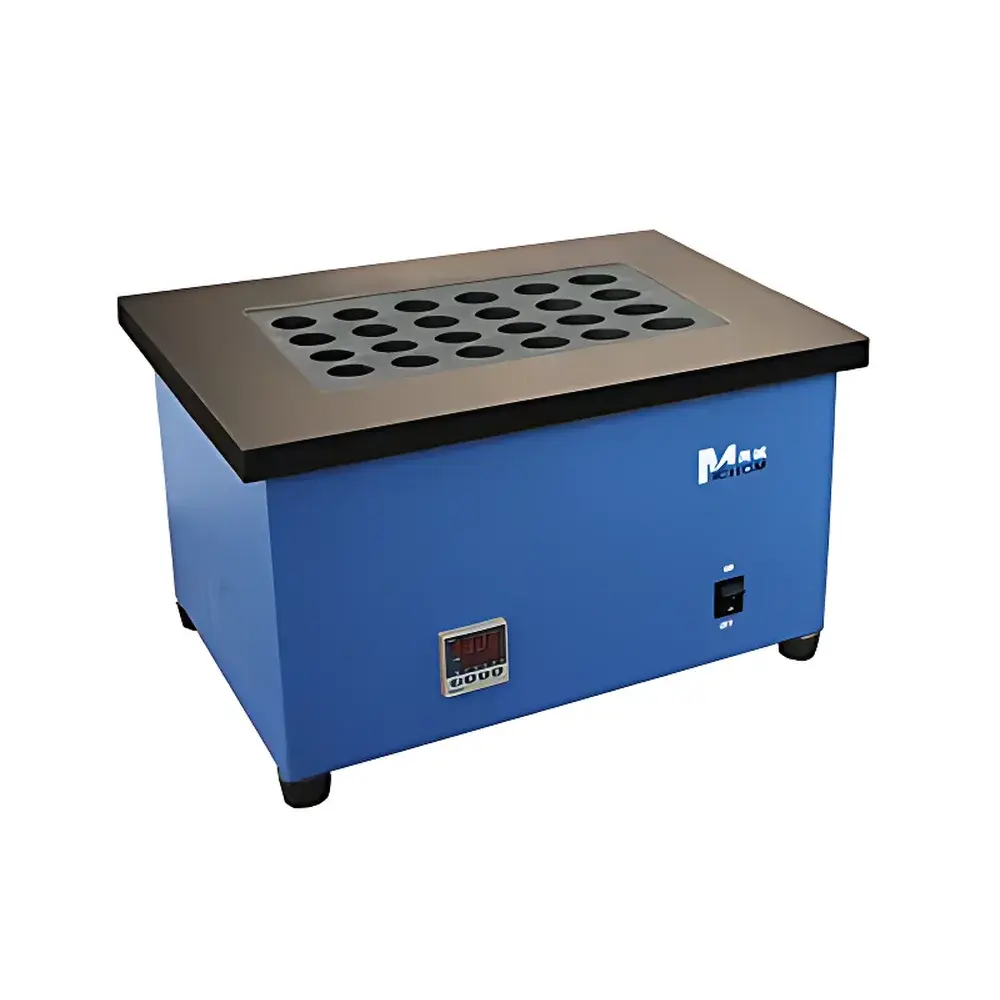
MICHEM HW Series Infrared Digestion System
| Brand | MICHEM |
|---|---|
| Origin | Beijing, China |
| Manufacturer Type | Authorized Distributor |
| Country of Origin | China |
| Model | HW Series |
| Instrument Type | Graphite-Based Infrared Digestion System |
| Heating Material | High-Temperature PTFE-Coated Graphite |
| Max Power | 2500 W (HW-15), 3500 W (HW-24/HW-40/HW-54) |
| Control Method | PID Digital Display |
| Temperature Program Steps | 30 |
| Max Operating Temperature | 460 °C |
| Temperature Accuracy | ±1.0 °C |
| Sample Capacity | HW-15: 15 × 100 mL |
| HW-24 | 24 × 50 mL |
| HW-40 | 40 × 100 mL |
| HW-54 | 54 × 50 mL |
| Digestion Well Dimensions | HW-15: Φ42 × 40 mm |
| HW-24 | Φ26 × 40 mm |
| HW-40 | Φ42 × 40 mm |
| HW-54 | Φ23 × 50 mm |
| Power Supply | AC 220 V / 50 Hz, 16 A |
| Unit Dimensions (W×D×H) | HW-15: 470 × 350 × 270 mm |
| HW-24/HW-40/HW-54 | 670 × 460 × 270 mm |
| Compatible Vessels | Standard borosilicate glass digestion tubes (custom diameters supported) |
Overview
The MICHEM HW Series Infrared Digestion System is a precision-engineered sample preparation instrument designed for rapid, uniform, and controlled thermal decomposition of solid and semi-solid matrices prior to elemental analysis. Unlike conventional conductive heating block digesters, the HW Series employs high-intensity infrared radiation coupled with longitudinal gradient temperature profiling—enabling direct energy transfer to digestion vessels and their contents without reliance on intermediate conduction through graphite mass alone. This hybrid thermal architecture significantly reduces thermal inertia, accelerates ramp rates, and improves inter-vessel temperature homogeneity across large sample batches. The system operates within a validated range of ambient to 460 °C, supporting open-vessel acid digestion protocols required for environmental soil, wastewater sludge, food commodities, pharmaceutical excipients, and biological tissues. Its design aligns with core principles of method robustness and reproducibility as defined in EPA Method 3050B, ISO 11466, and ASTM D5511—making it suitable for laboratories operating under GLP or ISO/IEC 17025 frameworks.
Key Features
- Infrared heating module with PTFE-coated graphite emitter plates ensures chemical resistance to aggressive reagents (e.g., HNO₃, HCl, HF, H₂O₂) and minimizes cross-contamination risk.
- 30-step programmable PID temperature controller enables precise multi-stage ramp-hold profiles—for example, low-temperature charring followed by high-temperature oxidation and final evaporation steps.
- Longitudinal gradient heating design mitigates edge effects and maintains ±1.0 °C uniformity across all wells at setpoint, verified per ASTM E220 calibration practice.
- Modular well configuration supports customizable bore diameters and depths; standard options include Φ23 mm × 50 mm, Φ26 mm × 40 mm, and Φ42 mm × 40 mm—compatible with common 50 mL and 100 mL borosilicate glass digestion tubes.
- Integrated overtemperature cutoff, ground-fault circuit interruption (GFCI), and real-time power monitoring ensure compliance with IEC 61010-1 safety standards for laboratory electrical equipment.
Sample Compatibility & Compliance
The HW Series accommodates a broad spectrum of sample types—including soils, sediments, plant tissues, animal feed, polymer composites, and clinical specimens—when processed using appropriate acid mixtures (e.g., HNO₃–HCl for aqua regia digestion or HNO₃–HF for silicate dissolution). All models are CE-marked and conform to EN 61326-1 (EMC) and EN 61010-1 (safety). The system supports trace-metal-clean workflows when used with class-A volumetric glassware and acid-washed consumables. For regulated environments, audit trails can be generated via optional RS-232/USB data logging interface, facilitating alignment with FDA 21 CFR Part 11 requirements when paired with compliant LIMS or ELN platforms.
Software & Data Management
While the base unit features an intuitive front-panel LCD with tactile keypad navigation, optional firmware upgrades enable PC-based control via MICHEM’s DigControl™ Desktop Suite (Windows 10/11 compatible). This application provides full access to method libraries, real-time temperature curve visualization, CSV export of time–temperature–power datasets, and electronic signature support for user authentication and change tracking. All logged data retain ISO/IEC 17025-compliant metadata—including operator ID, timestamp, method version, and instrument serial number—ensuring full traceability during accreditation audits.
Applications
- Preparation of samples for atomic absorption spectroscopy (AAS), atomic fluorescence spectroscopy (AFS), and inductively coupled plasma optical emission spectrometry (ICP-OES).
- Acid digestion of certified reference materials (CRMs) such as NIST SRM 2711a (Montana Soil) and BCR-680 (mussel tissue) for recovery validation studies.
- Residue removal post-microwave digestion (i.e., “final赶酸” or acid evaporation step) to achieve stable, low-volume digests suitable for hydride generation or direct nebulization.
- High-throughput screening in contract testing labs performing EPA 6010D or ISO 17294-2 compliant analyses.
- Method development for novel digestion matrices including carbon nanotubes, battery cathode materials, and microplastics.
FAQ
What distinguishes infrared heating from traditional graphite block heating?
Infrared heating delivers radiant energy directly to vessel walls and sample solution, reducing thermal lag and improving response time. Traditional conductive blocks rely on heat diffusion through bulk graphite, resulting in slower ramp rates and greater axial/radial gradients.
Can the HW Series be used with hydrofluoric acid (HF)?
Yes—provided vessels are made of HF-resistant materials (e.g., PFA or quartz) and operators follow strict PPE and fume hood protocols. The PTFE-coated graphite surface remains inert to HF under standard operating conditions.
Is method validation documentation available?
MICHEM provides a comprehensive validation kit including temperature uniformity mapping reports, accuracy verification certificates, and SOP templates aligned with ISO/IEC 17025 clause 7.2.1.
How is calibration performed?
Calibration uses NIST-traceable thermocouples inserted into representative wells at multiple depths; procedures follow ASTM E220 and are documented in the included Calibration Logbook.
Do you offer OEM integration support?
Yes—RS-485 Modbus RTU and analog 4–20 mA output options are available for integration into automated sample prep lines or central lab management systems.



