
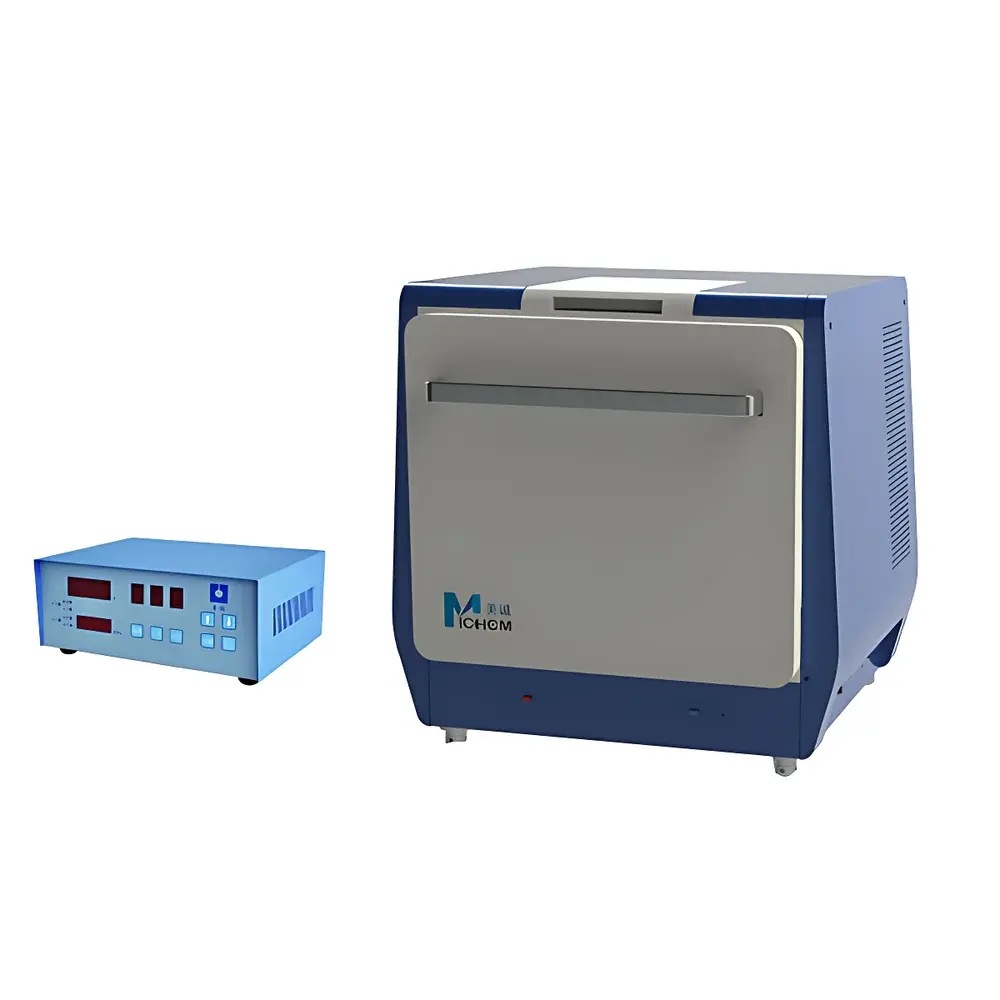
MICHEM MP6C Industrial-Grade Microwave Digestion and Extraction System
| Brand | MICHEM |
|---|---|
| Origin | Beijing, China |
| Model | MP6C |
| Microwave Frequency | 2450 ± 13 MHz |
| Output Power | 1200 W (0–100% PID-controlled) |
| Cavity Volume | 45 L |
| Max Temperature | 260 °C |
| Max Pressure | 1500 psi (10.34 MPa) |
| Sample Capacity | 10 vessels per run |
| Microwave Source | Single Magnetron |
| Cavity Lining | PFA-coated (DuPont™) |
| Outer Vessel Material | Reinforced PEEK (10 MPa burst rating) |
| Inner Vessel Material | TFM® (perfluoroalkoxy alkane) |
| Temperature Control | Pt100 RTD, ±0.5 °C accuracy (0–300 °C range) |
| Pressure Control | Direct-contact sensor, 0.01 MPa resolution |
| Safety Features | Six-layer protection including dual-stage pressure relief, auto-shutoff at overpressure, patented sliding-lock safety door (ZL 200420032536), microwave leakage ≤0.3 mW/cm² |
| Cooling | Forced-air exhaust, 3 m³/min, <20 min to safe opening temperature |
| Stirring | 360° bidirectional rotating carousel + optional electromagnetic/mechanical stirring (0–5000 rpm) |
| Control System | Embedded microcontroller (MP6C variant) with 15 pre-programmable methods (8-step ramping), real-time T/P curve display, method storage |
Overview
The MICHEM MP6C Industrial-Grade Microwave Digestion and Extraction System is a fully integrated, high-throughput sample preparation platform engineered for precision, reproducibility, and operational safety in regulated analytical laboratories. It employs controlled microwave energy (2450 MHz) to induce rapid, uniform thermal activation within sealed reaction vessels—leveraging principles of microwave-assisted chemistry (MAC) to accelerate acid digestion, solvent extraction, protein hydrolysis, and organic synthesis. Unlike conventional hotplate or block heater methods, the MP6C delivers closed-vessel processing under precisely monitored temperature and pressure conditions, enabling complete matrix decomposition of refractory samples—including geological, biological, pharmaceutical, and environmental matrices—while minimizing volatile element loss and reagent consumption. Its 45-L industrial cavity, PFA-lined chamber (DuPont™ certified), and reinforced PEEK/TFM® vessel architecture support sustained operation at up to 260 °C and 1500 psi—meeting the demanding requirements of trace elemental analysis by ICP-MS, ICP-OES, AAS, and AFS, as well as organic analysis via HPLC and GC.
Key Features
- Industrial-grade 45-liter cavity with DuPont™ PFA coating—chemically inert against concentrated HF, HNO₃, HCl, and aqua regia at elevated temperatures
- Single 1200 W magnetron with PID-regulated 0–100% power modulation for stable, repeatable energy delivery
- Real-time dual-parameter monitoring: Pt100 RTD-based temperature control (±0.5 °C from 0–300 °C) and direct-contact pressure sensing (0.01 MPa resolution, up to 10.34 MPa)
- Patented sliding-lock safety door (ZL 200420032536) with dual-stage pressure release mechanism and automatic microwave cutoff upon overpressure or door interlock breach
- Bidirectional 360° rotating carousel with optical feedback—ensures homogeneous microwave field distribution across all 10 sample positions
- Integrated forced-air cooling system (3 m³/min exhaust flow) achieving safe post-run vessel handling within 20 minutes
- Six-tier safety architecture: (1) real-time T/P slope control to prevent overshoot; (2) dual independent T/P sensors per run; (3) automatic power termination at user-defined thresholds; (4) rupture disc–based primary pressure relief (200/400 psi); (5) secondary mechanical door containment; (6) physically isolated control unit and cavity assembly
Sample Compatibility & Compliance
The MP6C accommodates a broad spectrum of sample types—including soils, sediments, plant tissues, animal tissues, polymers, catalysts, and pharmaceutical excipients—using standardized or custom-configured vessels ranging from 10 mL to 1500 mL. Its TFM® inner vessels and PEEK-reinforced outer vessels comply with ISO 17025 and ASTM D5511/D5512 requirements for digestate homogeneity and contamination control. The system supports method validation per USP , EPA Methods 3050B, 3051A, 3052, and EN 13656 for heavy metal determination, and is compatible with GLP/GMP workflows requiring audit-trail-capable instrumentation. Microwave leakage (<0.3 mW/cm²) conforms to IEC 61000-4-3 and national safety standards (GB 4706.21–2008), while pressure vessel design adheres to ASME BPVC Section VIII Division 1 guidelines for Class 1 pressure containment.
Software & Data Management
The MP6C (microcontroller-based MP6C variant) features an embedded operating system supporting up to 15 user-defined multi-step methods, each configurable with up to eight sequential ramps for temperature, pressure, hold time, and power. All parameters—including real-time temperature/pressure curves, method logs, and alarm events—are timestamped and stored locally with no external dependencies. Data export is supported via USB interface in CSV format for integration into LIMS or statistical analysis platforms (e.g., JMP, Minitab). While the MP6C does not include PC-linked software, its firmware architecture permits future firmware upgrades via secure USB update protocols—ensuring long-term compliance with evolving data integrity expectations under FDA 21 CFR Part 11 (when deployed with validated third-party electronic lab notebook solutions).
Applications
The MP6C serves as a core sample preparation tool in environmental testing labs (EPA-compliant soil and sludge digestion), clinical and forensic toxicology (blood/tissue mineral profiling), geochemical research (silicate rock dissolution), food safety (heavy metal screening in spices and infant formula), and materials science (catalyst residue analysis). Its dual-mode capability—supporting both high-pressure sealed-vessel digestion and open-vessel microwave-assisted extraction—enables method flexibility for applications such as PAH recovery from soils (EPA 3545A), pesticide residue extraction (AOAC 2007.01), and enzymatic digestion optimization. When coupled with ICP-MS, it achieves detection limits below 0.1 pg/g for As, Cd, Pb, and Hg in certified reference materials (e.g., NIST SRM 1577c).
FAQ
What is the maximum recommended operating pressure for routine use?
The MP6C is rated for continuous operation up to 1000 psi (6.9 MPa); 1500 psi represents the absolute burst limit of the PEEK/TFM® vessel system and is reserved for method development under strict supervision.
Can the MP6C be validated for GMP-compliant workflows?
Yes—the system’s deterministic control logic, hardware-enforced safety interlocks, and audit-ready event logging support IQ/OQ/PQ documentation when paired with qualified third-party software for electronic signature and change control.
Is PFA cavity coating resistant to hydrofluoric acid (HF)?
Yes—DuPont™ PFA exhibits exceptional resistance to HF up to 40% concentration at temperatures ≤200 °C; however, prolonged exposure above this threshold requires supplemental quartz shielding per ASTM D7279 guidance.
How does the bidirectional rotation improve analytical reproducibility?
The optically synchronized 360° carousel eliminates standing-wave hotspots by dynamically repositioning vessels relative to the microwave mode pattern—reducing inter-vial temperature variance to <±1.2 °C across a full 10-position run.
What maintenance is required for long-term reliability?
Annual verification of pressure transducer calibration, cavity waveguide inspection, and door seal integrity assessment are recommended; no routine magnetron replacement is needed under normal usage (rated lifespan ≥5000 hours).
Related Products



