
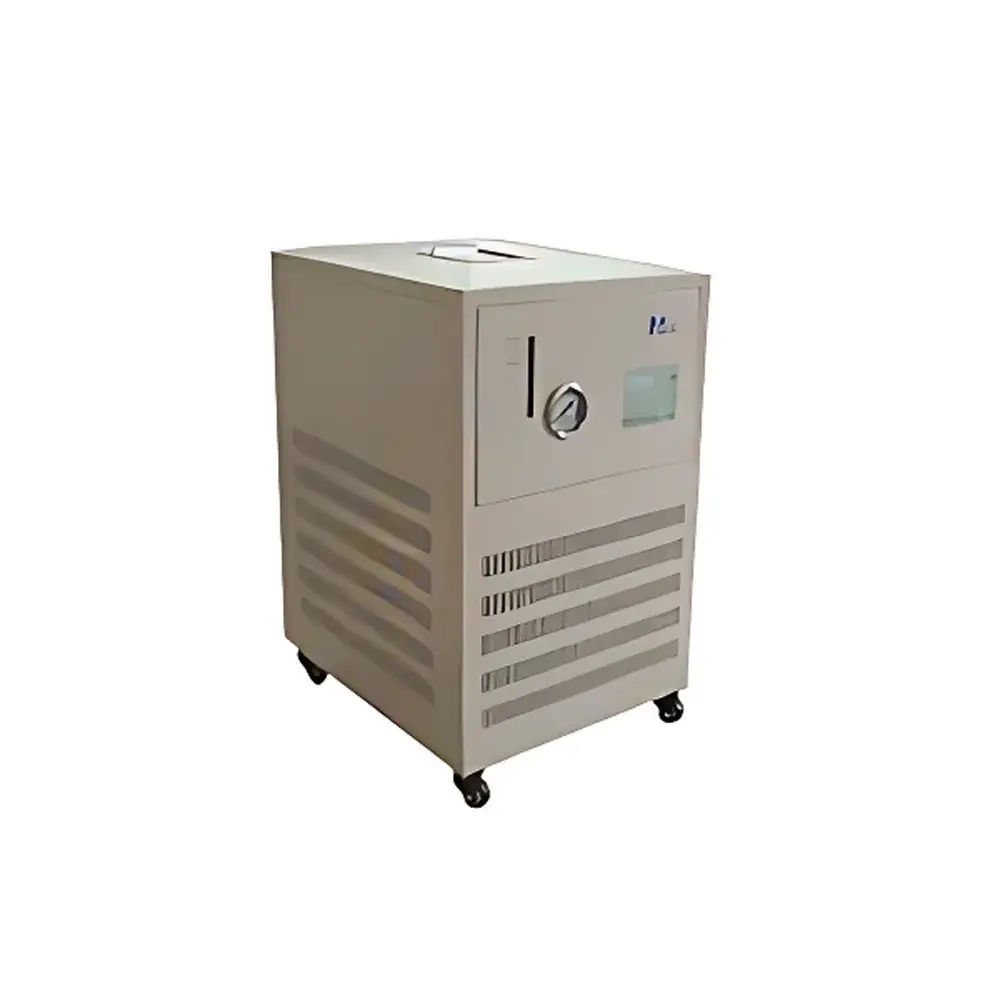
MICHEM MC-600C Integrated Circulating Chiller
| Brand | MICHEM |
|---|---|
| Origin | Beijing, China |
| Model | MC-600C |
| Instrument Type | Integrated |
| Cooling Method | Water-Cooled |
| Temperature Range | 5–35 °C |
| Cooling Capacity | 600 W |
| Temperature Stability | ±0.1 °C |
| Circulation Pump Pressure | 7 bar |
| Circulation Flow Rate | 5 L/min |
| Reservoir Volume | 7 L |
| Operation Mode | Continuous |
Overview
The MICHEM MC-600C Integrated Circulating Chiller is a precision-engineered laboratory cooling system designed to maintain stable thermal conditions for heat-sensitive analytical instrumentation. It operates on a closed-loop refrigeration cycle utilizing R134a or equivalent environmentally compliant refrigerant, coupled with a high-efficiency plate-type heat exchanger. Unlike open-loop tap-water cooling—historically used for graphite furnace atomic absorption spectrometers (GFAAS), ICP-OES, laser sources, and X-ray generators—the MC-600C eliminates uncontrolled water consumption, mineral scaling, and temperature drift. Its thermodynamic architecture ensures consistent heat extraction from instrument components such as plasma torches, detector housings, and high-power electronics, enabling uninterrupted operation under demanding 24/7 laboratory workflows.
Key Features
- Compact integrated design with 7 L stainless-steel reservoir, optimized for benchtop deployment in QC labs and research facilities.
- Microprocessor-based PID temperature control with Pt100 platinum resistance thermometer (±0.1 °C accuracy), featuring real-time digital display and user-adjustable setpoints across 5–35 °C range.
- High-pressure circulation pump delivering up to 7 bar pressure and 5 L/min flow rate—sufficient for multi-instrument daisy-chaining or high-backpressure applications including recirculating through spectrometer chill blocks or vacuum pump jackets.
- Dual-circuit electrical architecture minimizes component stress and improves energy efficiency; includes overvoltage protection, low-temperature cutoff (auto-shutdown below 3 °C), and anti-dry-run safeguards.
- Acoustically optimized diaphragm pump reduces operational noise to <52 dB(A), suitable for shared lab environments requiring low ambient disturbance.
- Overcooling protection circuit prevents condensation-related damage during low-temperature operation; integrated thermal insulation maintains uniform reservoir temperature distribution.
Sample Compatibility & Compliance
The MC-600C is routinely deployed in compliance-critical environments supporting ASTM E2912 (Standard Practice for Validation of Liquid Chromatography Systems), ISO/IEC 17025-accredited calibration labs, and GLP-regulated pharmaceutical QA/QC workflows. Its stable thermal output meets the cooling requirements of major analytical platforms—including PerkinElmer AAnalyst series, Thermo Scientific iCAP RQ, Agilent 7900 ICP-MS, and Shimadzu AA-7000 GFAAS—where precise coolant temperature directly impacts signal stability, detection limit reproducibility, and long-term detector quantum efficiency. The unit conforms to IEC 61010-1:2010 safety standards for laboratory electrical equipment and incorporates CE-marked components. While not FDA 21 CFR Part 11–certified as standalone software, its hardware-level temperature logging interface supports integration into validated LIMS or ELN systems with audit-trail-capable data acquisition modules.
Software & Data Management
The MC-600C operates via embedded firmware without external PC dependency. Temperature setpoint, real-time outlet temperature, and system status (e.g., compressor ON/OFF, pump fault, low-level alarm) are displayed on a backlit LCD panel. For laboratories requiring centralized monitoring, optional RS-485 Modbus RTU interface enables integration with building management systems (BMS) or SCADA platforms. Logged temperature history (sampled at 10-second intervals) can be exported via USB-to-serial adapter for traceability in ISO 17025 internal audits. All parameter changes—including PID tuning coefficients—are timestamped and retained in non-volatile memory, satisfying basic ALCOA+ data integrity principles for non-GxP auxiliary equipment.
Applications
- Cooling of graphite furnace atomizers in atomic absorption spectroscopy, preventing thermal degradation of graphite tubes and ensuring reproducible atomization efficiency.
- Thermal stabilization of CCD/CMOS detectors in Raman spectrometers and fluorescence imaging systems to reduce dark current noise and improve signal-to-noise ratio (SNR).
- Heat dissipation for high-power laser diodes (e.g., 532 nm or 1064 nm DPSS lasers) used in LIBS, confocal microscopy, and optical trapping setups.
- Condenser cooling in rotary evaporators and short-path distillation systems where precise bath temperature control affects solvent recovery yield and compound integrity.
- Supporting environmental test chambers and material fatigue testers requiring auxiliary cold-fluid circulation within defined thermal envelopes.
FAQ
What is the minimum ambient operating temperature for the MC-600C?
The unit is rated for continuous operation in ambient temperatures between 10 °C and 35 °C. Operation below 10 °C may impair compressor oil viscosity and refrigerant return, requiring optional low-ambient kit.
Can the MC-600C be connected to multiple instruments simultaneously?
Yes—provided total heat load remains ≤600 W and combined hydraulic resistance does not exceed 7 bar pressure drop. Use of balanced Y-fittings and insulated PTFE tubing is recommended to maintain flow uniformity.
Does the chiller require regular refrigerant servicing?
No—hermetically sealed refrigeration circuit requires no periodic recharge under normal operation. Annual inspection of condenser coil cleanliness and pump seal integrity is advised.
Is deionized water mandatory for the coolant loop?
While distilled or deionized water is preferred to prevent scaling, the system tolerates conductivity up to 50 µS/cm. For hard-water regions, 20% propylene glycol solution may be used, reducing effective cooling capacity by ~12%.
How is temperature calibration verified?
The built-in Pt100 sensor is factory-calibrated against NIST-traceable reference thermometers. Users may perform field verification using a calibrated immersion probe inserted into the reservoir’s dedicated sensor port.



