
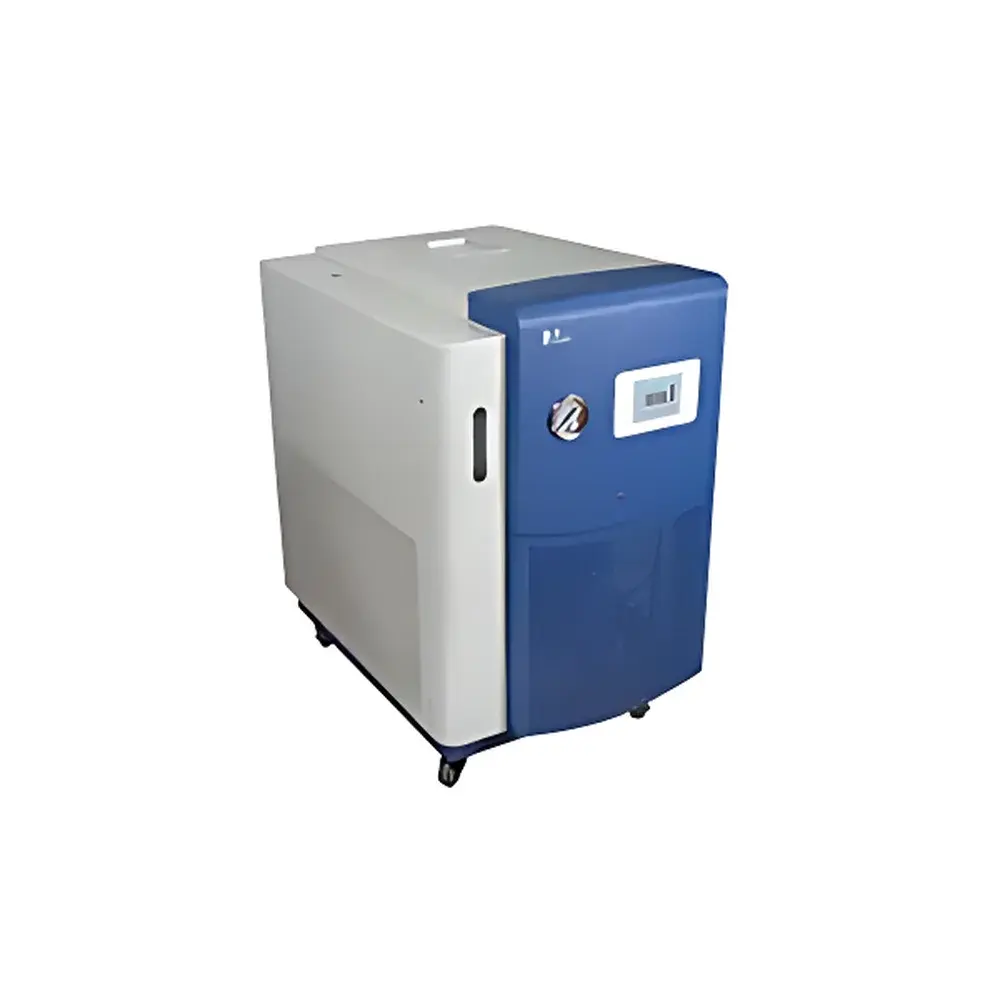
MICHEM MC-1000BP Variable-Frequency Circulating Chiller
| Brand | MICHEM |
|---|---|
| Origin | Beijing, China |
| Model | MC-1000BP |
| Instrument Type | Integrated Circulating Chiller |
| Cooling Method | Water-Cooled |
| Temperature Range | 5–35 °C |
| Temperature Stability | ±0.1 °C |
| Refrigeration Capacity | 1000 W |
| Circulating Pump Pressure | 7 bar |
| Flow Rate | 6 L/min |
| Reservoir Volume | 10 L |
| Operating Mode | Continuous |
Overview
The MICHEM MC-1000BP is an integrated, variable-frequency circulating chiller engineered for precision thermal management of laboratory and analytical instrumentation. It operates on a closed-loop refrigeration cycle employing inverter-driven compressor technology to deliver stable, energy-efficient cooling across a precisely controlled temperature range of 5–35 °C. Unlike conventional on/off chillers, the MC-1000BP dynamically modulates compressor speed via real-time feedback from high-stability Pt100 temperature sensors—enabling continuous power adjustment to match thermal load variations. This approach eliminates thermal overshoot, reduces mechanical stress on components, and ensures consistent heat extraction from sensitive equipment such as HPLC columns, ICP-MS torches, laser sources, NMR probe preamplifiers, and X-ray diffraction detectors. The unit complies with fundamental thermal management requirements outlined in ISO/IEC 17025:2017 (Clause 6.4.3 – Environmental conditions) and supports GLP-compliant operation when integrated into validated laboratory workflows.
Key Features
- Variable-frequency compressor control enables smooth, stepless regulation of refrigeration output—reducing energy consumption by ≥30% compared to equivalent fixed-speed units under identical load conditions.
- PID-based digital temperature control architecture with microprocessor supervision delivers ±0.1 °C stability at setpoint, supported by dual-stage sensor redundancy and auto-tuning capability.
- Soft-start compressor activation limits inrush current during startup, extending compressor service life and minimizing electrical grid disturbance.
- High-efficiency, low-noise imported circulation pump provides up to 7 bar pressure and 6 L/min flow rate—sufficient for multi-instrument daisy-chaining or long-loop coolant distribution systems.
- Corrosion-resistant stainless-steel reservoir (10 L capacity) with level monitoring, over-temperature protection, low-flow alarm, and dry-run prevention safeguards system integrity during unattended operation.
- Compact integrated design (360 × 350 × 540 mm) facilitates benchtop or under-bench installation without requiring external condenser units or dedicated ventilation ducting.
Sample Compatibility & Compliance
The MC-1000BP is compatible with all standard aqueous coolant formulations—including deionized water, 20–30% ethylene glycol/water mixtures, and proprietary corrosion-inhibited coolants—meeting ASTM D1384 (corrosivity testing for engine coolants) and ISO 2531 (ductile iron pipe system compatibility) material interaction guidelines. Its sealed refrigerant circuit uses R410A (GWP = 2088), compliant with EU F-Gas Regulation (EC) No 517/2014 phase-down schedules for new equipment placed on the market after 2025. Electrical safety conforms to IEC 61010-1:2010 (Measurement, Control, and Laboratory Equipment). While not inherently 21 CFR Part 11 compliant, the unit supports audit-trail-ready data logging when interfaced with third-party SCADA or LIMS platforms via RS485 Modbus RTU protocol.
Software & Data Management
The MC-1000BP features a local 4.3-inch TFT LCD interface with intuitive menu navigation, real-time trend display (temperature, pressure, flow status), and event log storage (≥1000 entries). Optional RS485 serial communication enables remote parameter setting, alarm acknowledgment, and operational data export (CSV format) using vendor-supplied PC software or industry-standard OPC UA clients. All configuration changes are timestamped and user-identified—facilitating traceability required under ISO/IEC 17025 Clause 7.7 (Control of nonconforming work) and supporting internal quality audits. Firmware updates are performed via USB flash drive with cryptographic signature verification to ensure integrity.
Applications
- HPLC and UHPLC column ovens and detector cells requiring stable thermal environments for retention time reproducibility (USP , EP 2.2.46).
- ICP-OES and ICP-MS plasma torch and interface cone cooling—critical for signal stability and oxide interference reduction.
- Laser-based instruments (e.g., Raman spectrometers, confocal microscopes) where diode or solid-state laser wavelength drift is thermally induced.
- Electron microscopy sample stages and detector cryo-coolers demanding low-vibration, pulse-free coolant delivery.
- Materials testing equipment including dynamic mechanical analyzers (DMA) and thermal gravimetric analyzers (TGA) requiring synchronized thermal conditioning.
- Pharmaceutical stability chambers and accelerated aging test racks requiring auxiliary temperature stabilization.
FAQ
What coolant types are recommended for use with the MC-1000BP?
Deionized water is optimal for short-loop applications; for extended loops or ambient temperatures below 10 °C, a 25% v/v ethylene glycol/water mixture is advised to prevent freezing and provide corrosion inhibition.
Does the unit support external temperature feedback from the instrument being cooled?
Yes—the MC-1000BP includes a 0–10 V analog input port for external process temperature signals, enabling cascade control configurations where the chiller maintains instrument-junction temperature rather than its own outlet temperature.
Is the refrigeration system serviceable in the field?
All major refrigeration components—including the inverter compressor, expansion valve, and condenser coil—are accessible for diagnostic testing and replacement per manufacturer’s service manual; however, refrigerant handling requires certified EPA Section 608 or equivalent national certification.
Can multiple instruments be connected to a single MC-1000BP?
Yes—provided total thermal load remains ≤1000 W and combined hydraulic resistance does not exceed 7 bar pressure drop; we recommend installing flow-balancing valves and individual shutoffs for each branch.
How often should the water reservoir be maintained?
Reservoir fluid should be inspected monthly for conductivity (<5 µS/cm for DI water) and visual clarity; full replacement is recommended every 6 months or after 1000 operating hours, whichever occurs first.
Related Products



