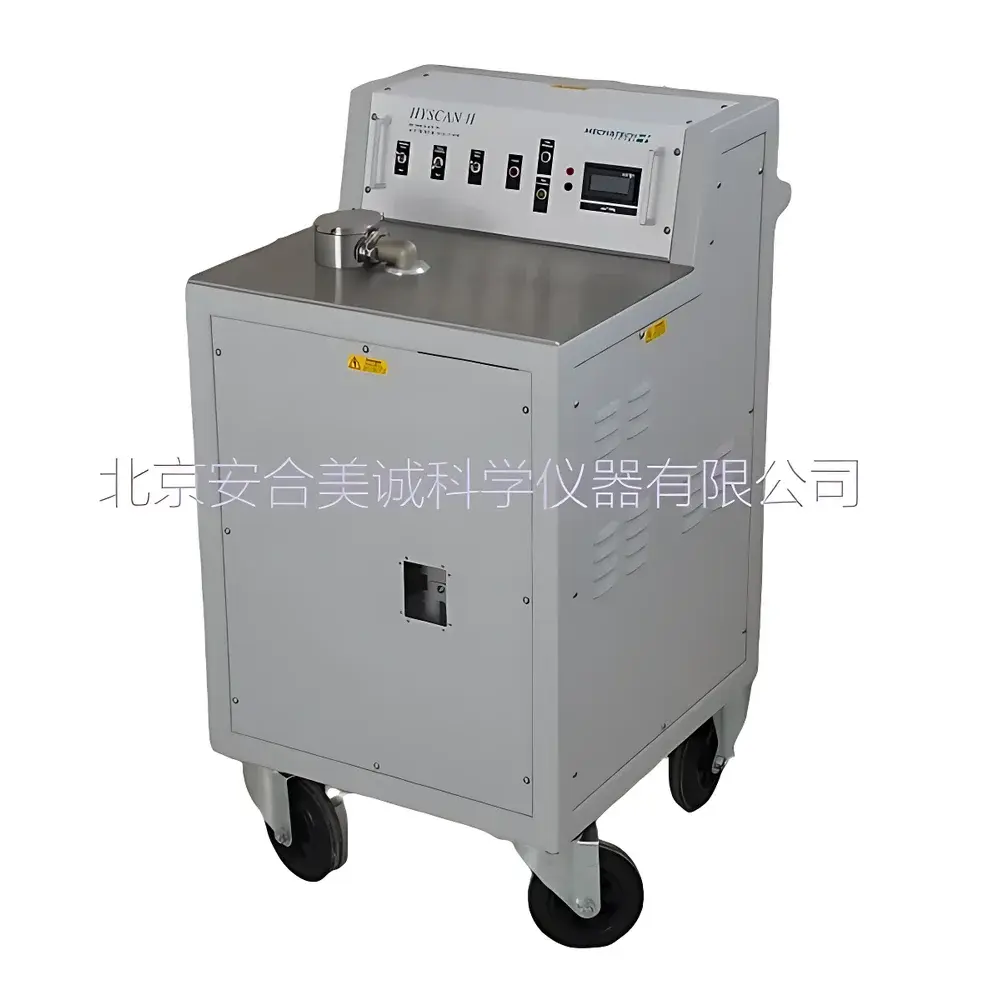
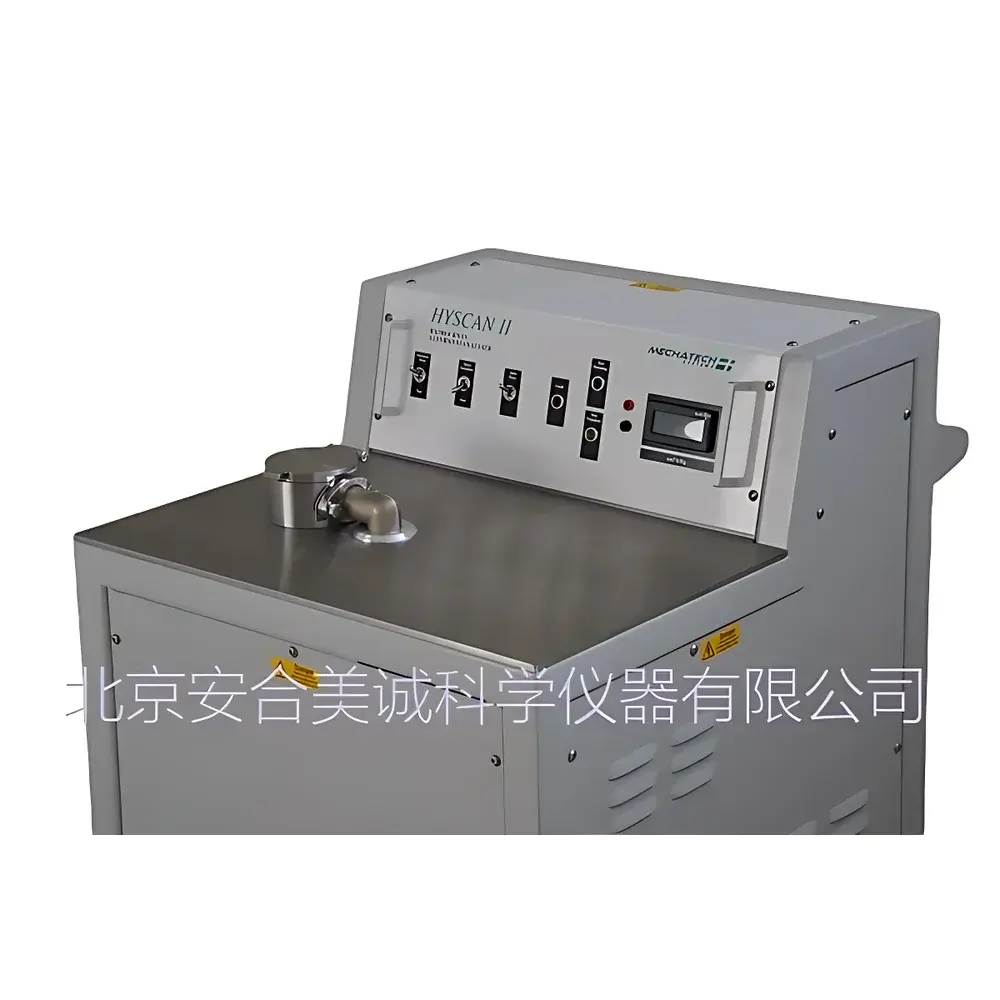
Savant Hyscan II Quantitative Hydrogen Analyzer for Molten Aluminum
| Origin | United Kingdom |
|---|---|
| Manufacturer Type | Authorized Distributor |
| Origin Category | Imported |
| Model | Hyscan II |
| Price | Upon Request |
| Dimensions (W×D×H) | 600 mm × 600 mm × 1000 mm |
| Weight | 120 kg |
| Power Supply | 220 V / 50 Hz, armored 5-m power cable |
| Sample Mass | 100 g |
| Analysis Time | < 5 minutes |
| Measurement Range | 0.01–1.99 cm³/100 g |
| Sensitivity | 0.01 cm³/100 g |
| Accuracy | ±5% (vs. vacuum fusion reference method) |
| Certification | LMFA (Light Metals Federation of Australia) Manufacturing License |
Overview
The Savant Hyscan II Quantitative Hydrogen Analyzer is a robust, field-deployable instrument engineered for precise determination of dissolved hydrogen concentration in molten aluminum and aluminum alloys. Hydrogen solubility in liquid aluminum is temperature-dependent and critically influences casting integrity: excess hydrogen leads to microporosity, surface blistering, and mechanical property degradation upon solidification. Unlike qualitative or semi-quantitative methods—such as visual bubble observation under controlled vacuum or gravimetric density assessment—the Hyscan II implements a validated quantitative depressurization technique grounded in Henry’s law and calibrated vacuum gas evolution measurement. A representative 100 g sample is extracted from the melt, rapidly sealed in a stainless-steel crucible, and subjected to controlled pressure reduction within an insulated chamber. As solidification proceeds under sub-atmospheric conditions, all dissolved hydrogen evolves quantitatively and is measured via a precision-calibrated Pirani vacuum gauge. The resulting gas volume, normalized to standard temperature and pressure (STP), yields hydrogen content in cm³/100 g with traceable metrological confidence.
Key Features
- Quantitative analysis with ±5% accuracy relative to ASTM E1447–21 (Standard Test Method for Determination of Hydrogen in Aluminum and Aluminum Alloys by Vacuum Hot Extraction)
- Complete measurement cycle completed in under 5 minutes—optimized for furnace-side deployment without process interruption
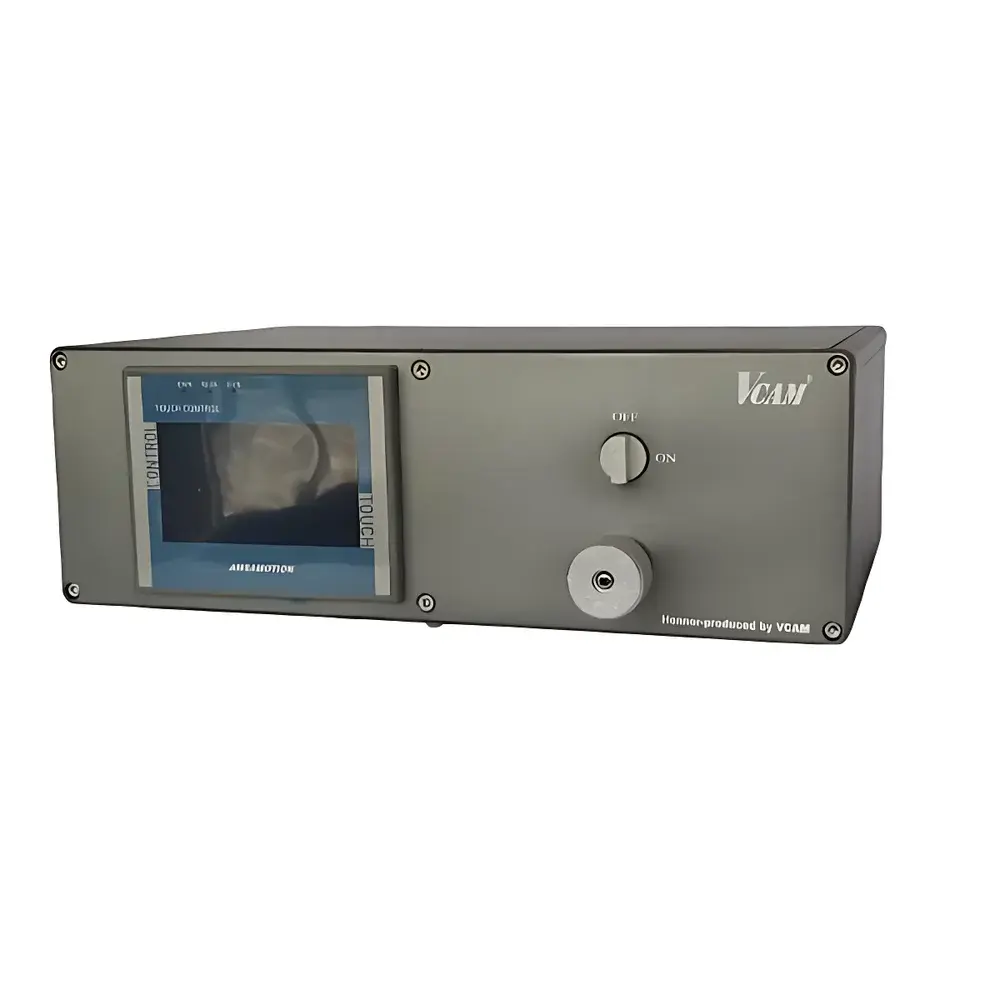
- Robust industrial enclosure (light-blue chassis, white control panel) rated for foundry environments: IP54 ingress protection, thermal shielding, and vibration-damped base
- No consumable probes or membranes: eliminates recurring costs associated with graphite sensor replacement or calibration drift
- Integrated safety interlocks, pressure relief valves, and thermal cutoffs compliant with EN 61000-6-2 (EMC immunity) and EN 61000-6-4 (EMC emission)
- On-site verification capability using certified reference standards traceable to NPL (UK National Physical Laboratory) hydrogen calibration gases
Sample Compatibility & Compliance
The Hyscan II accepts molten aluminum and common wrought/cast alloys (e.g., AA1xxx, AA3xxx, AA5xxx, AA6xxx, AA7xxx series) across temperature ranges from 660 °C to 780 °C. Sample introduction utilizes a pre-heated ceramic-lined sampling ladle compatible with standard foundry handling protocols. Instrument design adheres to ISO 9001:2015 quality management requirements and supports GLP/GMP documentation workflows through optional audit-trail-enabled data export. While not FDA-regulated, its measurement methodology aligns with USP <289> principles for elemental impurity quantification in metallic materials used in pharmaceutical manufacturing equipment. LMFA certification confirms conformance with international light-metal industry best practices for hydrogen analysis instrumentation.
Software & Data Management
Data acquisition is managed via an embedded microcontroller with real-time pressure/temperature logging at 10 Hz resolution. Raw vacuum transducer output is linearized and compensated for ambient temperature drift using on-board Pt100 sensors. Results are displayed on a high-contrast monochrome LCD with dual-unit readout (cm³/100 g and ppm w/w). Optional RS232 serial interface enables integration into plant SCADA systems or LIMS platforms; ASCII-formatted output includes timestamp, sample ID, operator code, and uncertainty flags. A dedicated thermal printer (optional accessory) produces tamper-evident hardcopy reports compliant with internal QA record retention policies. All firmware updates are performed via secure USB interface with cryptographic signature verification.
Applications
The Hyscan II serves as a primary metrology tool in aluminum casting facilities, foil mills, extrusion plants, and R&D laboratories. It is routinely deployed to: validate rotary degassing efficiency; benchmark flux-based purification performance; monitor hydrogen re-absorption during holding and transfer; support DOE (Design of Experiments) studies on grain refiner interactions; and verify compliance with aerospace-grade specifications such as AMS2772F (Hydrogen Content Limits in Aluminum Alloy Castings). Its portability enables cross-furnace comparative analysis—critical for multi-casting-line operations—and its repeatability supports statistical process control (SPC) charting per ISO/IEC 17025 clause 7.7.
FAQ
What is the minimum detectable hydrogen concentration?
The instrument achieves a detection limit of 0.01 cm³/100 g under standard operating conditions.
Does the Hyscan II require routine recalibration?
No factory recalibration is required within the first 12 months; annual verification using certified reference samples is recommended.
Can it be used with magnesium-containing alloys?
It is validated for aluminum alloys only; magnesium alters hydrogen solubility kinetics and requires method-specific validation.
Is operator training provided?
Yes—Savant offers on-site commissioning and competency-based operator certification aligned with ISO/IEC 17025 personnel competence requirements.
How is data integrity ensured during power interruption?
Non-volatile memory retains all measurement logs and system configuration parameters; analysis resumes automatically after power restoration.