
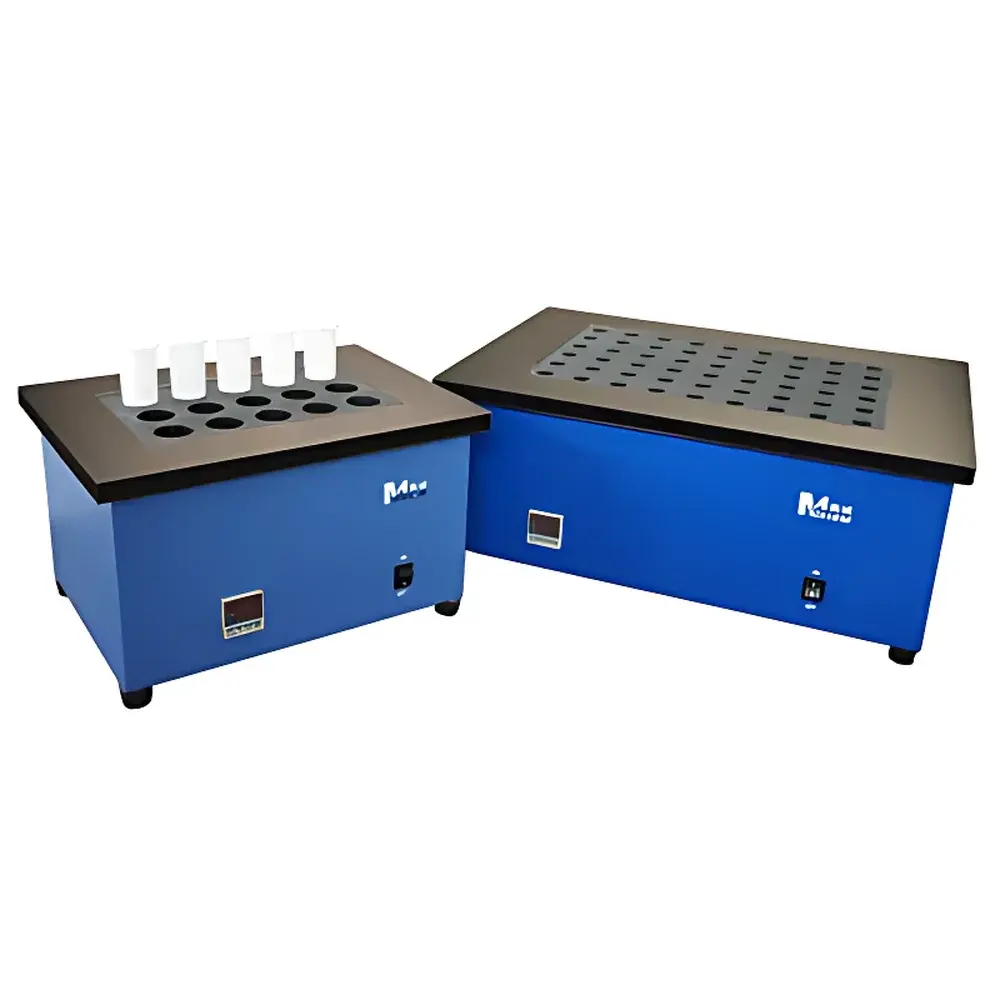
MICHEM DR Series Graphite Block Digestion System
| Brand | MICHEM |
|---|---|
| Model | DR-15 / DR-24 / DR-54 |
| Heating Material | PTFE-Coated Graphite |
| Max Temperature | 240 °C |
| Temperature Accuracy | ±1.0 °C |
| Heating Uniformity | ±2.0 °C across block |
| Control System | 30-Step PID Digital Programmable Controller |
| Sample Capacity | 15 × 100 mL (DR-15) |
| Power Rating | 1200 W (DR-15/DR-24) / 3000 W (DR-54) |
| Input Voltage | AC 220 V, 50 Hz |
| Dimensions (W×D×H) | 470×350×270 mm (DR-15/DR-24) / 670×460×270 mm (DR-54) |
| Compliance | Designed for ISO/IEC 17025-compliant sample preparation workflows |
| Application Scope | Acid digestion, post-microwave acid removal (acid evaporation), and controlled thermal pretreatment prior to AAS, AFSS, ICP-OES, and ICP-MS analysis |
Overview
The MICHEM DR Series Graphite Block Digestion System is a benchtop, open-vessel electric heating platform engineered for reproducible, high-throughput acid digestion and post-digestion acid removal (commonly referred to as “acid evaporation” or “赶酸”). Unlike microwave-assisted digestion systems that operate under sealed, pressurized conditions, the DR Series operates at ambient pressure—enabling safe, scalable, and operator-controlled thermal decomposition of organic matrices using strong mineral acids (e.g., HNO₃, HCl, HF, H₂O₂). Its core architecture centers on a monolithic, high-purity graphite heating block with electropolished PTFE coating, ensuring exceptional thermal conductivity, chemical inertness, and long-term stability in aggressive acidic environments. The system is widely deployed in environmental testing laboratories (soil, water, sludge), food safety QA/QC, pharmaceutical raw material screening, and clinical research—particularly as a complementary unit for microwave digestion workflows, where it serves both as a pre-digestion conditioning stage and as a dedicated platform for rapid, uniform acid removal prior to final volumetric adjustment.
Key Features
- Uniform Thermal Distribution: Engineered graphite block with optimized thermal mass and PTFE surface finish delivers temperature homogeneity of ±2.0 °C across all digestion wells—critical for inter-sample comparability in batch processing.
- Chemical Resistance: Fully PTFE-coated graphite surface resists corrosion from concentrated nitric, hydrochloric, hydrofluoric, and perchloric acids—eliminating contamination risk and extending service life under routine use.
- Precision Temperature Control: Integrated 30-segment PID digital controller enables programmable ramp-hold profiles, adjustable heating rates, and automatic shutdown upon cycle completion; temperature stability maintained within ±1.0 °C setpoint accuracy.
- Scalable Throughput: Three configurations support varying lab volumes—DR-15 (15 × 100 mL), DR-24 (24 × 50 mL), and DR-54 (54 × 50 mL)—with standardized well geometry (diameter × depth: Φ23–42 mm × 40 mm) accommodating common digestion vessels including borosilicate glass tubes and quartz crucibles.
- Energy-Efficient Design: Optimized power-to-volume ratio (up to 3000 W for DR-54) ensures rapid heat-up times while minimizing standby energy loss; no external cooling or ventilation required during standard operation.
Sample Compatibility & Compliance
The DR Series accommodates a broad range of solid and semi-solid samples—including plant tissues, animal feed, sediment, polymer composites, and pharmaceutical excipients—when digested using EPA Method 3050B, ISO 11466, ASTM D5511, and USP compliant protocols. All models are compatible with standard digestion vessels rated for temperatures up to 240 °C and resistive to Class I–III acids per ASTM D1308. While not a regulated medical device, the system supports GLP/GMP-aligned documentation practices through optional audit-trail-capable software interfaces (see Software & Data Management). It meets CE marking requirements for electrical safety (EN 61010-1) and electromagnetic compatibility (EN 61326-1), and its construction aligns with ISO/IEC 17025 clause 5.5.2 regarding equipment suitability for intended analytical applications.
Software & Data Management
The DR Series features a front-panel LED display with intuitive navigation for manual parameter entry. For laboratories requiring electronic record integrity, optional RS-232 or USB connectivity enables integration with LIMS or custom data acquisition platforms. When paired with validated third-party software, the system supports 21 CFR Part 11-compliant user authentication, electronic signatures, and full-cycle audit trails—including timestamped temperature logs, program start/stop events, and operator ID capture. Firmware updates are delivered via secure firmware image files, with version history traceable per ISO/IEC 17025 clause 5.6.3.
Applications
- Routine open-vessel acid digestion of environmental and biological matrices prior to elemental quantification by AAS, AFSS, or ICP-based techniques.
- Controlled post-microwave acid evaporation: Rapid, uniform removal of residual HNO₃/HF after sealed-vessel digestion—enabling direct final volume adjustment without sample transfer.
- Thermal pretreatment of calibration standards and reference materials to ensure matrix homogeneity and acid stabilization.
- Non-digestive applications including solvent evaporation, moisture determination support, and controlled drying of precipitates prior to gravimetric analysis.
- Method development for novel digestion protocols requiring precise thermal ramping and extended hold phases under atmospheric conditions.
FAQ
What types of digestion vessels are compatible with the DR Series?
Standard borosilicate glass digestion tubes (e.g., 50 mL or 100 mL tall-form), quartz crucibles, and PFA-lined vessels rated for continuous exposure to 240 °C and strong oxidizing acids.
Can the DR Series be used for hydrofluoric acid (HF) digestion?
Yes—provided vessels are HF-compatible (e.g., PTFE, PFA, or quartz) and appropriate fume hood containment and PPE protocols are followed. The PTFE-coated graphite block itself is chemically inert to HF.
Is calibration verification required, and how often?
Per ISO/IEC 17025, users should verify temperature uniformity and accuracy at least annually—or after any maintenance event affecting thermal performance—using NIST-traceable thermocouples placed in representative wells.
Does the system include safety interlocks or overtemperature protection?
Yes—integrated dual redundant thermal cutoffs prevent exceedance of 260 °C, and the PID controller automatically disables heating if sensor feedback is lost or inconsistent.
Can digestion well dimensions be customized?
Yes—MICHEM offers OEM configuration services for non-standard well diameters and depths to accommodate proprietary vessel formats, subject to minimum order quantities and lead time confirmation.



